· Marcus Lin · Engineering · 9 min read
How to Evaluate a PCB Manufacturer Before Sending
Practical checklist for evaluating PCB fabricators before committing your HDI, RF, or multilayer design. Covers capability verification, quality certifications, communication red flags, and the questions that separate capable shops from those that will waste your time.
Quick Answer
Before sending your RFQ to a PCB manufacturer, verify five critical capabilities: minimum feature sizes match your design with 20% margin, material certifications cover your required laminates, quality system matches your IPC class, the shop has verifiable experience with your specific technology (HDI, RF, rigid-flex), and engineering communication happens in your language with technical depth. A fabricator that cannot answer detailed stackup questions within 24 hours will not deliver a complex board on time.
The 30-Second Qualification Check
Before you invest time preparing files and writing specifications, run this quick filter on any PCB manufacturer:
| Capability | Your Design Needs | Manufacturer Must Demonstrate |
|---|---|---|
| Minimum trace/space | Your design minimum + 20% margin | Production-proven (not “achievable in theory”) |
| Layer count | Your design layers | Regular production at that count, not “maximum capability” |
| Material | Your specified laminate | In-stock or on approved vendor list with lead time |
| Via technology | Your via types | Cross-section evidence of quality fills |
| Surface finish | Your specified finish | Process control data (thickness uniformity) |
If a manufacturer cannot confirm all five within one business day of your inquiry, they are either too busy, too disorganized, or not actually capable. Move on.
Step 1: Verify Minimum Feature Capabilities — With Evidence
Every PCB manufacturer publishes a capability table on their website. These numbers are often aspirational — representing what they achieved once on a good day, not what they reliably produce in volume. The difference matters enormously when your design depends on those limits.
The right approach is to ask for production yield data at your required feature sizes. In our facility, we differentiate between three capability tiers: standard production (99%+ yield), advanced production (95-99% yield), and limit capability (85-95% yield, requires engineering review). When a customer designs to our “limit” tier, we flag it during DFM review because the yield risk translates directly to cost and delivery uncertainty.
Here is what to ask for specifically:
Trace and space: “What is your production-proven minimum trace/space at 95%+ yield for inner layers on your standard panel format?” The answer should include the dielectric material context — 3/3mil on thin low-flow prepreg is very different from 3/3mil on standard 1080 glass.
Drill: “What is your smallest finished hole size in production, and what aspect ratio have you achieved at that size on panels shipped in the last 90 days?” A shop that can drill 0.15mm mechanical holes at 8:1 aspect ratio is fundamentally different from one that claims 0.1mm at 12:1 but has never shipped it.
Registration: “What is your layer-to-layer registration tolerance at your maximum layer count?” This directly affects annular ring calculations and via capture pad sizing. We achieve +/-2mil registration on 20+ layer boards, but many shops are at +/-3-4mil, which requires larger pads and reduces routing density.
From our experience reviewing designs that failed at other fabricators before coming to us, the most common mismatch is between the manufacturer’s claimed capability and their actual production capability. A shop that lists “3/3mil trace/space” on their website but typically runs 5/5mil production is going to struggle with your HDI design.
CAPABILITY VERIFICATION
Not Sure If Your Design Is Manufacturable? Get a Free DFM Assessment.
Upload your Gerbers and we will tell you exactly which features are standard production, which need attention, and what yield to expect. Honest answers in 24h.
Upload Gerbers ›
Step 2: Material Sourcing and Certification
Material capability is the second most common failure point in PCB manufacturer selection, particularly for RF designs using Rogers, Taconic, or specialty laminates. The question is not whether a manufacturer can process the material — it is whether they have established relationships with material suppliers and understand the processing parameters.
Key questions to ask:
Material availability: “Do you stock [specific laminate] or purchase per-order? What is your typical material lead time?” A shop that stocks Rogers 4350B and 4003C can turn your RF board in 10 days. A shop that orders per-job adds 3-4 weeks.
Processing experience: “How many panels of [material] have you processed in the last quarter?” Specialty laminates like PTFE, ceramic-filled hydrocarbon, or ultra-low-loss materials require different drilling parameters, lamination profiles, and surface preparation. A shop that processes Rogers monthly versus annually will have vastly different yield.
Hybrid stackup capability: “Can you laminate [Material A] rigid layers bonded to [Material B] flex layers with [specific prepreg]?” Mixed-material stackups are where most manufacturers fail. The CTE mismatch management, bonding temperature profiles, and sequential lamination logistics separate experienced shops from aspirational ones.
In our production planning, we maintain pre-qualified lamination profiles for over 40 material combinations. When a customer specifies an unusual combination, we can pull historical data showing achieved Dk/Df values, peel strength results, and thermal reliability data. A manufacturer that cannot provide this evidence for your specific material stack is experimenting on your dime.
Step 3: Quality System and Certification Verification
Certifications are not just paperwork — they represent audited quality management systems that directly affect your board reliability. However, not all certifications are equal, and the certificate itself matters less than how the system operates in practice.
Minimum bar for any serious PCB work:
- ISO 9001:2015 — basic quality management system
- UL E-Series listing — safety agency recognition for laminate processing
- IPC-6012 Class 2 compliance — standard commercial electronics
For reliability-critical applications:
- IATF 16949 — automotive (requires PPAP documentation, FMEA, control plans)
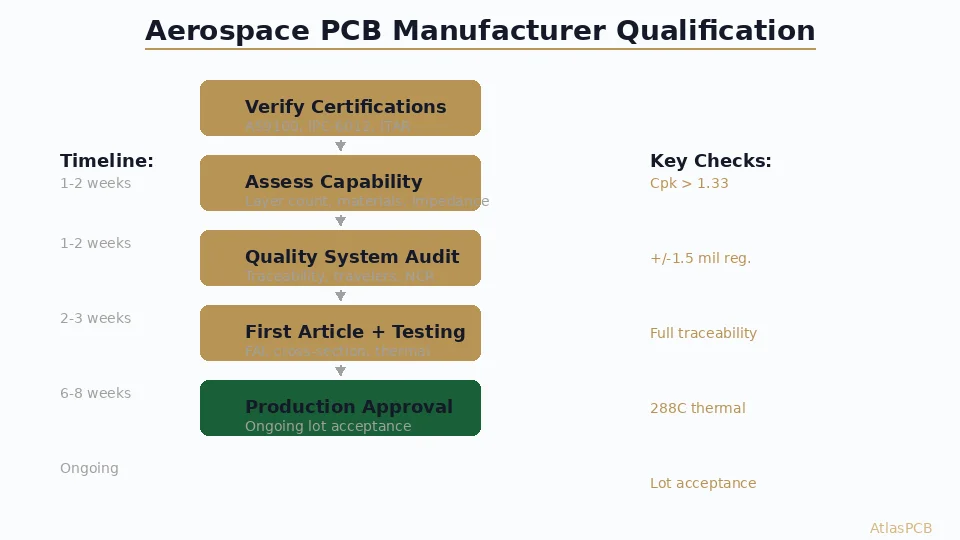
- AS9100D — aerospace/defense (requires complete material traceability)
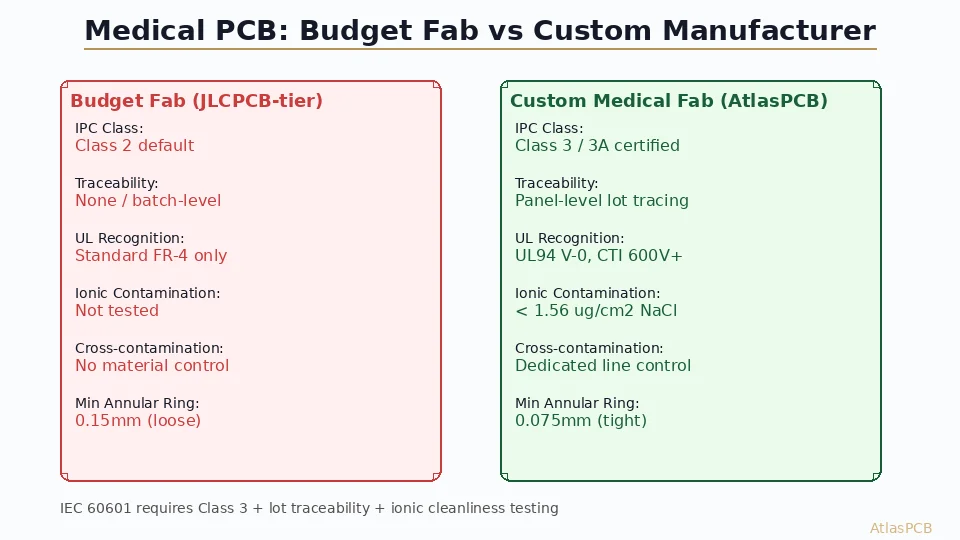
- ISO 13485 — medical devices (requires risk management documentation)
- NADCAP — for specific processes like chemical processing or NDT
What to actually verify: Request the certificate number and check its validity with the certifying body. We have seen manufacturers display expired certificates or certificates from a different facility. Also ask for recent audit results — a certification with zero non-conformances is either very mature or not being audited rigorously.
The practical impact of quality systems shows up in documentation. When we ship boards under AS9100, every panel has full material lot traceability, cross-section records, impedance test results, and dimensional inspection data. Under standard ISO 9001, the documentation requirements are less stringent. Your application requirements should drive which level you demand.
Step 4: Engineering Communication Quality
This is the evaluation criterion that most engineers overlook, yet it predicts project success more reliably than any published specification. The quality of engineering communication during the quoting phase directly indicates how problems will be handled during production.
Good signs:
- Engineer asks clarifying questions about your design intent before quoting
- Provides stackup recommendations with reasoning (not just numbers)
- Identifies potential DFM issues proactively during quote review
- Responds to technical questions within 4-8 business hours
- Offers alternative approaches when your design exceeds standard capabilities
- Provides a dedicated engineering contact (not just a sales representative)
Red flags:
- Quotes arrive without any technical questions (they did not review your files)
- All communication routes through non-technical sales staff
- Technical responses take more than 48 hours
- Answers are vague: “yes we can do that” without specifics
- Cannot provide a stackup recommendation for your impedance targets
- Price is 30%+ below other qualified quotes (what are they not doing?)
In our process, every RFQ goes through engineering review before pricing. Our engineers check impedance feasibility, material compatibility, drill aspect ratios, and registration requirements. We flag issues before quoting — not after you have placed the order and tooling is cut. This front-loaded engineering saves our customers an average of one design iteration cycle per complex project.
ENGINEERING-FIRST QUOTING
Get a Quote That Includes Real Engineering Review
Every AtlasPCB quote includes stackup verification, impedance feasibility check, and DFM feedback. We identify problems before they cost you money.
Step 5: Technology-Specific Validation
For complex board technologies (HDI, RF, rigid-flex, heavy copper), generic capability claims are insufficient. You need evidence of specific technology execution.
HDI validation questions:
- What is your maximum proven buildup structure? (e.g., 3+N+3, stacked microvias)
- Can you provide cross-section photos showing via fill quality on stacked microvias?
- What is your microvia reliability data? (IST or thermal cycling results)
- What via fill type do you use for via-in-pad? (Conductive vs non-conductive, IPC-4761 type)
RF/microwave validation questions:
- What dielectric constant tolerance do you achieve on Rogers/PTFE materials? (+/-5%? +/-3%?)
- Do you have test coupon data showing Dk/Df at my operating frequency?
- What is your impedance tolerance on RF structures? (+/-5%? +/-10%?)
- Can you process hybrid stackups (Rogers + FR-4 bonded with specific prepreg)?
Rigid-flex validation questions:
- What is your flex layer registration accuracy to rigid layers?
- Do you use adhesive-based or adhesiveless polyimide? (Affects reliability)
- What is your minimum bend radius capability? (6:1? 10:1?)
- Can you provide bend test results from recent rigid-flex production?
A manufacturer confident in their technology will provide this information readily — often within hours. They have the data because they track it for their own quality control. Hesitation or delays in providing technology-specific evidence is a clear signal that you are pushing beyond their comfort zone.
The Complete RFQ Checklist
Before clicking “submit” on your RFQ, verify you have assessed these items:
Capability match (non-negotiable):
- Minimum features verified with production evidence
- Material sourcing confirmed with lead time
- Via technology validated with cross-section data
- Layer count within regular production range (not “maximum”)
Quality system (application-dependent):
- Relevant industry certification current and verified
- IPC class capability matches your requirements
- Documentation level adequate for your quality system
Communication (predictive of success):
- Engineering contact assigned and responsive
- Stackup recommendations provided with technical rationale
- DFM issues identified proactively during quoting
- Clear escalation path for production issues
Logistics (often overlooked):
- Lead time realistic for your schedule (with margin for issues)
- Shipping and customs experience for your delivery location
- Capacity available for your volume (not overcommitted)
ATLASPCB
Ready to Send Your RFQ? We Answer Every Question on This Checklist.
1-30 layer boards, HDI up to 5+N+5, RF/Rogers, rigid-flex up to 22 layers. Engineering review included with every quote. Response within 24 hours.
Submit Your RFQ ›
Reviewed by AtlasPCB Engineering Team — 15+ years in advanced PCB fabrication for RF, HDI, and rigid-flex applications.
Related Reading:
About AtlasPCB — We specialize in complex PCB manufacturing for HDI, RF, and high-reliability applications. Explore our RF and high-frequency PCB services . Every order includes free engineering review. Get your quote.
Reviewed by AtlasPCB Engineering Team — IPC-certified manufacturing specialists with 15+ years of production experience in HDI, RF, and high-reliability PCB fabrication. Content based on factory floor data and real customer design reviews.
Frequently Asked Questions
What questions should I ask a PCB manufacturer before sending files?
What certifications should a PCB manufacturer have?
How do I know if a PCB manufacturer can actually build my HDI board?
What are red flags when evaluating PCB suppliers?
- PCB manufacturer
- RFQ checklist
- PCB sourcing
- vendor evaluation
- quality certification