· David Okafor · News · 11 min read
AI Adoption in PCB Manufacturing Hits Mainstream
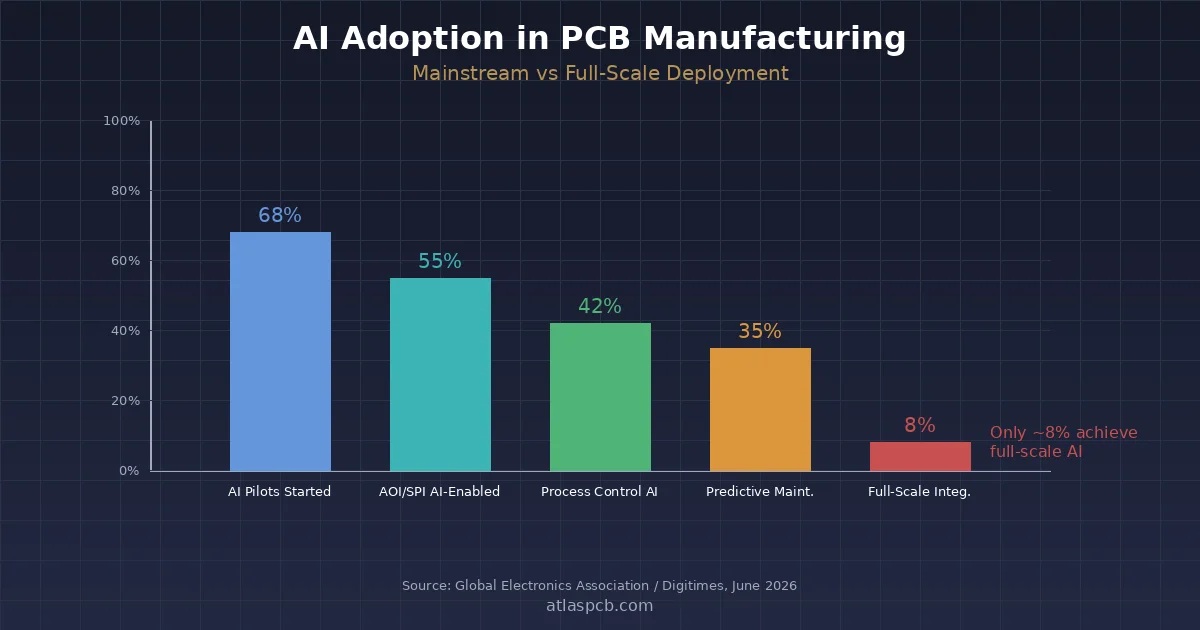
New industry data shows 68% of PCB manufacturers have deployed AI in some capacity, yet fewer than 10% have achieved full-scale factory integration. The gap between experimentation and enterprise-wide deployment reveals critical challenges in data quality, talent, and governance that define the next phase of manufacturing competition.
Quick Answer
As of mid-2026, 68% of PCB manufacturers globally have introduced AI into operations (72% in China), but only approximately 8% have achieved deep, full-scale integration between AI systems and manufacturing workflows. Primary barriers are not technological — they are organizational: data quality/consistency issues, talent shortages, unclear problem definitions, system integration difficulties, and governance gaps. The most successful deployments are in AI-powered AOI (Automated Optical Inspection) and SPI (Solder Paste Inspection), where machine learning reduces false positives by 40-60% and cuts root-cause analysis time significantly.
The numbers are in, and they tell a story of an industry caught between ambition and execution.
A comprehensive new report from the Global Electronics Association, covered by Digitimes on June 10, 2026, reveals that AI adoption in PCB manufacturing has officially crossed the mainstream threshold. With 68% of manufacturers globally now running AI systems in some capacity — and 72% in China — the question is no longer whether the PCB industry will embrace artificial intelligence. The question is whether most manufacturers can bridge the gap between isolated AI experiments and genuine factory-wide transformation.
The answer, for now, is sobering: fewer than 10% of surveyed companies have achieved what the report defines as “deep integration” between AI and their manufacturing systems.
Source: Digitimes, June 10, 2026 / Global Electronics Association Report: “AI in PCB Manufacturing: From Pilots to Scale”
The State of AI in PCB Manufacturing: Mid-2026 Snapshot
What “Mainstream Adoption” Actually Means
When the report says 68% of manufacturers have “introduced AI,” it encompasses a wide range of maturity levels:
Pilot/POC stage (30-35%): Running isolated AI experiments, typically a single AOI line with ML defect classification or a predictive maintenance model on one piece of equipment. Results are promising but not integrated into production decisions.
Departmental deployment (20-25%): AI systems running in production within specific departments — usually quality inspection or process engineering. Models are validated and trusted but operate alongside, not within, core MES/ERP workflows.
Cross-functional integration (5-8%): AI embedded across multiple departments with shared data infrastructure. Real-time feedback loops between AI inspection, process control, and production planning.
Full-scale transformation (<3%): AI-native operations where manufacturing decisions are data-driven by default. Complete digital twins, autonomous process optimization, and predictive quality management across all product lines.
The distribution is heavily weighted toward the left side of this maturity curve. Most manufacturers have proven that AI works in their environment but have not yet built the organizational capability to scale it.
Where AI Is Working: The Success Stories
The report identifies clear winners in the AI application landscape:
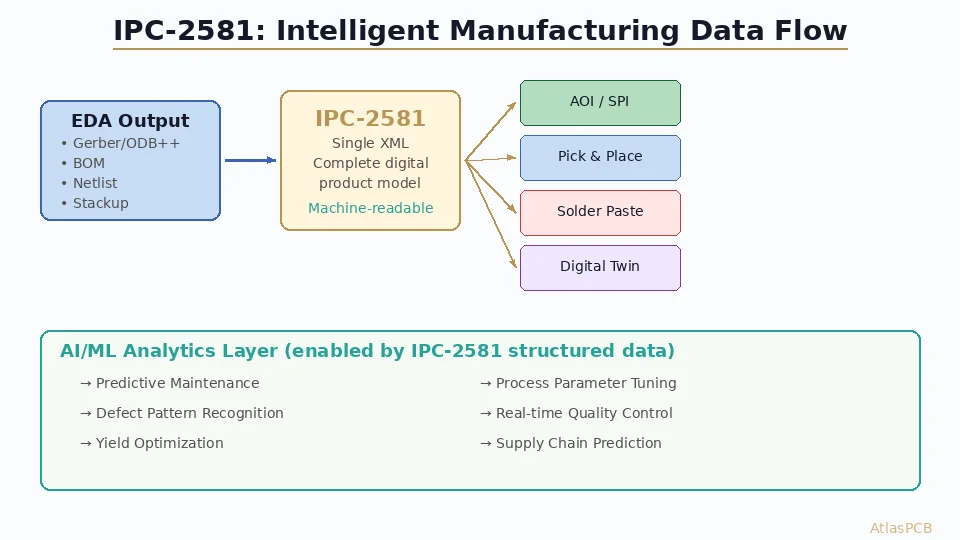
AI-Powered AOI and Optical Inspection
This remains the most mature and impactful application of AI in PCB manufacturing. Traditional rule-based AOI systems struggle with two fundamental problems: excessive false positives (operators learn to ignore alarms) and difficulty adapting to new product designs without extensive re-programming.
Machine learning-based AOI addresses both issues:
False positive reduction: 40-60% fewer false calls compared to threshold-based systems. This directly improves operator productivity and prevents “alarm fatigue” that leads to real defects being overlooked.
Adaptive learning: Models trained on production data automatically improve as they see more board types. New product introduction time for inspection programs drops from days to hours.
Root-cause acceleration: When defects are detected, AI-assisted pattern recognition can correlate defect types with upstream process parameters (etch rates, exposure energy, plating current density), cutting root-cause analysis from hours to minutes.
Solder Paste Inspection (SPI) Enhancement
AI-enhanced SPI goes beyond simple volume measurement to predict soldering outcomes. Models correlate paste deposit characteristics (volume, area, height uniformity, offset) with downstream reflow results, flagging boards that will likely produce defects before they enter the oven.
Predictive Equipment Maintenance
Drilling spindles, plating bath chemistry, and lamination press conditions all degrade gradually. AI models monitoring vibration spectra, chemical analysis trends, and temperature profiles can predict failures 48-72 hours in advance, enabling planned maintenance windows instead of emergency line stops.
The Scaling Gap: Why 90% Cannot Get Past Pilots
The most important finding in the report is not about technology — it is about organizational readiness. The barriers cited most frequently by manufacturers struggling to scale AI are fundamentally human and structural:
1. Data Quality and Consistency
PCB manufacturing generates enormous volumes of data — drill parameters, plating currents, exposure energies, inspection images, test results. But this data was historically collected for process control and compliance documentation, not for machine learning.
Common data problems include:
Inconsistent labeling: Defect classification varies between shifts, operators, and even plants within the same company. What one operator calls “micro-void” another calls “pinhole.”
Missing context: Inspection data often lacks correlation to upstream process parameters. The AI model sees the defect but cannot determine its cause without manual investigation.
Siloed systems: Drilling machines, plating lines, AOI equipment, and electrical testers typically run separate data systems from different vendors. Creating a unified data pipeline requires significant integration work.
Legacy equipment: Older machines (pre-2018) often lack digital interfaces for real-time data extraction, requiring retrofit sensors or manual data entry.
2. Talent Shortage
The intersection of “understands machine learning” and “understands PCB manufacturing” is remarkably small. Manufacturers report that:
- Data scientists hired from tech companies struggle with the physics of manufacturing processes
- Process engineers interested in AI lack the programming and statistical foundations
- Training programs take 12-24 months to produce hybrid talent capable of effective AI deployment
- Competition for this talent is intense, with semiconductor fabs and electronics OEMs offering higher compensation
3. Problem Definition Failures
Many AI pilot projects fail not because the technology does not work, but because the problem was poorly defined from the start. Common pitfalls:
- Building a model to detect defects that are already caught by existing methods (solving a solved problem)
- Optimizing a process parameter that accounts for only 2% of total yield loss (misallocated effort)
- Training models on lab data that does not represent production variability (deployment gap)
- Setting accuracy targets without considering the cost of false positives vs. false negatives (wrong metric)
4. System Integration Complexity
Even when an AI model works perfectly in isolation, integrating it into the production workflow raises significant challenges:
Latency requirements: Real-time process control demands inference times under 100ms. Many models trained for accuracy need optimization or hardware acceleration to meet these constraints.
MES integration: Manufacturing Execution Systems from established vendors (Aegis, Siemens, Cogiscan) have limited native AI interfaces. Custom integration requires specialized middleware.
Change management: Shifting from operator-driven decisions to AI-assisted decisions requires new SOPs, training, and organizational trust that takes months to build.
Validation and qualification: In automotive and aerospace PCB manufacturing, any AI system that influences production decisions must go through formal validation processes (IATF 16949, AS9100) that can take 6-12 months.
5. Governance and Accountability
When an AI system makes a decision that results in a quality escape or yield loss, who is responsible? This question remains largely unanswered in most organizations:
- Model versioning and change control procedures are immature
- Regulatory frameworks for AI in manufacturing are still developing
- Intellectual property concerns around training data (especially in multi-customer facilities) create legal uncertainty
- Black-box model architectures make it difficult to explain decisions to auditors
Regional Dynamics: China Leading in Deployment Speed
The report highlights China’s 72% AI adoption rate in PCB manufacturing — above the global 68% average — driven by several factors:
Government incentives: China’s “Smart Manufacturing 2025” follow-on programs provide tax credits and subsidies for AI deployment in manufacturing. Provincial governments in Guangdong, Jiangsu, and Hubei (major PCB manufacturing clusters) offer additional local incentives.
Scale advantages: Chinese PCB manufacturers tend to operate larger factories with higher volumes, making the unit economics of AI deployment more favorable. A fixed AI infrastructure cost amortized across 100,000 panels per month is very different from 5,000 panels per month.
Ecosystem density: The concentration of PCB manufacturers, equipment suppliers, and AI service providers in clusters like Shenzhen and Kunshan creates rapid knowledge transfer and competitive pressure to adopt.
Workforce cost dynamics: Rising labor costs in China’s manufacturing sector make automation and AI-assisted inspection increasingly attractive from a pure cost perspective, even before quality improvements are considered.
However, China’s manufacturers face the same scaling challenges as their global peers. High adoption does not equal deep integration, and the 8% full-scale figure is roughly consistent across regions.
What This Means for PCB Buyers and Designers
For engineers and procurement teams ordering PCBs, the AI adoption landscape creates both opportunities and risks:
Potential benefits from AI-enabled suppliers:
- More consistent quality: AI-powered inspection catches defects that human operators miss during long shifts
- Faster problem resolution: When issues arise, AI-assisted root-cause analysis reduces resolution time from weeks to days
- Better DFM feedback: Suppliers with AI-analyzed manufacturing data can provide more specific, data-backed DFM recommendations
- Predictive delivery: AI-assisted production planning reduces unexpected delays from equipment failures or process excursions
Questions to ask your PCB supplier:
- What percentage of your inspection stations use AI/ML-based defect classification?
- Do you have traceability from inspection results back to process parameters?
- What is your false positive rate on AOI, and how has AI affected it?
- How do you validate AI model updates before deploying to production?
- Can you provide SPC data that demonstrates AI-driven process improvement over time?
Suppliers who can answer these questions with specifics — not marketing generalities — are likely among the 8% with genuine AI integration rather than the much larger group running isolated pilots.
AI-ENHANCED MANUFACTURING
Quality You Can Verify
AtlasPCB integrates AI-powered AOI and process control across our production lines. We provide full traceability and SPC data with every order. Ask us about our inspection capabilities.
Get a Quote ›The Road Ahead: From Adoption to Advantage
The report’s conclusion aligns with what many industry observers have noted: AI in PCB manufacturing is past the hype cycle and entering the “trough of disillusionment” for companies that expected plug-and-play transformation. But for manufacturers willing to invest in the foundational work — data infrastructure, talent development, process standardization — the competitive advantages are significant and durable.
Near-term outlook (2026-2027):
- AOI/SPI AI will become table stakes for tier-1 manufacturers serving automotive and aerospace
- Predictive maintenance will expand from individual machine monitoring to line-level optimization
- Digital twin deployments will move from simulation-only to real-time process optimization
- First-mover manufacturers with 3+ years of production AI data will have compounding advantages in model accuracy
Medium-term outlook (2028-2030):
- Fully autonomous process control for specific operations (plating, etching, drilling) becomes achievable for leading manufacturers
- AI-driven production planning integrates with customer demand forecasting for JIT manufacturing
- Inter-factory AI models enable distributed manufacturing optimization across global production networks
- Standardized AI interfaces between equipment vendors reduce integration barriers
The manufacturers that will lead in 2030 are not necessarily those adopting AI fastest today — they are those building the data foundations, organizational capabilities, and governance frameworks that enable AI to scale beyond isolated pilots.
Industry Context: Why This Matters Now
The timing of this report is not coincidental. The PCB industry faces simultaneous pressure from multiple directions:
AI hardware demand explosion: Data center and AI accelerator PCBs require unprecedented layer counts, tighter tolerances, and exotic materials — driving complexity that human-only inspection cannot reliably manage.
Automotive electronics growth: ADAS, EV power electronics, and in-vehicle networking are pushing automotive PCB volumes while demanding zero-defect quality levels.
Workforce challenges: Experienced process engineers are retiring faster than new talent enters the industry. AI-assisted manufacturing is not optional — it is necessary to maintain institutional knowledge.
Customer expectations: OEMs increasingly require suppliers to demonstrate digital manufacturing capabilities as part of qualification. Smart factory certifications are becoming procurement requirements.
The 68% adoption figure tells us the industry recognizes these pressures. The 8% full-scale figure tells us that recognition alone is not enough. The next few years will determine which manufacturers convert AI potential into manufacturing advantage — and which remain permanently stuck in pilot mode.
Key Takeaways for Hardware Engineers
AI adoption is real but shallow. Most PCB manufacturers have experimented with AI, but few have integrated it deeply enough to affect your board quality consistently.
Ask for evidence, not claims. Supplier marketing may emphasize AI capabilities; ask for specific metrics (false positive rates, yield improvement data, SPC trends) that demonstrate genuine deployment.
Data quality matters more than model sophistication. A supplier with clean, well-structured manufacturing data and simple models will outperform one with cutting-edge algorithms trained on messy, inconsistent data.
The gap will widen. Manufacturers that achieve full-scale AI integration now will compound their advantages through better data, faster learning, and lower quality costs — making it progressively harder for laggards to catch up.
This affects pricing. Over time, AI-enabled manufacturers will be able to offer better quality at lower cost. Manufacturers stuck in manual-intensive workflows will face margin pressure from both directions.
READY TO ORDER?
Get Your PCB Quote with Full DFM Review
Upload your Gerber files and receive a detailed quote with engineering review. We will flag manufacturability issues before production begins.
Start Your Quote ›About AtlasPCB — We specialize in complex PCB manufacturing for HDI, RF, and high-reliability applications. Explore our full PCB manufacturing capabilities, or get an instant online quote . Every order includes free engineering review. Get your quote.
Reviewed by AtlasPCB Engineering Team — IPC-certified manufacturing specialists with 15+ years of production experience in HDI, RF, and high-reliability PCB fabrication. Content based on factory floor data and real customer design reviews.
Frequently Asked Questions
What percentage of PCB manufacturers use AI in 2026?
What are the main barriers to scaling AI in PCB manufacturing?
Where is AI most successfully applied in PCB factories?
How does AI adoption affect PCB manufacturing costs?
- industry news
- AI manufacturing
- PCB production
- smart factory
- AOI
- quality inspection
- Industry 4.0
- digital transformation