· Dr. Chen Wei · Engineering · 7 min read
Text-to-PCB
From siliXon's text-prompt PCB generation to Quilter's autonomous layout and Siemens Fuse AI agents—explore how generative AI is transforming electronic design automation and what it means for hardware engineers.
Quick Answer
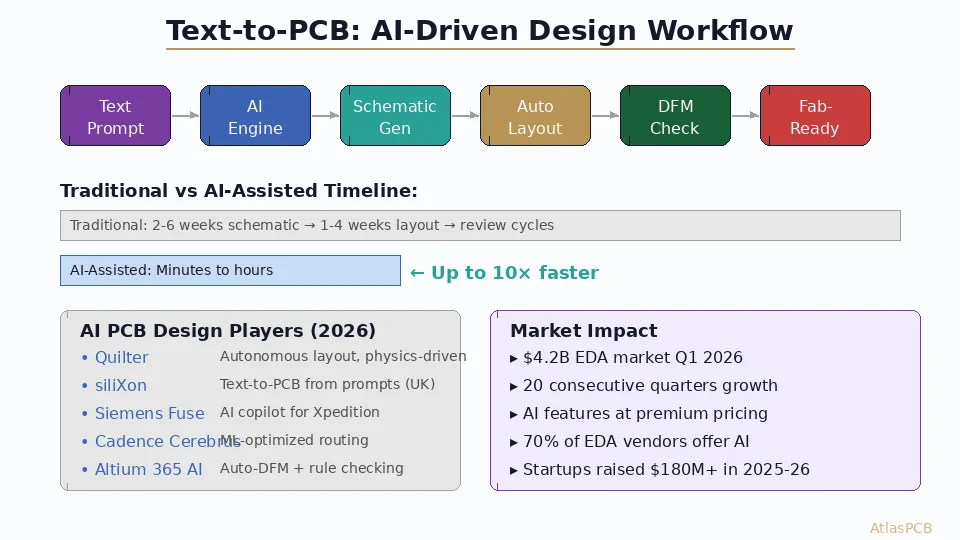
Generative AI is creating a paradigm shift in PCB design where engineers can describe a circuit's function in natural language and receive manufacturable board layouts. In 2026, companies like siliXon (text-to-PCB from prompts, $1.5M raised), Quilter (autonomous physics-driven layout, proven on complex 4+ layer designs), and Siemens Fuse (agentic AI copilot for Xpedition) represent three distinct approaches: fully generative, fully autonomous, and AI-augmented traditional workflows. While none yet replace experienced engineers for complex designs, the $4.2 billion EDA market recorded its 20th consecutive growth quarter in Q1 2026 with AI features driving premium pricing across all major platforms.
The EDA Industry’s ChatGPT Moment
When OpenAI’s ChatGPT made text-to-text generation mainstream in 2022, hardware engineers watched from the sidelines. Software had its revolution; hardware seemed too physical, too constrained by physics, too dependent on manufacturing realities to follow.
Four years later, that assumption is crumbling. The electronic design automation (EDA) industry is experiencing its own generative AI transformation—and the results are moving from demos to production.
EDA tool revenue for PCB design reached $4.2 billion in Q1 2026, marking 20 consecutive quarters of growth. The acceleration isn’t from incremental improvements to traditional tools—it’s driven by AI-native features that command premium pricing because they demonstrably reduce design time.
Three distinct approaches to AI-powered PCB design have emerged, each representing a different philosophy about how much autonomy AI should have:
Approach 1: Fully Generative (siliXon)
Text-to-PCB: Design from Natural Language
UK startup siliXon, which raised $1.5 million in May 2026 led by German investor System.One, is building the most ambitious vision: generate complete circuit board designs from text prompts.
How it works:
- Engineer describes the desired circuit function in natural language
- AI generates a component selection and schematic
- The system produces a manufacturable PCB layout
- DFM checks run automatically against fabrication constraints
Target user: Hardware startups, mechanical engineers who need simple electronics, and rapid prototyping teams.
Current limitations:
- Works best for well-characterized design patterns (sensor boards, MCU development kits, power supplies)
- Cannot handle novel architectures or unconventional component combinations
- Generated layouts may not be cost-optimized for volume production
- Still requires human verification for safety-critical applications
The vision: siliXon also explicitly aims to “help Europe reclaim its technology supply chain” by making PCB design accessible enough that local manufacturing becomes the default rather than overseas outsourcing.
Approach 2: Fully Autonomous Layout (Quilter)
Physics-Driven PCB Routing Without Human Intervention
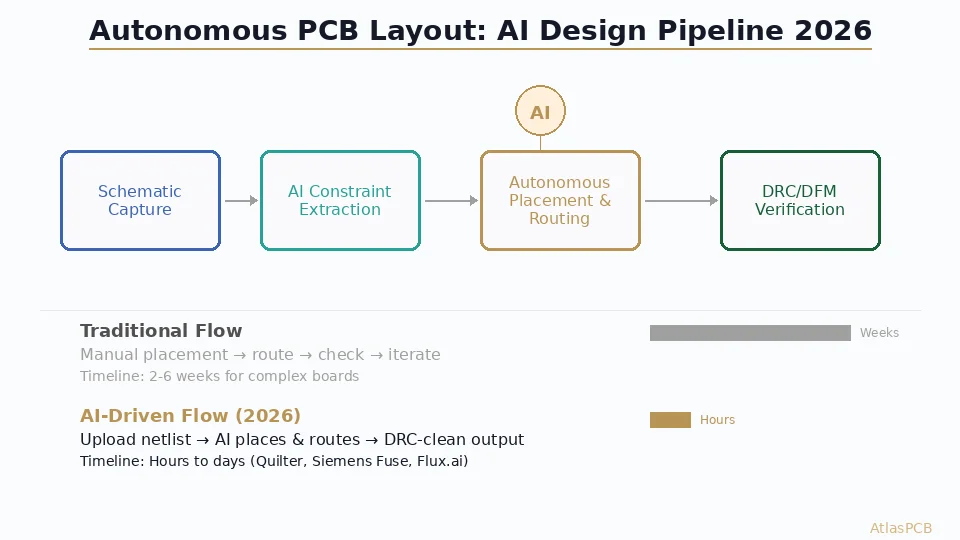
Quilter takes a different approach: rather than generating from text, it accepts a complete schematic and design constraints, then autonomously produces a DRC-clean, manufacturable PCB layout. Think of it as an autonomous layout engineer that works in minutes rather than weeks.
Key differentiator: Quilter’s engine treats routing as a physics problem—solving electromagnetic field equations rather than following heuristic rules. This means it can optimize for signal integrity, power delivery, and thermal management simultaneously.
Project Speedrun results (demonstrated 2026):
- Complete 4+ layer computer motherboard
- Autonomous layout from schematic to DRC-clean in hours
- Human involvement limited to constraint review and final sign-off
- Board powered on and ran real workloads successfully
What this means for engineers: The layout phase—historically 30–60% of the design cycle for complex boards—can compress to a fraction of the time. Engineers spend more time on architecture and validation, less on manual trace routing.
The Quilter Workflow
1. Upload schematic + netlist
2. Define constraints (impedance targets, keep-outs, layer assignment)
3. Quilter compiles (interprets design intent from schematic structure)
4. Autonomous layout generation (minutes to hours)
5. Engineer reviews, requests modifications if needed
6. Export Gerber/ODB++ for fabrication
Approach 3: AI-Augmented Traditional (Siemens Fuse)
Copilot, Not Replacement
Siemens introduced Fuse, an agentic AI system for their Xpedition EDA platform, in early 2026. Rather than replacing the engineer, Fuse acts as an intelligent copilot within the existing workflow.
Capabilities:
- Natural language queries: “Route the DDR5 bus matching within 5 mil”
- Automated DFM optimization based on selected fabricator’s design rules
- Intelligent component placement suggestions based on thermal and SI analysis
- Design rule creation from datasheet specifications
- Automated design reuse identification from previous projects
Target user: Professional design teams already using Siemens tools who want productivity gains without workflow disruption.
Pricing model: Premium tier subscription—AI features are explicitly monetized as a differentiator from base-level tools.
AI-Ready PCB Manufacturing
From AI-Generated Design to Production-Quality Board
Whether your layout comes from Quilter, siliXon, or traditional EDA—AtlasPCB's DFM review ensures it's manufacturable. Free engineering consultation for AI-generated designs.
Submit Your Design →The Broader Landscape: Who Else Is Building AI for PCB?
| Company | Approach | Key Feature | Status |
|---|---|---|---|
| Quilter | Autonomous layout | Physics-based routing engine | Production-available |
| siliXon | Text-to-PCB | Natural language generation | Early access (2026) |
| Siemens Fuse | AI copilot | Agentic workflow integration | Released (Xpedition) |
| Cadence Cerebrus | ML optimization | Reinforcement learning for routing | Available |
| Altium 365 AI | Cloud-native assist | Auto-DFM, component suggestion | Available |
| Flux.ai | Collaborative AI | Real-time design collaboration + AI | Available |
| Jitx | Code-to-PCB | Programmatic design with AI assist | Available |
The diversity of approaches signals market uncertainty about which paradigm will win—and suggests the answer is likely “all of them” for different use cases.
What AI Can and Cannot Do in PCB Design (2026)
AI Excels At:
- Routine routing: Standard digital bus routing, power distribution, simple analog
- DFM optimization: Ensuring designs are manufacturable before fabrication
- Design rule enforcement: Catching violations that humans miss in complex layouts
- Component selection: Recommending alternatives for obsolete or unavailable parts
- Documentation: Auto-generating BOMs, assembly drawings, and fabrication notes
- Impedance calculation: Optimizing trace geometry for target impedance
AI Still Struggles With:
- Novel architectures: First-of-their-kind designs without training data
- Mixed-signal partitioning: Deciding where analog/digital boundaries should be
- RF design: Electromagnetic behavior at microwave frequencies requires specialized solvers
- Thermal management: System-level heat flow involving airflow and enclosure interaction
- Mechanical constraints: 3D packaging, flex-rigid transitions, connector mating forces
- Manufacturing economics: Optimizing for cost requires knowledge of specific fabricator capabilities
Impact on PCB Manufacturing
Generative AI in EDA has direct implications for fabricators:
More Designs, Faster Iteration
When layout takes hours instead of weeks, engineers iterate more. This means:
- Higher volume of unique designs entering fabrication
- Shorter production runs (more NPI, less high-volume repeat)
- Greater demand for fast-turn prototyping services
Better DFM Compliance (Eventually)
AI tools trained on fabrication constraints should produce more manufacturable designs with fewer DFM violations. However, the transition period may actually increase DFM issues as less-experienced users generate designs without understanding manufacturing limitations.
Standard Stackups and Materials
AI-generated designs tend toward standard configurations (standard stackups, common materials, conservative design rules) because training data skews toward proven approaches. This is good for manufacturing efficiency but may limit innovation in material selection.
The Engineer’s Role in 2030: A Projection
Based on current trajectory, the PCB design engineer’s role will evolve from:
Today: Manual layout specialist → impedance expert → DFM liaison
2030: Architecture definition → AI prompt engineering → validation and optimization → manufacturing coordination
The demand for hardware engineers isn’t decreasing—it’s the nature of the work that’s changing. Engineers who embrace AI tools as leverage rather than threats will design more complex systems in less time, while those who resist may find their routine layout work automated.
Practical Recommendations for Engineers Today
Learn the tools: Get early access to Quilter, Flux.ai, or your EDA vendor’s AI features. Understanding their capabilities and limitations makes you more valuable, not less.
Focus on what AI can’t do: Develop expertise in system architecture, mixed-signal design, RF/analog, and manufacturing process knowledge—areas where AI tools still need human judgment.
Validate aggressively: Never trust AI-generated output without verification. Run SI/PI simulations, check DFM rules against your specific fabricator, and prototype before production.
Document your constraints: AI tools work best with clearly defined constraints. Engineers who can precisely specify requirements get better AI output.
Stay manufacturing-aware: Understanding what a fabricator can and cannot build remains essential—AI tools trained on generic data may not know your fabricator’s specific capabilities.
Conclusion
The text-to-PCB revolution isn’t theoretical anymore—it’s shipping products. The question for hardware engineers isn’t whether to adopt AI tools, but which approach matches their workflow and design complexity.
For simple designs (sensor boards, development kits, LED drivers), fully generative tools like siliXon may soon eliminate the need for manual layout entirely. For complex professional designs (servers, medical devices, aerospace), AI copilots like Siemens Fuse accelerate the expert without replacing their judgment. And for the middle ground, autonomous engines like Quilter offer a compelling “upload schematic, get layout” workflow.
The $4.2 billion EDA market is betting that AI is the future. Hardware engineers who learn to work with these tools effectively will have a significant competitive advantage in the next design cycle.
Building boards from AI-generated designs? AtlasPCB provides comprehensive DFM review for layouts produced by any EDA tool—traditional or AI-generated. Our process engineers identify manufacturability issues before fabrication, saving you prototype iterations. Get free DFM analysis →
Further Reading
About AtlasPCB — We specialize in complex PCB manufacturing for HDI, RF, and high-reliability applications. Explore our full PCB manufacturing capabilities, or get an instant online quote . Every order includes free engineering review. Get your quote.
Reviewed by AtlasPCB Engineering Team — IPC-certified manufacturing specialists with 15+ years of production experience in HDI, RF, and high-reliability PCB fabrication. Content based on factory floor data and real customer design reviews.
Frequently Asked Questions
Can AI fully design a PCB from scratch without human input?
What does text-to-PCB mean practically for a hardware startup?
Will AI make PCB designers obsolete?
- AI PCB design
- generative AI
- EDA
- text-to-PCB
- Quilter
- siliXon
- Siemens Fuse
- design automation
- machine learning