· Thomas Webb · Engineering · 8 min read
ITEQ IT-180A vs Isola 370HR
Direct comparison of ITEQ IT-180A and Isola 370HR laminates for high-reliability applications. Covers Tg, Td, CTE, Dk/Df, CAF resistance, and total cost impact. Decision framework for automotive, industrial, and telecom designs.
Quick Answer
ITEQ IT-180A and Isola 370HR are both mid-Tg (~180C) enhanced FR-4 laminates targeting high-reliability applications, but they differ in key ways: IT-180A offers slightly better Dk consistency (3.9-4.0 at 1GHz) and wider regional availability in Asia-Pacific fabrication, while 370HR provides superior CAF (Conductive Anodic Filament) resistance and slightly higher Td (340C vs 330C). For automotive and industrial applications where CAF resistance is critical, 370HR edges ahead. For cost-optimized high-layer-count builds with Asia-based manufacturing, IT-180A typically wins on lead time and price.
Quick Decision: IT-180A or 370HR?
| Criterion | ITEQ IT-180A | Isola 370HR | Winner |
|---|---|---|---|
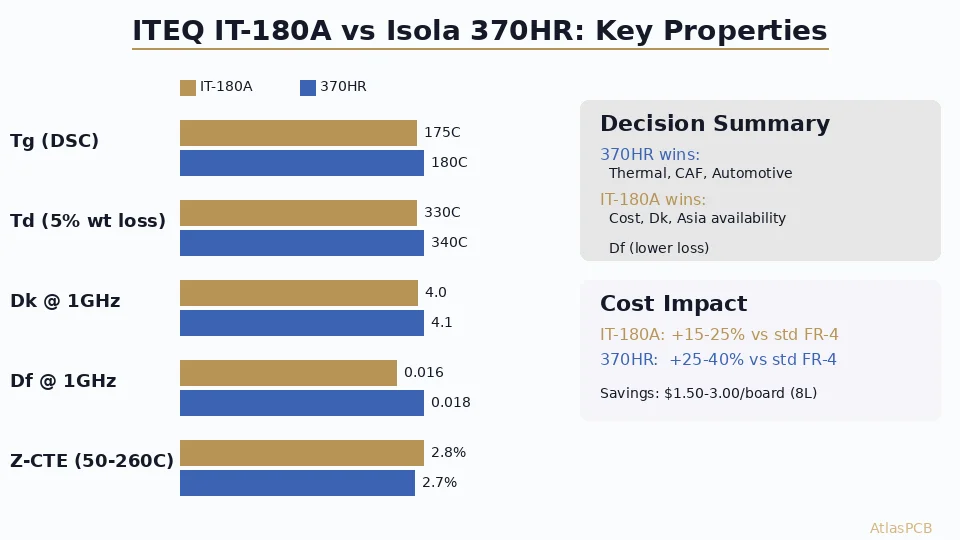
| Tg (DSC) | 175C | 180C | 370HR |
| Td (5% weight loss) | 330C | 340C | 370HR |
| Dk at 1 GHz | 4.0 | 4.1 | IT-180A |
| Df at 1 GHz | 0.016 | 0.018 | IT-180A |
| Z-axis CTE (50-260C) | 2.8% | 2.7% | 370HR |
| CAF resistance | Good | Excellent | 370HR |
| Lead-free compatible | Yes (6x reflow) | Yes (6x reflow) | Tie |
| Asia-Pacific availability | Excellent | Good | IT-180A |
| Automotive OEM history | Growing | Established | 370HR |
| Typical cost premium vs std FR-4 | +15-25% | +25-40% | IT-180A |
The 30-second answer: Choose 370HR when CAF resistance and automotive qualification matter more than cost. Choose IT-180A when you need solid mid-Tg performance with better pricing and faster delivery from Asian fabricators.
Where These Laminates Fit in the Material Hierarchy
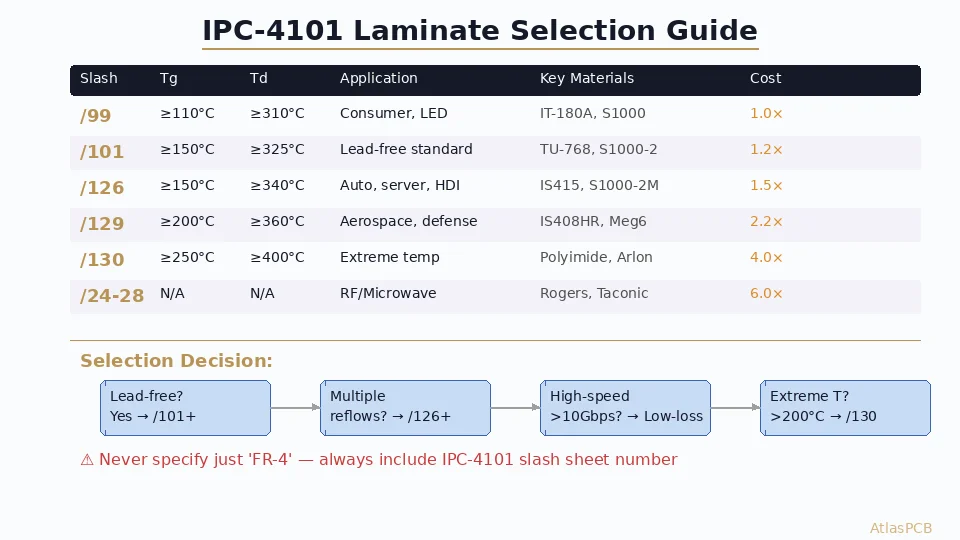
Both IT-180A and 370HR sit in the “enhanced FR-4” tier — above standard Tg 130-140C material but below true high-performance laminates like Megtron 6 or Isola I-Speed. Engineers reach for this tier when standard FR-4 fails thermal cycling requirements or when the design operates above 100C ambient, but the signal integrity budget does not justify premium low-loss materials.
The typical applications driving this material choice include automotive ECUs that must survive under-hood temperatures, industrial motor drives with sustained 85C operation, telecom infrastructure boards requiring 20-year field life, and medical devices needing IPC Class 3 reliability. In all these cases, the designer needs confidence that the laminate will not delaminate during lead-free assembly (260C+ peak reflow) and will maintain structural integrity through thousands of thermal cycles.
What makes this comparison particularly relevant in 2026 is the supply chain dynamic. ITEQ has significantly expanded its manufacturing capacity in Taiwan and mainland China, making IT-180A increasingly price-competitive for Asia-sourced fabrication. Meanwhile, Isola’s 370HR remains the default specification at many North American and European OEMs, creating a qualification barrier that is slowly eroding as more Tier 1 suppliers validate IT-180A as an approved alternate.
MATERIAL SELECTION SUPPORT
Not Sure Which Laminate Your Design Needs?
Upload your stackup and we'll recommend the optimal material grade based on your thermal, signal integrity, and reliability requirements.
Get Stackup Recommendation ›
Thermal Performance: The Numbers That Matter
The glass transition temperature (Tg) headline numbers — 175C for IT-180A versus 180C for 370HR — tell only part of the thermal story. More important for real-world reliability is the thermal decomposition temperature (Td), which indicates when the resin system begins irreversible degradation.
At Td 330C (IT-180A) versus 340C (370HR), the 10C difference provides 370HR with slightly more margin during lead-free reflow profiles that peak at 250-260C. In practice, both materials comfortably survive 6 reflow cycles per IPC-TM-650 testing, which is the standard qualification threshold for double-sided SMT assembly with rework allowance.
The more meaningful thermal differentiator is the Z-axis coefficient of thermal expansion (CTE) above Tg. Both materials maintain excellent Z-CTE (2.7-2.8% total expansion from 50C to 260C), which directly correlates with plated through-hole reliability during thermal cycling. For comparison, standard FR-4 typically shows 3.5-4.5% Z-expansion over the same range — a significant difference that manifests as barrel cracks in plated vias after 500-1000 thermal cycles from -40C to 125C.
For designs requiring IPC-6012 Class 3 performance (telecommunication infrastructure, medical life-support), the 370HR’s slightly lower Z-CTE provides a measurable margin. Our internal data from IST (Interconnect Stress Test) cycling shows 370HR consistently passing 300+ cycles at the -55C to +125C extreme range, while IT-180A achieves 250+ cycles — both well above the IPC minimum but with 370HR showing approximately 20% more fatigue life.
Electrical Properties: Dk, Df, and What They Mean for Your Design
For controlled impedance designs operating below 3 GHz, both materials deliver adequate dielectric constant stability. IT-180A’s slightly lower Dk (4.0 vs 4.1 at 1 GHz) means marginally wider traces for a given impedance target — typically 0.5-1.0 mil wider on inner layers, which can provide a small manufacturing yield benefit at tight trace/space geometries.
The dissipation factor (Df) comparison is counterintuitive: IT-180A actually has lower loss (0.016 vs 0.018 at 1 GHz) despite being the lower-cost material. This 12% difference in Df translates to roughly 0.1 dB/inch less insertion loss at 5 GHz on a typical stripline configuration. For short interconnects under 4 inches, this difference is negligible. For backplane traces running 20+ inches, it accumulates to a measurable eye diagram improvement.
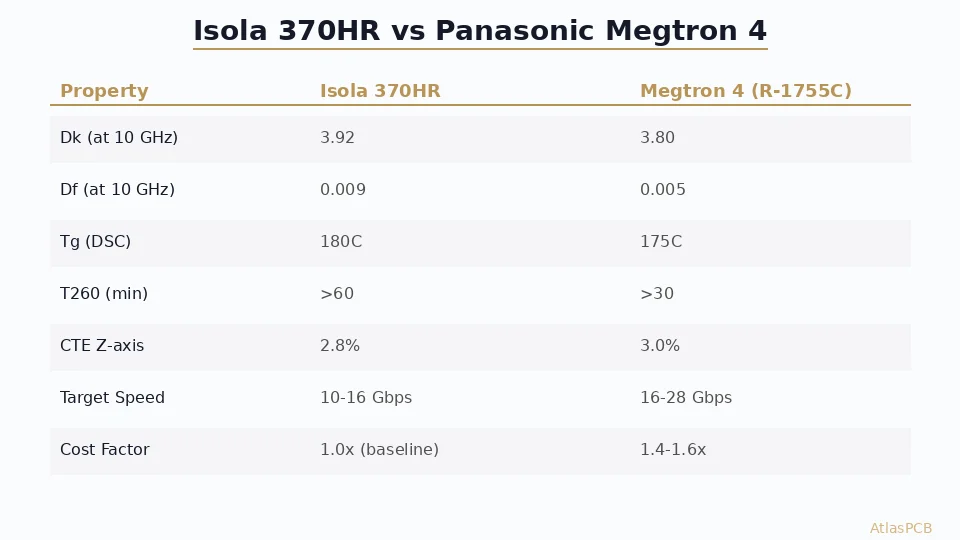
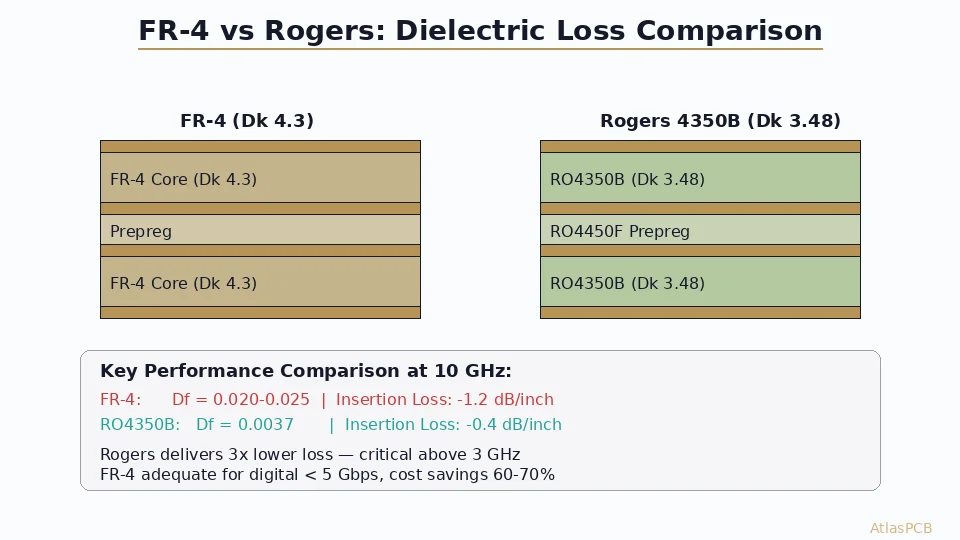
However, neither material should be your first choice for genuine high-speed applications above 10 Gbps NRZ. At those data rates, you need actual low-loss laminates (Df below 0.005) like Megtron 6, Panasonic R-5775, or Isola I-Speed. The IT-180A/370HR tier is appropriate for PCIe Gen 3, USB 3.0, Gigabit Ethernet, and similar moderate-speed interfaces where the primary material requirement is thermal reliability rather than electrical performance.
IMPEDANCE CONTROL
Controlled Impedance with IT-180A or 370HR
AtlasPCB maintains validated Dk/Df models for both laminates. We simulate your stackup with actual measured material data from our qualified suppliers.
Upload Stackup ›CAF Resistance: The Hidden Reliability Factor
Conductive Anodic Filament (CAF) formation is a failure mechanism that receives insufficient attention during material selection. CAF occurs when copper ions migrate along the glass fiber/resin interface under bias voltage, eventually creating a conductive path between adjacent conductors. It is accelerated by high humidity, elevated temperature, and fine-pitch geometries — exactly the conditions present in automotive, industrial, and outdoor telecom equipment.
Isola 370HR was specifically engineered with enhanced resin-to-glass adhesion to resist CAF formation. In standardized testing per IPC-TM-650 Method 2.6.25, 370HR demonstrates no failures at 100V bias, 85C/85%RH, for 1000+ hours at 0.3mm drill-to-drill spacing. IT-180A performs well under the same test conditions but shows earlier onset of resistance degradation at extreme conditions (0.25mm spacing, 1500+ hours).
For designs operating at 48V or higher (EV battery management, power supplies, solar inverters), CAF resistance should be a primary material selection criterion. The combination of high voltage, high humidity exposure, and fine-pitch via patterns creates the worst case for CAF. In these applications, the 370HR premium is justified by reduced field failure risk.
For lower-voltage consumer and computing applications below 12V with standard via spacing (0.5mm+), CAF risk is minimal with either material, making IT-180A’s cost advantage the dominant selection factor.
Supply Chain and Cost Considerations
The pricing differential between IT-180A and 370HR varies significantly by region and fabrication partner. In mainland China and Taiwan, ITEQ material is typically available with 1-2 week lead time from local distributors, while Isola 370HR requires 3-4 week procurement cycles due to import logistics from Isola’s manufacturing sites.
For a representative 8-layer, 1.6mm thick board with 1oz copper:
| Cost Factor | IT-180A (Asia fab) | 370HR (Asia fab) | 370HR (NA/EU fab) |
|---|---|---|---|
| Laminate cost per sqft | $8-12 | $12-16 | $14-18 |
| Per-board material (100x150mm) | $4-6 | $6-9 | $7-10 |
| Lead time impact | None | +5-7 days | None |
| MOQ constraint | Standard | Standard | Standard |
Beyond the direct material cost, the supply chain reliability matters. ITEQ’s multiple manufacturing sites across Asia provide redundancy, while Isola’s more concentrated production occasionally leads to allocation constraints during demand surges — as seen during the 2024-2025 automotive PCB ramp.
COMPETITIVE PRICING
IT-180A and 370HR In Stock
AtlasPCB maintains qualified inventory of both ITEQ and Isola mid-Tg laminates. Get a quote with real material pricing — no surprises at order confirmation.
Decision Framework: When to Specify Each Material
Specify Isola 370HR when:
- Automotive OEM qualification requires it (most NA/EU automotive programs)
- Operating voltage exceeds 48V with fine-pitch vias (CAF risk)
- Design must meet MIL-PRF-31032 or IPC-6012 Class 3/A requirements
- Thermal cycling range exceeds -40C to +125C for 1000+ cycles
- Your customer’s approved material list (AML) specifies Isola products
Specify ITEQ IT-180A when:
- Primary fabrication source is in Asia-Pacific (China, Taiwan, Korea)
- Cost optimization is important without sacrificing mid-Tg reliability
- Design operates below 48V with standard via geometries (0.3mm+ spacing)
- Lead time is critical and local material availability matters
- Application is industrial/telecom where ITEQ qualification is accepted
Consider either (evaluate on cost/delivery):
- Standard server and networking equipment (below 125C operation)
- Industrial control systems with moderate thermal requirements
- Medical devices where both materials have documented biocompatibility data
- Telecom infrastructure with IPC Class 2/3 requirements
ATLASPCB
Ready to Order? Both Materials Available.
Upload your Gerber files and specify your preferred laminate. Our engineering team validates material compatibility with your stackup before production.
Get Instant Quote ›
Related Reading:
About AtlasPCB — We specialize in complex PCB manufacturing for HDI, RF, and high-reliability applications. Explore our Isola 370HR high-Tg PCB manufacturing . Every order includes free engineering review. Get your quote.
Reviewed by AtlasPCB Engineering Team — IPC-certified manufacturing specialists with 15+ years of production experience in HDI, RF, and high-reliability PCB fabrication. Content based on factory floor data and real customer design reviews.
Frequently Asked Questions
Is ITEQ IT-180A equivalent to Isola 370HR?
Which laminate is better for automotive PCBs?
What is the cost difference between IT-180A and 370HR?
Can I use IT-180A for controlled impedance designs?
- PCB laminate
- ITEQ IT-180A
- Isola 370HR
- high-Tg FR-4
- PCB material selection
- CAF resistance
- high-reliability PCB