· Marcus Lin · Engineering · 8 min read
Immersion Silver vs ENIG
Immersion silver vs ENIG for high-reliability PCBs: compare solderability, shelf life, cost, and failure modes to choose the right surface finish for your board.
Quick Answer
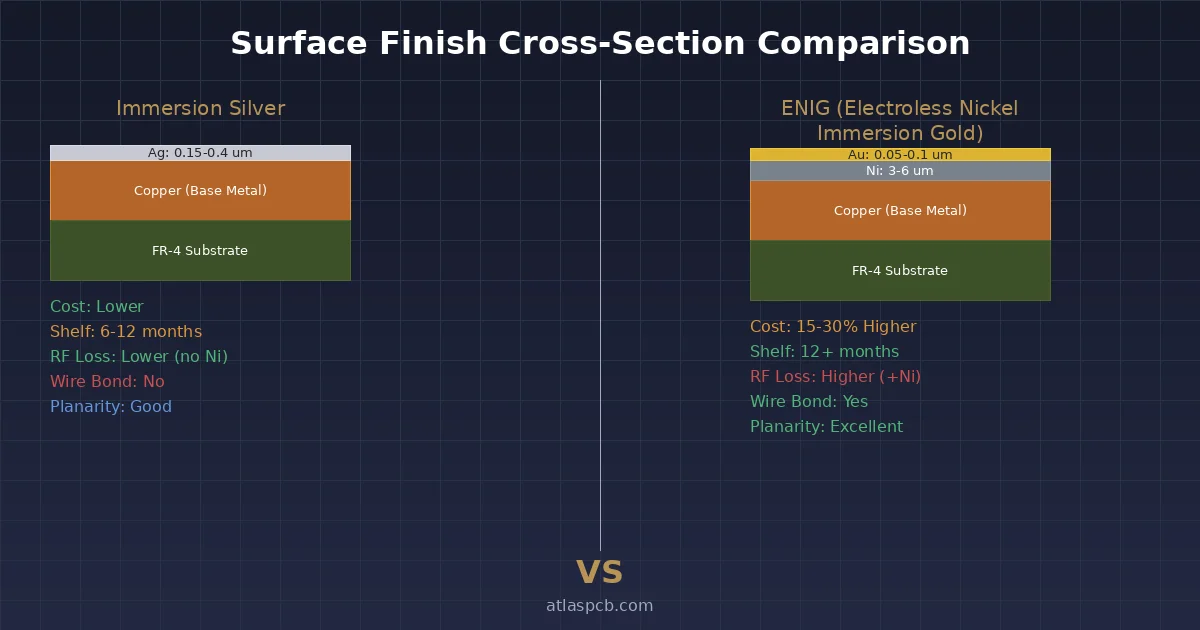
Choose Immersion Silver for RF/microwave applications where signal loss matters and boards will be assembled within 6 months. Choose ENIG for BGA-heavy designs, wire bonding, or products requiring 12+ months shelf life. ENIG costs 15-30% more but offers superior planarity and longer storage.
Quick Answer: Immersion Silver vs ENIG at a Glance
| Parameter | Immersion Silver | ENIG |
|---|---|---|
| Relative cost | Lower (baseline) | 15-30% higher |
| Shelf life | 6-12 months (sealed) | 12+ months |
| Wire bondable | No | Yes |
| Solderability | Excellent | Excellent |
| Signal loss at 10 GHz | Lower (no Ni barrier) | Higher (+0.02-0.05 dB/in) |
| Planarity | Good (0.05-0.15um Ra) | Excellent (0.05-0.10um Ra) |
| Fine-pitch BGA (<0.4mm) | Acceptable | Preferred |
| Tarnish sensitivity | High | Low |
If you are designing an RF front-end module operating above 5 GHz and can control your supply chain timeline, Immersion Silver wins. If you need long shelf life, wire bonding capability, or ultra-flat pads for 0.3mm-pitch BGAs, ENIG is the safer choice.
Immersion Silver: Properties and Trade-offs
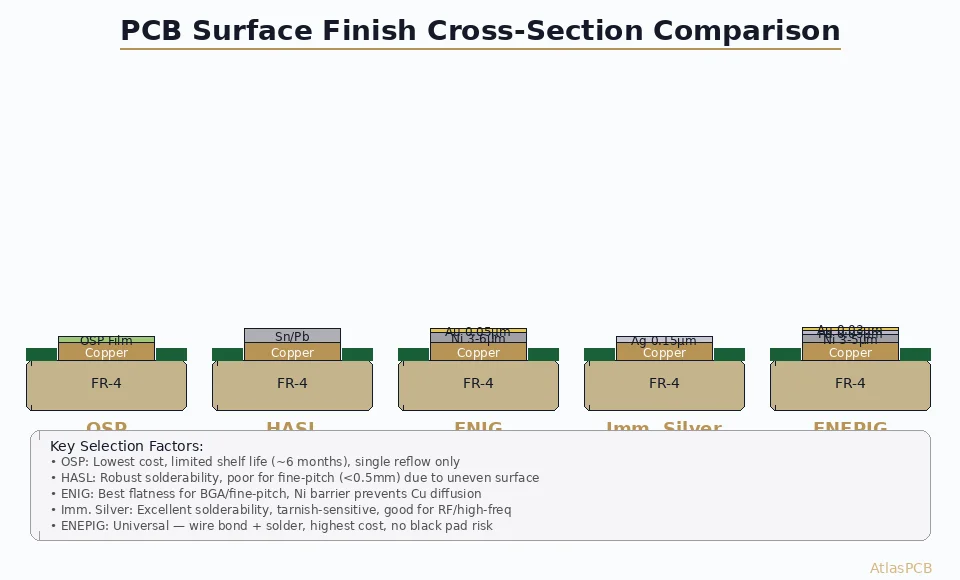
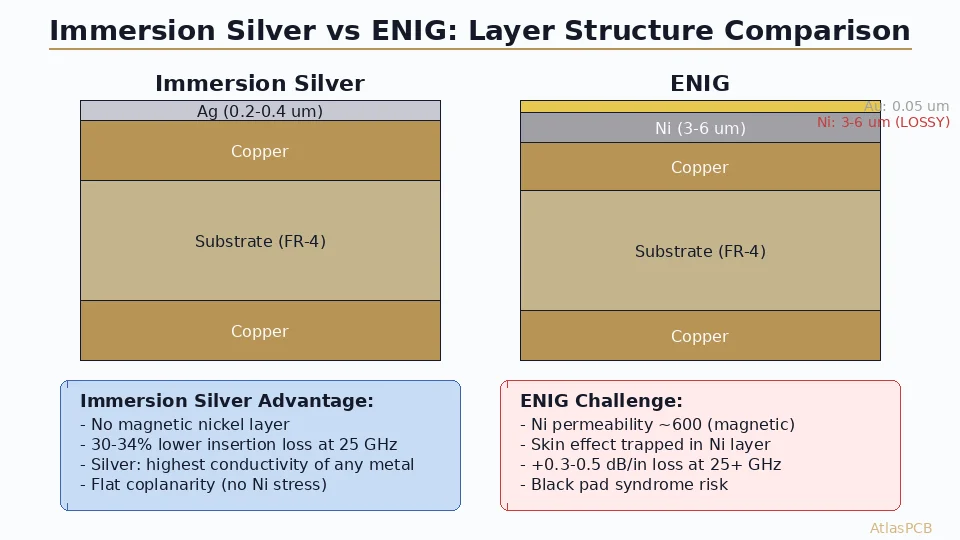
Immersion Silver deposits a thin layer of pure silver (0.15-0.40um typical) directly onto exposed copper through a chemical displacement reaction. No intermediate barrier layer exists between the copper and the solderable surface.
Advantages:
- Lowest insertion loss of any standard finish at RF frequencies, since the signal path is copper-silver with no ferromagnetic nickel layer
- Excellent solderability with both SnPb and lead-free alloys
- Flat, coplanar surface suitable for fine-pitch components
- Lower cost than ENIG: fewer chemical baths, no precious metal underlayer
- RoHS compliant
Limitations:
- Tarnish sensitivity: silver reacts with atmospheric sulfur compounds (H2S, COS) to form silver sulfide, which degrades solderability
- Shelf life of 6-12 months requires sealed packaging with sulfur-free desiccants
- Not suitable for multiple reflow cycles without degradation (2-3 reflows maximum)
- Cannot be used for wire bonding
- Creep corrosion risk in high-sulfur environments (industrial settings near paper mills, volcanic regions)
Typical thickness: 0.15-0.40um Ag on Cu
Process: Single-step immersion (displacement) reaction in silver nitrate or silver cyanide bath, preceded by micro-etch and pre-dip.
RF & MICROWAVE PCB
Need Immersion Silver for Your RF Design?
We process Immersion Silver with anti-tarnish packaging as standard. Boards ship in nitrogen-sealed bags.
Get a Quote ›
ENIG: Properties and Trade-offs
Electroless Nickel Immersion Gold (ENIG) deposits a nickel barrier layer (3-6um) followed by a thin gold flash (0.05-0.15um) onto exposed copper. The nickel acts as a diffusion barrier; the gold protects the nickel from oxidation until soldering.
Advantages:
- Long shelf life (12+ months) due to gold’s inertness
- Excellent planarity for fine-pitch BGA and QFN components (0.3-0.5mm pitch)
- Wire bondable (gold wire bonding)
- Multiple reflow compatible (3-5 cycles)
- Resistant to handling damage and environmental exposure
- Good solder joint reliability when properly processed
Limitations:
- Black pad risk: hyperactive corrosion of the nickel layer during gold deposition creates brittle, unreliable solder joints. Modern processes have reduced this to <1% occurrence, but it cannot be eliminated entirely.
- Higher cost: nickel and gold chemicals, additional process steps, tighter process control
- RF signal degradation: the nickel underlayer has high magnetic permeability (relative permeability ~600), introducing eddy current losses above 1 GHz that increase with frequency
- Nickel is a brittle intermetallic former; excessive nickel thickness can reduce drop-test reliability
Typical thickness: 3-6um Ni + 0.05-0.15um Au (per IPC-4552 Rev B)
Process: Activation, electroless nickel bath (phosphorus content 7-9% for mid-phos), immersion gold displacement reaction.
Head-to-Head: Application-Specific Recommendations
RF and Microwave (>5 GHz)
Winner: Immersion Silver
At 10 GHz on standard FR-4 (which you should not be using at 10 GHz, but for illustration), the nickel layer in ENIG adds approximately 0.02-0.05 dB/inch of additional insertion loss compared to Immersion Silver. On a Rogers RO4350B board with 50-ohm microstrip, this difference is measurable and meaningful for low-noise amplifier front ends, filter structures, and antenna feed networks.
If your design operates primarily below 3 GHz and trace lengths are short (<2 inches), the difference is negligible and ENIG is acceptable.
BGA Assembly (0.4-0.65mm pitch)
Winner: ENIG
ENIG’s superior planarity ensures consistent paste printing and self-alignment during reflow. For BGAs at 0.4mm pitch or below, the flatness tolerance becomes critical. Immersion Silver works at 0.5mm pitch and above without issues, but at finer pitches, the slight surface roughness variations can cause insufficient paste volume on individual pads.
Automotive Electronics (AEC-Q100 environments)
Winner: ENIG (with exceptions)
Automotive applications demand long shelf life (boards may sit in warehouse for months), multiple thermal cycles, and resistance to underhood environments. ENIG’s robustness wins here. However, for automotive radar modules (24 GHz, 77 GHz), Immersion Silver or OSP on Rogers materials is standard because the nickel loss is unacceptable at millimeter-wave frequencies.
LED Lighting
Winner: Immersion Silver or ENIG (depends on reflectivity needs)
Silver has higher reflectivity (95%+) than gold at visible wavelengths, making Immersion Silver preferred for LED PCBs where the board surface contributes to light output. ENIG is acceptable when reflectivity is not a design factor.
SURFACE FINISH OPTIONS
Not Sure Which Finish Fits Your Design?
Our engineers review every order for finish compatibility. Upload your Gerber files and we will recommend the optimal surface finish.
Upload Design Files ›Decision Flowchart
Follow this logic to select your finish:
Does your design require wire bonding?
- Yes: Use ENIG (or Hard Gold for edge connectors)
- No: Continue to step 2
Does your design operate above 5 GHz with trace lengths exceeding 1 inch?
- Yes: Use Immersion Silver (or OSP if shelf life is not a concern)
- No: Continue to step 3
Will assembled boards sit in inventory for more than 6 months before use?
- Yes: Use ENIG
- No: Continue to step 4
Does your BOM include BGAs at 0.4mm pitch or finer?
- Yes: Use ENIG
- No: Continue to step 5
Is cost a primary driver?
- Yes: Use Immersion Silver
- No: ENIG is the safer default
Handling and Storage Considerations
For Immersion Silver boards:
- Store in nitrogen-sealed or vacuum-sealed anti-tarnish bags immediately after fabrication
- Include humidity indicator cards (below 30% RH target)
- Use within 6 months of manufacture for best results
- Open bags only at the SMT line, immediately before paste printing
- Wear gloves (sulfur from skin oils accelerates tarnish)
For ENIG boards:
- Standard dry-pack storage is sufficient
- No special handling beyond ESD precautions
- Inspect for discoloration (brown or black spots may indicate black pad)
Cost Comparison
For a standard 4-layer FR-4 board (100x100mm, 200 pieces):
- HASL (lead-free): Baseline cost
- Immersion Silver: +8-15% over HASL
- ENIG: +20-35% over HASL
The cost gap between Immersion Silver and ENIG narrows at higher volumes because the fixed chemistry costs are amortized over more boards. At 10,000+ pieces, expect the difference to shrink to 10-15%.
PROTOTYPE TO PRODUCTION
Compare Pricing for Both Finishes
Submit your design and receive quotes for both Immersion Silver and ENIG to see the actual cost difference for your specific board.
Get Comparative Quote ›IPC Standards Reference
- ENIG: IPC-4552 Rev B (Electroless Nickel/Immersion Gold)
- Immersion Silver: IPC-4553 Rev A (Immersion Silver)
- General surface finish selection: IPC-6012 Class 2/3 (Rigid PCB qualification)
Both finishes meet IPC-6012 Class 3 requirements for high-reliability electronics when processed within specification.
Summary
There is no universally “better” finish. The choice depends on your specific constraints:
- Immersion Silver delivers lower RF loss, lower cost, and excellent solderability, but demands tighter supply chain control and faster board consumption.
- ENIG provides longer shelf life, wire bonding capability, and superior planarity for ultra-fine-pitch assembly, at higher cost and with a small RF penalty.
For most general-purpose designs below 5 GHz that do not require wire bonding, either finish works. Default to ENIG when in doubt. Switch to Immersion Silver when you have a specific technical reason (RF performance, LED reflectivity, or cost pressure with controlled logistics).
ATLASPCB
Ready to Order? We Support Both Finishes.
ENIG, Immersion Silver, OSP, HASL, Immersion Tin, and Hard Gold all available with no minimum order quantity.
Start Your Order ›
Related Reading
- PCB Surface Finish Comparison: OSP vs HASL vs ENIG Decision Guide — Full comparison of all common finishes
- Rigid PCB Manufacturing Services — Our standard rigid board capabilities including all surface finish options
- PCB Capabilities Overview — Complete specifications for materials, tolerances, and finishes
About AtlasPCB — We specialize in complex PCB manufacturing for HDI, RF, and high-reliability applications. Explore our RF and high-frequency PCB services, or get an full PCB manufacturing capabilities . Every order includes free engineering review. Get your quote.
Reviewed by AtlasPCB Engineering Team — IPC-certified manufacturing specialists with 15+ years of production experience in HDI, RF, and high-reliability PCB fabrication. Content based on factory floor data and real customer design reviews.
Frequently Asked Questions
Is Immersion Silver cheaper than ENIG?
Can I wire bond to Immersion Silver?
What is the shelf life of Immersion Silver PCBs?
Does ENIG cause signal loss at high frequencies?
What is black pad in ENIG and how common is it?
- surface finish
- immersion silver
- ENIG
- high reliability
- RF PCB