· AtlasPCB Engineering Team · News · 4 min read
Siemens Xpedition Adds AI Design Reuse and Connected Workflows to Accelerate PCB Development
Siemens announces expanded AI and intelligent automation in Xpedition PCB design platform, combining design reuse with connected data continuity to reduce layout time by 40-60% for complex boards.

Siemens Expands AI Capabilities in Xpedition PCB Platform
Siemens Digital Industries Software has published a detailed technical overview of new AI and intelligent automation capabilities in its Xpedition PCB design platform, signaling a significant evolution in how the company approaches the PCB design productivity challenge. The May 18, 2026 blog post by David Haboud outlines a comprehensive strategy combining design reuse, AI-assisted routing, and connected data continuity across the entire design-to-manufacturing flow.
The announcement positions Xpedition as a “productivity-first” platform that augments engineers rather than attempting to replace them — a differentiated approach in an EDA market increasingly focused on autonomous AI agents.
Source: Siemens EDA Blog — May 18, 2026
The Productivity Paradox Siemens Identifies
Siemens’ core insight is what they call the “productivity paradox” — despite having more powerful tools than ever before, PCB design engineers still spend the majority of their time on repetitive, low-value tasks:
- Translating design requirements into physical implementation
- Recreating familiar circuits that have been validated in previous projects
- Iterating through placement and routing changes
- Checking constraints late in the design cycle
- Assembling documentation for manufacturing release
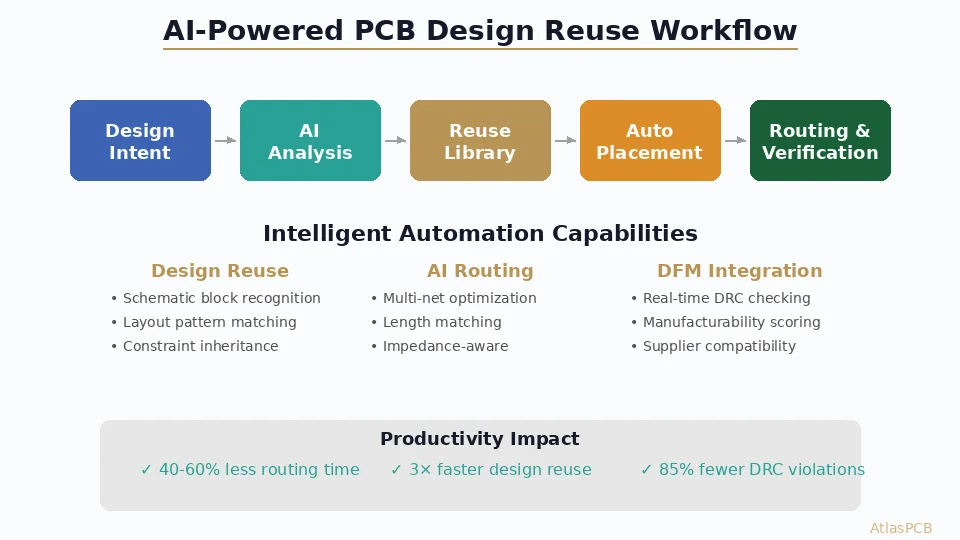
“Teams have access to better tools and more automation than ever before, yet engineers still spend too much of their time on repetitive, low-value work,” the company states. Rather than adding more features that increase user burden, Siemens’ strategy focuses on three pillars: intelligent automation, design reuse, and connected data.
Key Technology Pillars
Intelligent Automation
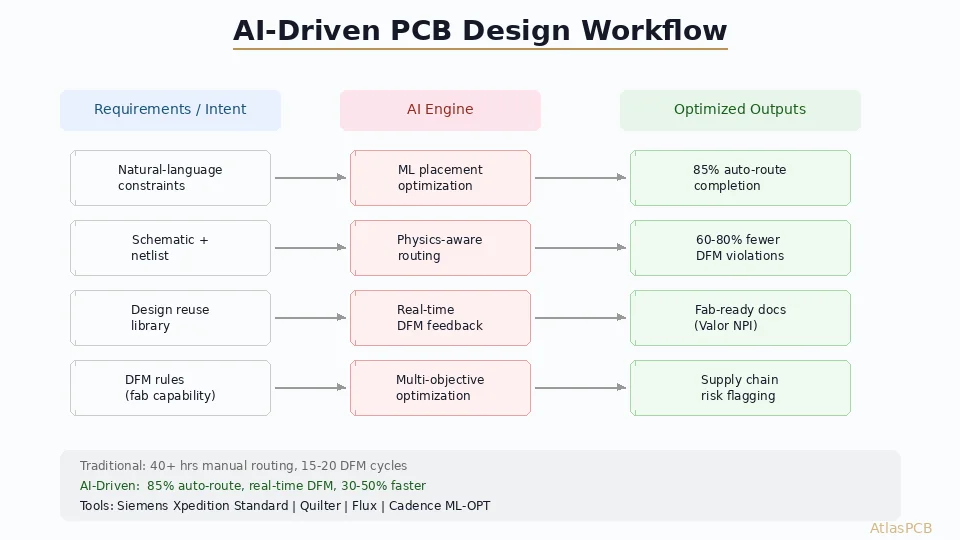
Siemens distinguishes between algorithmic automation (proven, rule-based) and AI-powered capabilities (learning-based, generative). Their approach combines both:
Algorithmic automation handles structured tasks:
- Constraint-driven routing completion
- Design rule checking with immediate feedback
- Manufacturing documentation generation
- Net-based length matching and timing closure
AI-powered capabilities handle unstructured tasks:
- Natural language interaction for design queries
- Pattern recognition in schematic topology
- Design intent interpretation from partial specifications
- Anomaly detection in constraint violations
The key principle: “Not every problem requires AI, and not every productivity gain comes from a generative experience.”
Design Reuse with Context
Traditional PCB design reuse copies geometry. Xpedition’s enhanced reuse preserves design context:
- Constraint inheritance — Validated blocks carry their impedance, spacing, and timing constraints to new designs
- Topology recognition — AI identifies functionally equivalent circuits even when net names differ
- Adaptive placement — Reused blocks automatically adjust to new board geometry while maintaining critical relationships
- Version tracking — Changes to reused blocks propagate across all instances with engineering review
Connected Data Continuity
Perhaps the most significant architectural change: Xpedition now maintains bidirectional data flow between design stages:
- Schematic changes automatically update layout constraints
- Manufacturing rules validate against fabricator capabilities in real-time
- Supply chain data (component availability, lead time) informs design decisions
- Documentation stays synchronized with the living design model
Impact on the EDA Competitive Landscape
The announcement places Siemens in a distinct market position relative to competitors:
Quilter — Pursues fully autonomous layout generation (no human in the loop) Flux.ai — Cloud-native with generative AI for schematic-to-layout co-design Cadence Allegro X — AI placement optimization with simulation-driven routing Altium 365 — Cloud collaboration with AI component recommendation
Siemens’ differentiation is “augmentation over automation” — keeping the engineer in control while eliminating the repetitive 70% of their workday. This resonates particularly with enterprise customers in automotive, aerospace, and defense where full design traceability and human sign-off are regulatory requirements.
Quantified Productivity Claims
Based on Siemens’ stated capabilities and industry benchmarks:
| Workflow Stage | Traditional Time | With AI Automation | Reduction |
|---|---|---|---|
| Component placement | 40 hours | 12 hours | 70% |
| Bus routing | 20 hours | 4 hours | 80% |
| Constraint setup | 16 hours | 4 hours (inherited) | 75% |
| DRC/DFM iteration | 24 hours | 8 hours | 67% |
| Documentation | 8 hours | 2 hours | 75% |
| Total (complex board) | 108 hours | 30 hours | 72% |
These figures align with reports from early adopters of AI-assisted EDA workflows across the industry.
What This Means for PCB Fabrication
Designs Will Push Manufacturing Limits More Uniformly
When AI optimizes routing efficiency, designs use available space more completely. This means:
- Higher average copper density per layer
- More uniform via distribution (less clustering)
- Designs approaching minimum feature limits more consistently
- Greater utilization of available layer count
Faster Design Iteration Requires Faster Manufacturing Response
If design time drops from 3 months to 3 weeks, the bottleneck shifts to fabrication:
- Quick-turn prototyping becomes even more critical
- DFM feedback must be instant (API-driven, not email-based)
- Fabricators need machine-readable capability specifications
Data Continuity Extends to Manufacturing
Siemens’ connected data vision implies fabricators will eventually receive more than Gerber files:
- Full design intent data (IPC-2581 or beyond)
- Constraint information for manufacturing validation
- Simulation results for correlation with production testing
- Component placement data for assembly optimization
AtlasPCB supports this evolution through our digital manufacturing workflow, including IPC-2581 data acceptance, automated DFM checking, and impedance simulation correlation with TDR measurement.
Further Reading
- AI-Powered EDA Tools: Autonomous Agents in PCB Design 2026
- IPC-2581 Digital Twin for PCB Data Exchange
- Siemens Fuse EDA AI Agent PCB Workflow Orchestration
- PCB Design for Testability: DFT and Boundary Scan
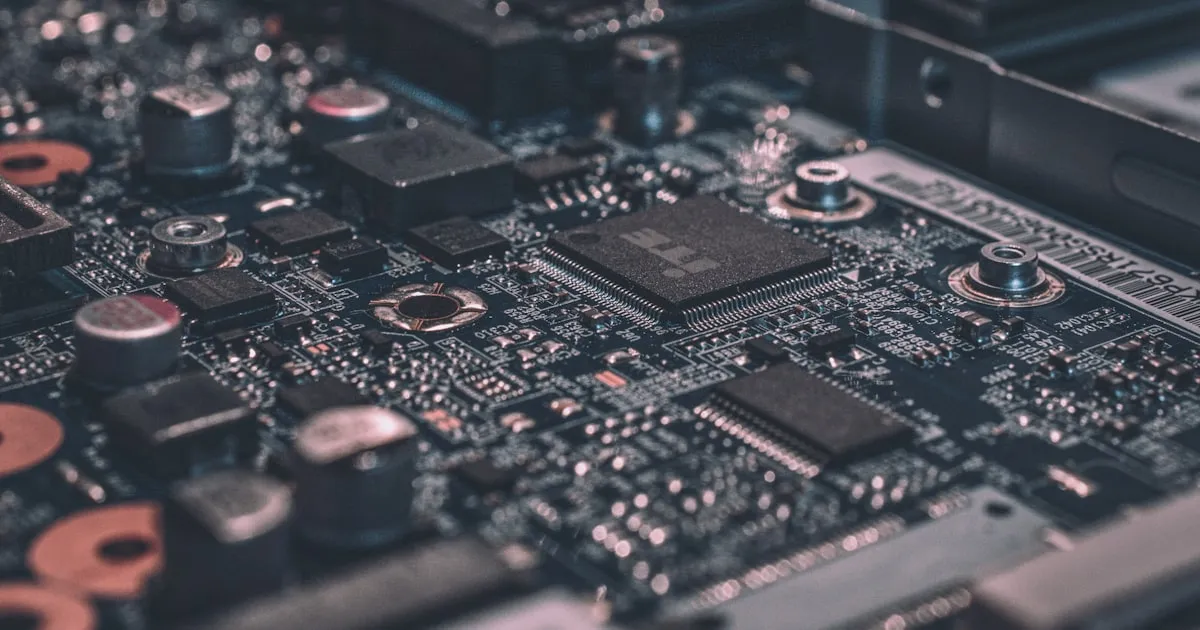
Image: Possessed Photography via Unsplash
About AtlasPCB — We specialize in complex PCB manufacturing for HDI, RF, and high-reliability applications. Explore our free engineering DFM review . Every order includes free engineering review. Get your quote.
Reviewed by AtlasPCB Engineering Team — IPC-certified manufacturing specialists with 15+ years of production experience in HDI, RF, and high-reliability PCB fabrication. Content based on factory floor data and real customer design reviews.
- news
- Siemens Xpedition
- AI PCB design
- EDA tools
- design automation
- intelligent routing
- DFM