· Thomas Webb · News · 4 min read
Global Semiconductor Sales Hit $298.5B in Q1 2026
The Semiconductor Industry Association reports Q1 2026 chip sales reached $298.5 billion, putting the industry on track for its first $1 trillion year. The downstream impact on PCB substrate capacity, advanced packaging, and material demand is already reshaping supply chains.

Chip Industry Crosses $298.5 Billion Quarterly Threshold
The Semiconductor Industry Association (SIA) reported that global semiconductor sales in Q1 2026 reached $298.5 billion, establishing a trajectory that — if sustained — would make 2026 the first calendar year to exceed $1 trillion in total chip revenue.
According to reporting by Tom’s Hardware citing SIA data, this figure represents approximately 25% year-over-year growth, driven primarily by:
- AI accelerator demand (data center GPUs, AI ASICs, HBM memory)
- 5G infrastructure expansion and device proliferation
- Automotive semiconductor content growth (EV powertrains, ADAS)
- Recovery in consumer electronics after the 2023-2024 downturn
PCB and Substrate Industry Implications
The semiconductor industry’s growth has a direct and multiplicative effect on PCB demand. Every chip sold ultimately sits on a package substrate and connects to a printed circuit board.
IC Substrate Capacity Constraints
The AI chip boom has created severe constraints in ABF (Ajinomoto Build-up Film) IC substrates — the high-density packages that house GPU, HPC, and networking ASICs. Key data points:
- ABF substrate demand is growing at 30-40% annually while capacity additions lag at 15-20%
- TSMC’s CoWoS advanced packaging expansion requires corresponding substrate capacity growth
- Nan Ya PCB recently announced a NT$10B+ capex plan specifically for AI chip substrates
- Lead times for complex 20+ layer ABF substrates have extended to 20-26 weeks
High-Layer-Count PCB Demand
AI servers don’t just need substrates — they need the most advanced motherboards and backplanes the PCB industry can produce:
- Server motherboards: 16-24 layers with controlled impedance at 56-112 Gbps per channel
- AI accelerator boards: 20+ layers with sequential lamination, HDI, and ultra-low-loss materials
- Networking switches: High-layer-count backplanes for 51.2 Tbps switch fabrics
- HBM interposers: Silicon bridge and organic interposer substrates with 2µm line/space
Material Supply Chain Ripple Effects
The demand surge is propagating through the entire materials stack:
| Material | Impact | Lead Time (May 2026) |
|---|---|---|
| Copper foil (thin, <18µm) | Allocation | 12-16 weeks |
| Low-loss laminates (Dk <3.3) | Tight supply | 14-20 weeks |
| ABF film | Severe shortage | On allocation |
| Prepreg (high-Tg) | Stable | 6-8 weeks |
| Copper clad laminate (standard) | Adequate | 4-6 weeks |
Regional Distribution of Growth
The semiconductor growth is not uniform across regions:
- Asia-Pacific dominates with ~60% of global chip consumption, driven by manufacturing hubs in Taiwan, South Korea, China, and Japan
- Americas growing fastest by percentage (driven by hyperscale AI data center investment from Meta, Google, Microsoft, Amazon)
- Europe showing steady growth focused on automotive and industrial applications
- China maintaining double-digit growth despite trade restrictions, with domestic fabs increasing output in mature nodes
For PCB fabricators, this regional distribution matters: boards for AI servers tend to be manufactured in Taiwan, South Korea, and increasingly in Southeast Asia (Thailand, Vietnam, Malaysia), while automotive PCBs are produced closer to car manufacturing clusters in Germany, Mexico, and China.
What Hardware Engineers Should Do Now
With the industry moving toward $1 trillion in semiconductor revenue, downstream effects will intensify through 2026 and into 2027:
- Lock in substrate and PCB capacity early — multi-quarter forecasts to fabricators are increasingly necessary
- Second-source critical materials — don’t rely on single laminate suppliers for production programs
- Design for available materials — consider material substitution tables in your stackup documentation
- Plan for longer programs — prototype-to-production timelines may need 2-4 extra weeks for material procurement
- Consider alternative surface finishes — ENIG lead times growing; OSP or immersion silver may offer faster availability
Industry Context
The $1 trillion milestone — if achieved in 2026 — would represent a doubling of the semiconductor industry in roughly 5 years (2021: ~$555 billion). The PCB industry, estimated at $100-112 billion for 2026, has historically grown at 60-70% of the semiconductor industry’s rate — suggesting PCB industry revenue could reach $150+ billion by 2028 if current trends continue.
The interconnect: for every $1 of silicon sold, approximately $0.10-0.15 is spent on the PCB and substrate that hosts it. As chips grow more complex and packaging advances, this ratio is trending upward — making PCB technology an increasingly critical determinant of system performance.
Source: Tom’s Hardware / Semiconductor Industry Association, May 2026
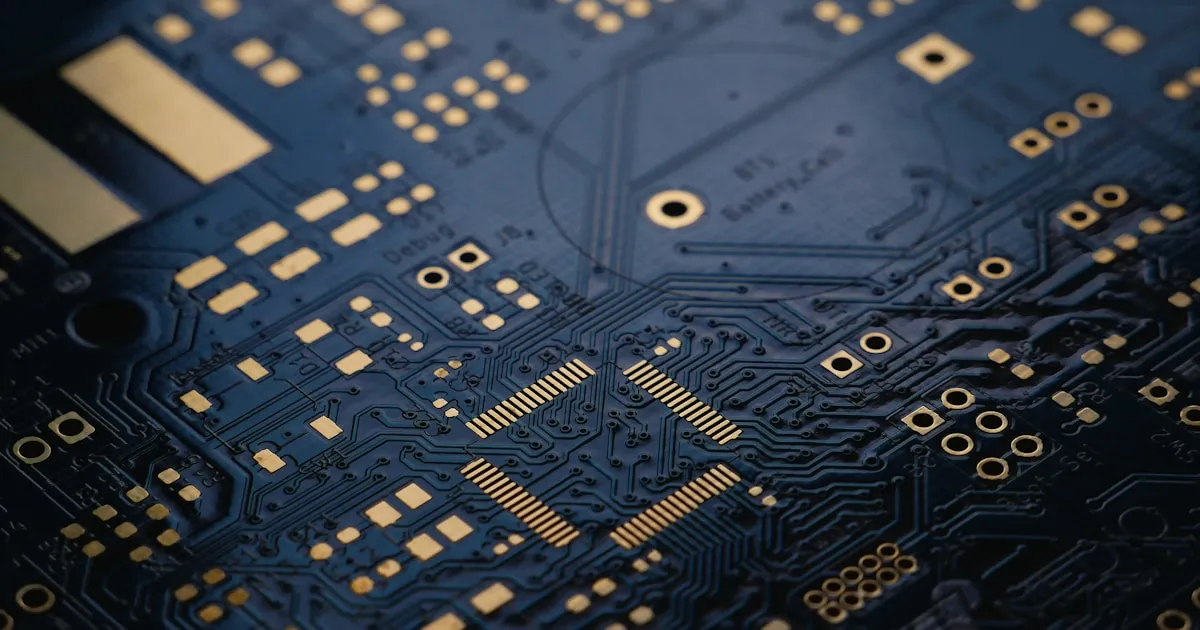
Image: Laura Ockel via Unsplash
Related: AtlasPCB maintains multi-source material agreements with Isola, Rogers, Shengyi, and Nan Ya PCB to ensure consistent availability for your production runs, even during tight supply conditions. Check Lead Times →
About AtlasPCB — We specialize in complex PCB manufacturing for HDI, RF, and high-reliability applications. Explore our impedance-controlled PCB manufacturing . Every order includes free engineering review. Get your quote.
Reviewed by AtlasPCB Engineering Team — IPC-certified manufacturing specialists with 15+ years of production experience in HDI, RF, and high-reliability PCB fabrication. Content based on factory floor data and real customer design reviews.
- news
- semiconductor
- chip sales
- trillion dollar
- PCB substrate
- IC substrate
- advanced packaging
- AI chips
- supply chain
- market growth