· AtlasPCB Engineering Team · News · 4 min read
Quilter Publishes Project Speedrun Results
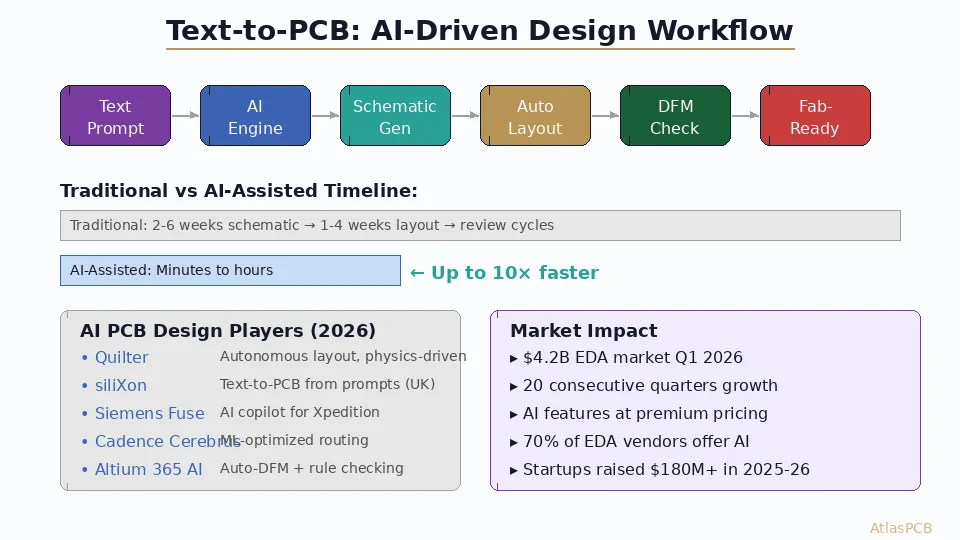
Quilter's Project Speedrun demonstrates end-to-end autonomous PCB layout producing a functional computer that boots and runs workloads — marking a milestone for AI-driven hardware design validation.

Quilter Proves AI-Designed Hardware Works in the Real World
Quilter, the autonomous PCB layout startup, has published the complete results of their “Project Speedrun” series — a multi-part documentation of an entire computer designed from schematic to fabricated and assembled board using their AI layout engine, culminating in successful power-on and real-workload validation.
The project, detailed across four blog posts on Quilter’s website, walks through:
- Preparing the design — uploading schematic and component data
- Compiling — the AI interpreting circuit intent and constraints
- Cleanup — a brief human pass to finalize for fabrication
- Validation — powering on, booting, and running real workloads
Why This Matters
Previous AI PCB layout demonstrations showed DRC-clean output and simulated performance. Project Speedrun is significant because it demonstrates the full pipeline to functional hardware:
- The board powers on without magic smoke
- The design boots an operating system
- It runs sustained workloads without signal integrity failures
- No respin was required — first-spin success
This represents a meaningful transition from “AI can route traces” to “AI can design hardware that works” — a gap that the industry has been watching closely since autonomous layout tools emerged in 2024.
Technical Approach
Quilter’s workflow for Project Speedrun:
- Input: Standard schematic netlist with component specifications
- Constraint extraction: The AI automatically identifies interface types (DDR, USB, power delivery), assigns impedance targets, and determines placement priorities
- Autonomous layout: Placement and routing performed entirely by AI, producing DRC-clean output
- Human cleanup: A precision pass addressing mechanical details (mounting holes, connector orientation, silkscreen) — described as taking a fraction of the layout time
- Fabrication and assembly: Standard PCB manufacturing and SMT assembly
- Validation: Electrical testing, power-on, and functional verification
The Cleanup Phase: What AI Still Needs Help With
Quilter is transparent that autonomous layout isn’t fully hands-off. The cleanup phase addresses:
- Mechanical integration with enclosures
- Silkscreen/legend label positioning
- Manufacturing-specific preferences (panel layout, fiducials)
- Aesthetic considerations for exposed boards
However, they characterize these as “brief precision passes” compared to the days or weeks the routing phase would require manually — suggesting the AI handles >90% of the layout effort.
Industry Implications
For Hardware Startups
The barrier to custom hardware just dropped significantly. Teams that previously needed $50,000-$100,000 in layout engineering resources (or months of founder time learning EDA tools) can potentially get from schematic to fabrication-ready design in days.
For PCB Fabricators
Expect an increase in:
- Unique board designs from smaller companies
- Faster iteration cycles (design → fab → test → redesign)
- More AI-optimized designs that may push standard manufacturing limits in unexpected ways
- Customers who are less familiar with manufacturing constraints (requiring more DFM feedback)
For EDA Incumbents
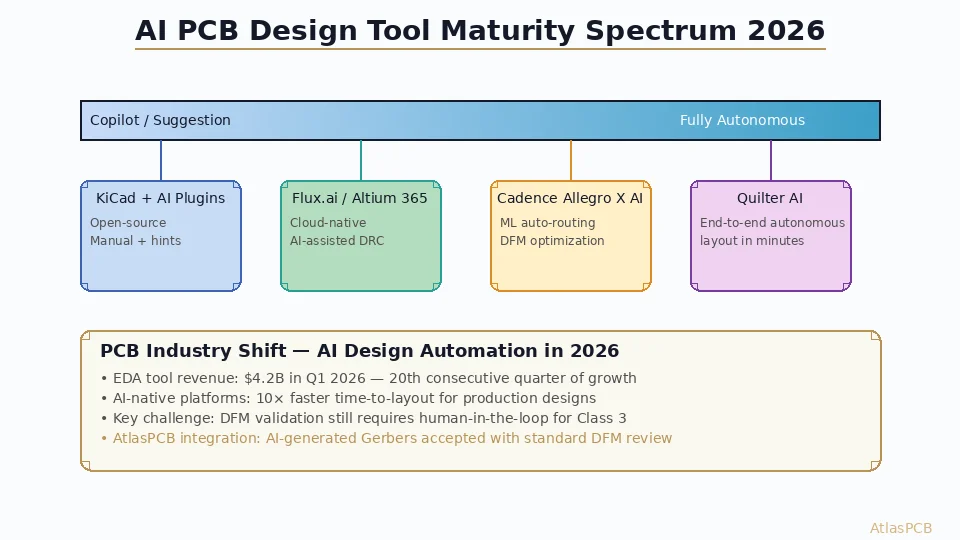
Quilter’s validation represents competitive pressure on traditional EDA tools. While Siemens, Cadence, and others are adding AI features to existing platforms, Quilter is demonstrating that ground-up autonomous design can produce working hardware — potentially disrupting the traditional license-heavy EDA business model.
For Layout Engineers
The role shifts from manual execution (placement and routing) toward:
- Design architecture and partition decisions
- Manufacturing liaison and DFM optimization
- Verification and validation of AI output
- Complex designs beyond current AI capability (RF, high-speed serial, mixed-signal)
What’s Next
Quilter has demonstrated capability on moderately complex digital boards. Key questions for 2026-2027:
- High-speed designs: Can AI handle 112G SerDes routing with all the tuning requirements? These interfaces demand precise length matching, impedance discontinuity management, and via optimization that pushes current AI boundaries
- Mixed-signal: Will the system correctly partition analog and digital domains? The sensitivity of precision analog circuits to digital noise requires nuanced understanding of electromagnetic behavior
- RF/microwave: Impedance matching networks, transmission line design, and substrate selection remain challenging because small geometry changes create large performance impacts
- Manufacturing awareness: Can the tool account for specific fabricator capabilities in real-time? Different factories have different minimum features, aspect ratios, and material availability
- Regulatory compliance: Can autonomous tools generate designs that meet IPC Class 3, automotive IATF 16949, or aerospace AS9100 requirements without explicit human review?
Broader Industry Trajectory
The autonomous PCB layout space is evolving at a pace comparable to the early days of computer-aided drafting replacing hand-drawn schematics. The parallel is instructive:
- CAD didn’t replace draftspeople overnight — it first handled simple tasks, then gradually expanded capability
- Eventually CAD became universal, and the role shifted from “person who draws” to “person who designs”
- Similarly, autonomous layout is first handling routine boards, and will gradually expand to more complex designs
- The engineer’s role will shift from “person who places and routes” to “person who architects and validates”
Within 3-5 years, it’s reasonable to expect that 60-80% of new PCB layouts will involve AI in a significant role — whether as full autonomy for simple boards or AI-assisted workflows for complex ones.
Source: Quilter Blog — Project Speedrun Series, 2026
Image: Possessed Photography via Unsplash
Related: Whether your PCB is designed by AI or seasoned engineers, AtlasPCB ensures fabrication quality with controlled impedance (±5% tolerance), 100% electrical testing, and free DFM review on every order. Upload Your AI-Designed Board →
About AtlasPCB — We specialize in complex PCB manufacturing for HDI, RF, and high-reliability applications. Explore our full PCB manufacturing capabilities . Every order includes free engineering review. Get your quote.
Reviewed by AtlasPCB Engineering Team — IPC-certified manufacturing specialists with 15+ years of production experience in HDI, RF, and high-reliability PCB fabrication. Content based on factory floor data and real customer design reviews.
- news
- Quilter
- AI PCB design
- autonomous layout
- hardware validation
- PCB manufacturing
- EDA
- machine learning
- design automation