· Thomas Webb · News · 6 min read
PCB Supply Chain Crisis Deepens
The global PCB supply chain faces its most severe disruption since COVID-19 as the Iran-Saudi conflict drives material shortages. Copper foil up 30%, epoxy resin lead times at 15 weeks, and PCB prices surging 40% in April alone. NCAB Group's May 2026 outlook warns of sustained constraints through H2.

The PCB industry is experiencing its most acute supply chain crisis since the COVID-19 pandemic, with multiple material shortages converging to create unprecedented pricing pressure and extended lead times. The May 2026 NCAB Group PCB Supply Chain Outlook warns procurement leaders to prepare for sustained constraints through the second half of 2026, while Goldman Sachs analysts report PCB prices surged as much as 40% in April alone.
Sources: The Silicon Review, NCAB Group, Reuters, April-May 2026
The Cascade of Shortages
PPE Resin Supply Disruption: The Trigger
The crisis traces back to early April, when military strikes on Saudi Arabia’s Jubail petrochemical complex halted production of high-purity polyphenylene ether (PPE) resin. The operator of the complex accounts for approximately 70% of the world’s high-purity PPE supply—the critical base material for manufacturing PCB laminates.
Six weeks after the attack, the operator has been unable to resume output. Shipping disruptions in the Gulf have compounded the problem, preventing even limited supply from reaching global customers. Industry sources indicate alternative suppliers may need 6-9 months to qualify and scale production to fill the gap.
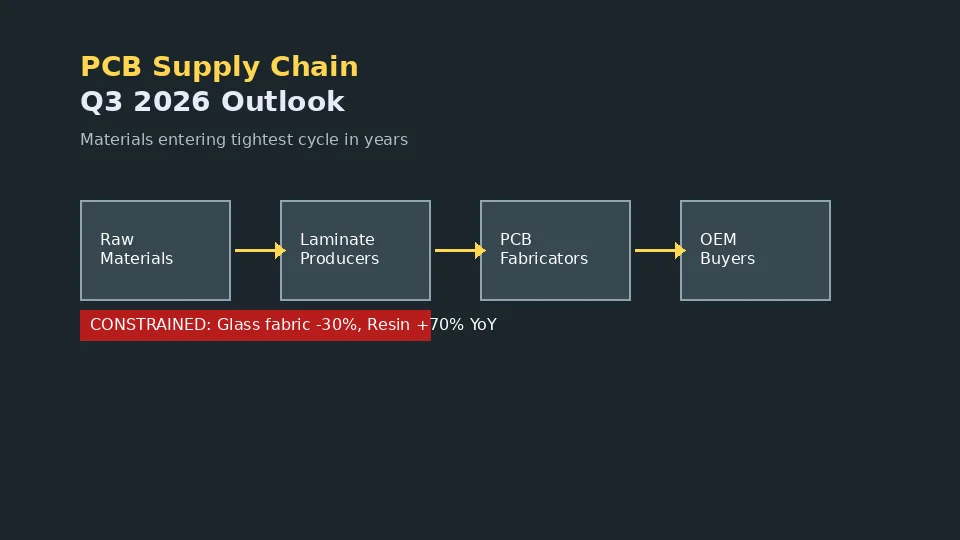
The impact is cascading through the entire laminate supply chain:
- Epoxy resin waiting times have stretched to 15 weeks (from 3 weeks previously)
- Laminate manufacturers report dwindling inventory with no near-term resupply
- Some CCL (Copper-Clad Laminate) suppliers have halted new customer orders entirely
Copper Foil: The Structural Squeeze
Beyond the PPE resin crisis, copper foil prices have surged 30% year-to-date, with the rally accelerating since March. Copper accounts for approximately 60% of total raw material costs in PCB manufacturing, making this increase particularly painful for fabricators already facing margin compression.
The copper foil shortage is driven by:
Demand-side pressure:
- AI server buildout consuming massive quantities of high-layer-count PCBs
- EV production growth requiring thick copper power electronics boards
- 5G infrastructure deployment continuing at scale
- Global PCB market growing 12.5% to reach $95.8 billion in 2026 (Prismark)
Supply-side constraints:
- New copper smelter capacity delayed by environmental permitting
- Energy cost increases in major copper foil producing regions
- Competition for electrodeposited copper foil between PCB and battery applications
- Some producers redirecting capacity to higher-margin battery foil
Glass Fiber: The Third Bottleneck
Glass fiber supply—the structural reinforcement in FR-4 and most PCB laminates—is also constrained. While not as acute as the PPE crisis, glass fabric lead times have extended by 3-4 weeks across major suppliers, adding further pressure to an already stressed supply chain.
Pricing Impact: $204-$1,970 per Square Meter
The material cost cascade has driven dramatic PCB price increases:
| PCB Type | Current Price ($/m²) | Change vs. Q4 2025 |
|---|---|---|
| Standard 2-4 layer | ~$204 | +35-40% |
| High-density multilayer (8-16L) | $500-900 | +25-35% |
| AI server PCBs (high-end) | ~$1,970 | +20-30% |
| IC substrates | $3,000-8,000 | +15-25% |
Data: Victory Giant Technology (PCB supplier for Nvidia), Goldman Sachs, Reuters
Daeduck Electronics, a major South Korean PCB maker supplying Samsung Electronics, SK Hynix, and AMD, has begun discussions with customers over price increases. A senior executive told Reuters that priorities have shifted “from meeting customer demand to securing supplier relationships.”
Who’s Absorbing the Cost?
The pricing dynamics vary dramatically by market segment:
Cloud hyperscalers (absorbing): Companies like Google, Microsoft, and Amazon are willing to accept PCB price increases because AI server demand far exceeds supply. Goldman Sachs analysts note that cloud providers “expect demand will outstrip supplies over the coming years” and are locking in capacity at premium prices.
Consumer electronics (passing through): Smartphone, laptop, and tablet manufacturers face a harder equation. PCB cost increases of 30-40% on boards that represent 5-15% of device BOM translate to 1.5-6% device cost increases—significant enough to affect retail pricing later this year.
Automotive (negotiating): Automotive Tier 1 suppliers are leveraging long-term contracts to delay price increases, but Q3-Q4 negotiations will reflect the new cost reality. The automotive segment’s smaller PCB volumes (relative to consumer electronics) give it less pricing power.
Industrial/medical (vulnerable): Smaller-volume buyers without long-term supply agreements face the worst of the squeeze—spot market pricing, allocation-based supply, and lead time uncertainty.
Strategic Implications for Hardware Companies
Near-Term Actions (May-June 2026)
- Audit current inventory: Identify PCB orders in pipeline and assess material coverage
- Extend planning horizons: Move from 4-week to 12-16 week order forecasts
- Qualify alternative laminates: Work with PCB manufacturers to approve lower-risk substitutes
- Lock supply agreements: Commit to volumes with preferred manufacturers to secure allocation
- Review BOM flexibility: Identify designs that can accept alternative PCB constructions
Medium-Term Strategy (H2 2026)
Material diversification:
- Qualify multiple laminate systems per design (not just one primary)
- Consider material substitution where performance allows (e.g., mid-Tg where high-Tg specified but not needed)
- Work with manufacturers who maintain relationships with multiple CCL suppliers
Design optimization:
- Reduce layer count where possible (significant material cost reduction)
- Optimize panel utilization to maximize yield from scarce material
- Consider alternative constructions (reduce copper weight where current capacity permits)
Supply chain resilience:
- Develop relationships with PCB manufacturers in multiple geographies
- Maintain safety stock of critical long-lead-time PCBs
- Consider consignment arrangements for critical materials
PCB Market Growth Continues Despite Disruption
Despite the supply chain turmoil, underlying demand remains strong. Prismark projects the global PCB industry will reach $95.8 billion in 2026, growing 12.5% year-over-year. The growth is concentrated in high-end segments:
- AI/HPC PCBs: Market doubling from $5.6B (2025) to $10B (2026)
- Automotive electronics: Sustained growth from electrification and ADAS
- 5G infrastructure: Continued base station deployment in emerging markets
- Advanced packaging substrates: IC substrate demand growing 20%+ annually
This demand-supply imbalance explains why prices are rising so sharply—reduced supply meeting growing demand creates a seller’s market where allocation decisions matter more than pricing.
AtlasPCB’s Response to Supply Chain Constraints
Material Security Measures
AtlasPCB has implemented proactive measures to protect customer delivery commitments:
Strategic inventory: Pre-positioned laminate inventory covering 8-12 weeks of production for standard material systems, insulating customers from spot-market volatility.
Multi-supplier qualification: Active qualification of 3+ CCL suppliers per material category, enabling rapid substitution when primary sources face allocation constraints.
Early warning system: Real-time monitoring of supplier inventory levels and lead time changes, enabling proactive customer communication before orders are impacted.
Customer Support During the Crisis
Lead time transparency: Regular updates on material availability and realistic delivery projections.
Design optimization consultation: Free DFM review focused on material substitution opportunities—identifying where alternative laminates can reduce cost and lead time without performance compromise.
Flexible scheduling: Priority queuing for customers with confirmed material availability, maximizing throughput efficiency.
Volume commitment programs: Preferential pricing and guaranteed allocation for customers providing rolling 12-week forecasts.
Outlook: When Does Relief Arrive?
Industry consensus suggests the current acute crisis will ease gradually:
Q3 2026: Alternative PPE resin suppliers begin limited qualification shipments. Copper foil prices stabilize as new smelter capacity reaches commissioning phase.
Q4 2026: Laminate supply recovers to 70-80% of pre-crisis levels. Pricing remains elevated but stops increasing.
Q1 2027: Full supply chain recovery expected only if Gulf shipping lanes normalize and no additional supply disruptions occur.
The critical variable remains the geopolitical situation in the Middle East. Further escalation could extend the crisis well into 2027, while de-escalation would accelerate recovery timelines.
Navigating PCB supply chain challenges? AtlasPCB’s procurement team has secured material allocation for standard and high-performance laminates through Q3 2026. Contact us for current lead times and material availability for your specific requirements.
About AtlasPCB — We specialize in complex PCB manufacturing for HDI, RF, and high-reliability applications. Explore our instant online PCB quote . Every order includes free engineering review. Get your quote.
Reviewed by AtlasPCB Engineering Team — IPC-certified manufacturing specialists with 15+ years of production experience in HDI, RF, and high-reliability PCB fabrication. Content based on factory floor data and real customer design reviews.
- industry news
- PCB supply chain
- copper foil
- resin shortage
- material pricing
- procurement