· AtlasPCB Engineering Team · News · 3 min read
NCAB Group May 2026 Outlook
NCAB Group's latest supply chain report confirms the PCB industry has shifted to a seller's market — with AI infrastructure demand, material shortages, and capacity constraints creating the most challenging procurement environment since 2021.
PCB Supply Chain Officially in Seller’s Market Territory
NCAB Group, one of the world’s largest PCB trading companies, has released its May 2026 supply chain outlook confirming what procurement teams have felt for months: the PCB industry has entered a full seller’s market, with no near-term relief in sight.
The report, available on NCAB’s website, identifies AI technology requirements as the primary catalyst for the shift. High-layer multilayer boards, HDI designs, low-loss/low-Df materials, and high-speed PCBs have pushed factory utilization to unprecedented levels — creating spillover effects even for factories not directly producing AI-grade products.
Key Findings from the May 2026 Report
According to NCAB’s analysis and corroborating market data:
Demand drivers:
- AI data center buildout absorbing premium capacity globally
- Spillover demand affecting standard PCB production as materials tighten
- Power supply, thermal management, and supporting hardware boards competing for the same factory resources
- Logistics disruptions from regional fuel concerns adding unpredictability
Supply constraints:
- Factory utilization at unprecedented levels for high-tech segments
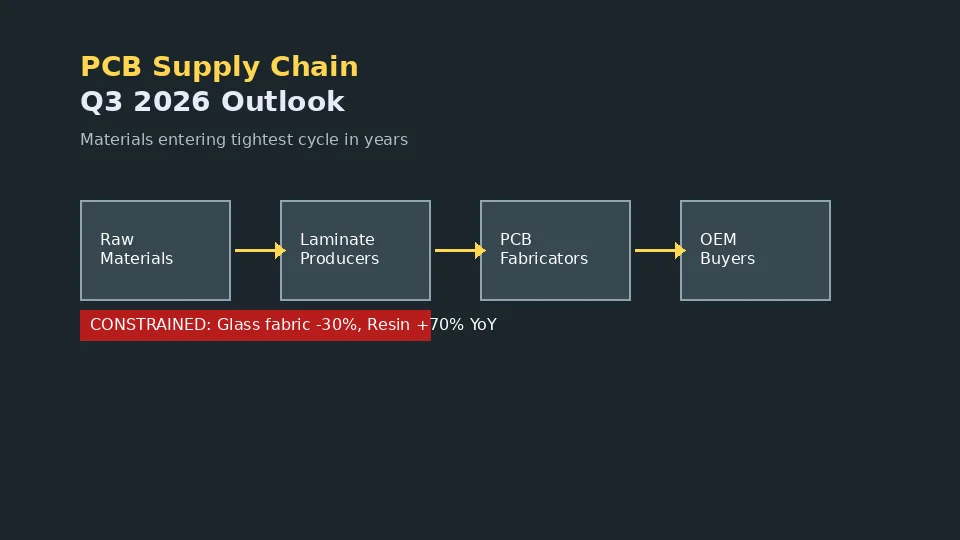
- Material allocations tightening (copper, glass fiber, specialty resins)
- Lead times extending across all complexity levels
- Annual pricing frameworks becoming unviable as costs shift quarterly
NCAB’s assessment: “The immediate outlook does not indicate any improvement or relief. Allocations are tightening, lead times are extending, and factories no longer have the material availability they once relied on.”
What’s Driving the Shift
The seller’s market isn’t simply about increased volume — it’s a structural rebalancing:
AI Infrastructure Demand
Every major cloud provider (Google, Microsoft, Amazon, Meta, Oracle) is simultaneously expanding AI compute capacity. Each AI server requires:
- 1× main motherboard (20–28 layers, low-loss material)
- 4–8× GPU module substrates (ABF or high-layer HDI)
- 2–4× networking switch boards (ultra-low-loss, controlled impedance)
- 10–20× power delivery boards
- Memory module PCBs for HBM packaging
This demand pyramid means one AI server generation consumes 40–60 PCBs across the system — mostly at the highest complexity tier.
Material Cascade Effect
When premium materials (low-Dk prepregs, HVLP copper foils, specialty glass cloths) are allocated to AI products, standard products that previously used the same supply chains face shortages. Even standard 4-layer FR-4 boards are seeing extended lead times because glass fiber and copper foil production can’t serve both markets simultaneously.
Capacity vs Investment Timing
PCB fabricators are investing in new capacity (as evidenced by Nan Ya PCB’s record ¥10B+ capex plan and Unimicron’s expansion), but new production lines take 18–24 months from investment decision to volume output. Current demand growth is outpacing the capacity pipeline.
Implications for Procurement Teams
NCAB’s report outlines strategies for navigating the seller’s market:
- Abandon annual pricing assumptions — negotiate quarterly reviews or index-based pricing tied to material costs
- Extend planning horizons — commit to orders 8–12 weeks ahead (vs typical 4–6 weeks)
- Diversify supplier base — single-sourcing creates vulnerability in allocation-tight markets
- Design for supply chain — material substitution flexibility built into designs (multiple approved laminates, wider process windows)
- Engage fabricators early — capacity reservation during design phase, not after tapeout
NCAB’s Own Performance Reflects the Market
The supply dynamics have benefited NCAB’s business. The company’s Q1 2026 results (reported via iConnect007) showed double-digit revenue growth, a surge in order intake, and improved profitability — indicating strong demand flowing through to intermediaries and fabricators.
How AtlasPCB Is Responding
As a PCB manufacturing partner, AtlasPCB has taken several steps to protect customer supply chains:
- Material pre-positioning — maintaining 4–6 weeks of safety stock on popular FR-4 and low-loss laminates
- Multi-factory allocation — distributing production across facilities to reduce single-point-of-failure risk
- Transparent lead time updates — weekly updates on current production timelines by technology tier
- Design optimization for availability — engineering team can suggest material alternatives that meet specs without supply chain risk
For customers with upcoming projects requiring HDI, high-layer-count, or low-loss material boards, we recommend engaging 2–3 weeks earlier than historical norms to secure capacity allocation.
Source: NCAB Group PCB Supply Chain Outlook May 2026, iConnect007
Image: CHUTTERSNAP via Unsplash
About AtlasPCB — We specialize in complex PCB manufacturing for HDI, RF, and high-reliability applications. Explore our quick-turn PCB manufacturing from 24 hours . Every order includes free engineering review. Get your quote.
Reviewed by AtlasPCB Engineering Team — IPC-certified manufacturing specialists with 15+ years of production experience in HDI, RF, and high-reliability PCB fabrication. Content based on factory floor data and real customer design reviews.
- news
- pcb supply chain
- ncab group
- seller market
- procurement
- lead time
- ai demand
- material shortage