· Thomas Webb · News · 4 min read
Kyocera Unveils Multilayer Ceramic Core Substrate
Kyocera announces a breakthrough multilayer ceramic core substrate offering superior rigidity and circuit miniaturization for next-gen AI chips, addressing warpage challenges in large 2.5D packages for data centers and ASICs.
Kyocera Corporation has announced the commercialization of a new multilayer ceramic core substrate designed for advanced semiconductor packages — specifically targeting the AI accelerators and switch ASICs that are rapidly scaling in complexity. The technology will be officially unveiled at ECTC 2026 (Electronic Components and Technology Conference) in Orlando, Florida, May 26-29.
Source: Kyocera Corporation Newsroom, April 27, 2026; BusinessWire
The Warpage Problem in AI Chip Packaging
As AI processors grow larger and more complex — NVIDIA’s next-gen GPUs, Google’s TPUs, and custom hyperscaler ASICs — their packages are pushing the physical limits of organic substrate materials. The fundamental challenge: warpage.
Large 2.5D packages (60mm × 60mm and beyond) using traditional organic ABF substrates experience significant deformation during thermal cycling. This warpage causes:
- Solder joint reliability failures at BGA interfaces
- Die cracking in multi-chiplet configurations
- Assembly yield loss during flip-chip attachment
- Long-term field failures from thermal fatigue
Kyocera’s ceramic solution directly addresses these challenges with materials engineered for rigidity at scale.
Key Features of Kyocera’s Ceramic Core Substrate
Built from Kyocera’s proprietary Fine Ceramic materials, the new substrate offers three differentiating capabilities:
1. Superior Rigidity (Anti-Warpage)
The multilayer ceramic structure provides dramatically higher mechanical stiffness than organic alternatives. For large packages where ABF substrates flex and warp during thermal excursions, the ceramic core maintains flatness throughout assembly and operation — critical for maintaining solder joint co-planarity across 1000+ BGA balls.
2. High-Density 3D Wiring
The multilayer ceramic construction enables:
- Via diameter: 75µm (matching or exceeding organic HDI capability)
- Via pitch: 200µm (enabling escape routing from fine-pitch flip-chip bumps)
- Three-dimensional routing that reduces lateral space requirements
- Controlled impedance through precise dielectric thickness control
3. Custom Design and Simulation Support
Kyocera offers performance simulations during the design phase, allowing package designers to:
- Predict warpage behavior before fabrication
- Optimize layer stack-up for signal integrity
- Validate thermal performance under operating conditions
- Iterate designs quickly using modeling rather than silicon
Why This Matters for the PCB Industry
Kyocera’s ceramic core substrate sits at the intersection of PCB technology and semiconductor packaging — a convergence that’s accelerating as chip complexity grows:
The Glass vs. Ceramic vs. Organic Substrate Race
2026 is shaping up as a pivotal year for advanced substrate technology:
- Intel is pursuing glass core substrates for next-gen processors
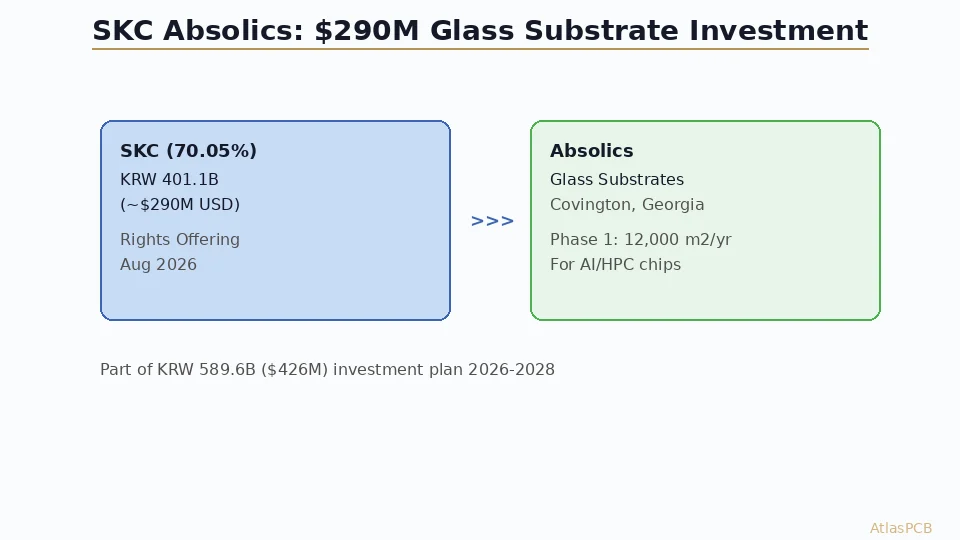
- Samsung and Absolics are investing billions in glass substrate capacity
- Kyocera now offers ceramic as a third option with proven manufacturing maturity
Each approach has trade-offs: glass offers CTE matching and large-panel scalability, ceramics provide superior rigidity and established reliability data, and organic substrates remain cost-competitive for mainstream applications.
Implications for PCB Manufacturers
As chiplet architectures drive substrate complexity upward, PCB manufacturers must understand how their products interface with these advanced substrates:
- Motherboard-to-socket interfaces must accommodate the mechanical properties of new substrate materials
- Interposer PCBs require matching CTE characteristics to prevent stress at the attachment interface
- Test board design must account for the electrical characteristics of ceramic vs. organic substrates
Connection to PCB Manufacturing
While ceramic core substrates operate at the IC packaging level, they directly influence PCB requirements:
- Power delivery architecture — Rigid substrates enable better power plane designs that reduce noise coupling to the motherboard PCB
- Signal breakout routing — Finer-pitch substrates mean more channels need routing on the PCB, driving HDI adoption
- Thermal management — Ceramic’s thermal conductivity differs from organic, requiring PCB-level thermal solutions to compensate
Market Implications: The ECTC 2026 Timeline
The timing of Kyocera’s announcement — ahead of ECTC 2026 in late May — signals that commercial availability is imminent rather than years away. Key market implications:
For chip designers: Ceramic core substrates unlock package sizes and integration densities that organic substrates cannot support. Expect to see new AI accelerator package roadmaps leveraging this technology within 12-18 months.
For PCB designers: As chip packages grow larger and pin counts increase (beyond 10,000 BGA balls), motherboard routing complexity escalates. HDI via-in-pad technology and any-layer PCB designs become mandatory rather than optional.
For procurement teams: The substrate technology race (glass vs. ceramic vs. organic) will create supply chain complexity. Teams should track which substrate technology their key chip suppliers adopt to ensure compatible PCB specifications.
The semiconductor packaging industry is clearly signaling that organic substrates alone cannot support the next generation of AI hardware. Whether glass, ceramic, or hybrid approaches win will depend on cost, reliability data, and ecosystem readiness — but the direction is unmistakable.
At AtlasPCB, we manufacture the high-performance PCBs that these advanced packages mount onto — from 30+ layer server boards to impedance-controlled high-speed designs that preserve signal integrity from chip to connector.
Building hardware that interfaces with next-gen AI chip packages? Contact AtlasPCB for expert consultation on high-layer-count, impedance-controlled PCB manufacturing for advanced semiconductor applications.
About AtlasPCB — We specialize in complex PCB manufacturing for HDI, RF, and high-reliability applications. Explore our impedance-controlled PCB manufacturing . Every order includes free engineering review. Get your quote.
Reviewed by AtlasPCB Engineering Team — IPC-certified manufacturing specialists with 15+ years of production experience in HDI, RF, and high-reliability PCB fabrication. Content based on factory floor data and real customer design reviews.
- industry news
- Kyocera
- ceramic substrate
- AI chips
- semiconductor packaging
- ECTC 2026
- 2.5D packaging
- warpage