· David Okafor · News · 8 min read
IPC-CFX Standard Gains Momentum
IPC Connected Factory Exchange (IPC-CFX / IPC-2591) adoption is accelerating in PCB fabrication plants, enabling real-time machine-to-machine data exchange and full lot traceability — a game-changer for aerospace, medical, and automotive Class 3 board quality.
Quick Answer
IPC-CFX (IPC-2591) adoption is accelerating in PCB fabrication, with major manufacturers implementing machine-to-machine data exchange for full lot traceability from raw material to finished board. This Industry 4.0 capability is particularly valuable for Class 3 aerospace, medical, and automotive PCBs where defect root cause analysis and regulatory compliance demand complete process documentation.
IPC-CFX Standard Gains Momentum: Smart Factory Traceability Reaches PCB Fabrication
For decades, PCB fabrication has been one of the most process-intensive segments of electronics manufacturing — and one of the least digitally connected. A typical multilayer PCB passes through 40 to 60 discrete process steps across drilling, lamination, imaging, etching, plating, soldermask, surface finishing, and electrical testing. At most fabrication plants, the data from these processes lives in isolated silos: each machine logs its own parameters, but connecting that data into a coherent, lot-level traceability record has been a manual, error-prone, and incomplete effort.
That is changing. IPC-CFX — the Connected Factory Exchange standard, formally designated IPC-2591 — is bringing standardized machine-to-machine communication to PCB fabrication floors. And in 2026, adoption has reached an inflection point.
What IPC-CFX Actually Does
IPC-CFX defines a publish-subscribe messaging protocol based on AMQP (Advanced Message Queuing Protocol) that enables factory equipment to broadcast structured data about what it’s doing, what it’s processing, and what results it’s producing — without requiring proprietary integrations between each pair of machines.
In practical terms, a CFX-enabled PCB fabrication line works like this:
- A lamination press publishes a message when it starts a cycle: panel ID, recipe parameters (temperature, pressure, dwell time), and timestamp.
- The CNC drilling machine receives the panel, reads its ID (via barcode or RFID), and publishes drill parameters: spindle speed, hit count, tool wear data, and positional accuracy for each hole.
- The electroless copper plating line logs immersion time, bath chemistry (temperature, pH, copper concentration), and the specific tank sequence for that panel.
- The direct imaging system records alignment accuracy, exposure parameters, and any defect flags from in-line inspection.
- The automated optical inspection (AOI) system publishes defect maps with coordinates, defect classification, and pass/fail status.
All of this data flows to a central message broker and is stored in a structured database, creating a complete digital thread for every panel — from raw laminate receiving to final electrical test.
From Assembly to Fabrication: CFX’s Expanding Scope
IPC-CFX was originally developed for SMT assembly lines, where it gained traction with pick-and-place machines, reflow ovens, and solder paste inspection systems. The extension to PCB fabrication — the “upstream” of electronics manufacturing — is a more recent and more challenging development.
The challenge is twofold. First, PCB fabrication equipment is more heterogeneous than assembly equipment. A fabrication plant might have drilling machines from Schmoll and Hitachi, imaging systems from Orbotech and SCREEN, plating lines from Atotech and a local integrator, and lamination presses from Bürkle and JSW. Each vendor has its own data formats, communication protocols, and levels of digital maturity.
Second, the process environment is harsher. PCB fabrication involves wet chemistry, high temperatures, mechanical vibration, and conductive fluids — none of which are friendly to sensors and communication infrastructure. Retrofitting CFX connectivity to a 15-year-old plating line requires hardened interfaces and often intermediate gateway devices.
Despite these challenges, progress in 2025–2026 has been substantial:
- Orbotech/KLA has integrated CFX messaging into its direct imaging and AOI platforms, covering two of the most data-rich process steps in fabrication.
- Schmoll Maschinen and Posalux have added CFX interfaces to their CNC drilling platforms, enabling real-time reporting of drill parameters and tool lifecycle data.
- Atotech/MKS Instruments has developed CFX-compatible monitoring modules for its plating and surface treatment lines, capturing bath chemistry and process timing data.
- Ucamco, maker of the Integr8tor CAM platform, has built CFX bridges that connect the digital design data (Gerber, ODB++, IPC-2581) with the physical manufacturing process data, enabling design-to-fabrication traceability.
- Bürkle has implemented CFX in its latest-generation lamination presses, publishing cure profile data for each press cycle.
IPC reports that over 70 equipment vendors have demonstrated CFX-compliant interfaces at trade shows and customer installations as of early 2026, compared to fewer than 30 in 2023.
The Quality Case: Why Class 3 Boards Drive Adoption
The strongest business case for IPC-CFX in PCB fabrication comes from high-reliability applications governed by stringent quality standards:
Aerospace and defense boards manufactured to [IPC Class 3 standards]/blog/ipc-standards-pcb-classes/) and AS9100 quality management requirements demand complete process traceability. When a field failure occurs in an avionics system, the investigation must trace back to the specific PCB lot, the specific process parameters used at each fabrication step, and any deviations from the qualified process. Before CFX, this traceability relied on paper travelers, manual data entry, and siloed machine logs — an approach that was slow, incomplete, and susceptible to human error.
Medical device PCBs manufactured under [ISO 13485 and FDA 21 CFR Part 820]/blog/medical-pcb-manufacturing-requirements/) face similar traceability requirements. The FDA’s increasing focus on digital quality management systems (as outlined in the 2023 QMSR final rule harmonizing with ISO 13485) is pushing medical PCB suppliers toward automated data collection. CFX provides a standardized framework for this automation.
Automotive PCBs under IATF 16949 require process capability monitoring (Cpk tracking) and statistical process control (SPC) across all critical parameters. CFX enables real-time Cpk calculation by streaming process data continuously rather than relying on periodic sampling.
For all three sectors, the value proposition is the same: CFX transforms traceability from a documentation burden into a continuous, automated data stream that improves quality while reducing compliance overhead.
Defect Root Cause Analysis: The Killer Application
Beyond compliance, CFX’s most transformative application is defect root cause analysis (RCA). Consider a real-world scenario:
A [reliability test]/blog/pcb-reliability-testing/) reveals that a batch of 16-layer military-spec boards has elevated microsection void rates in specific via barrels. Without CFX, the investigation involves:
- Identifying which panels are affected (from final test data).
- Manually pulling lamination records to check press parameters.
- Reviewing drilling logs to check drill parameters and tool condition.
- Checking plating line records for that time period.
- Cross-referencing all data to find correlations.
This process typically takes 2–5 days and often fails to find a definitive root cause because the data granularity is insufficient or records are incomplete.
With CFX, the same investigation works like this:
- Query the traceability database with the affected panel IDs.
- The system automatically returns complete process records for every step, time-stamped and linked to specific machine states.
- A correlation analysis reveals that all affected panels passed through Plating Tank 3 during a 4-hour window when the copper concentration dipped below the process specification lower limit — the bath chemistry data was logged automatically by the CFX-connected plating monitor.
- Root cause identified in minutes, not days.
This capability fundamentally changes the economics of quality. Instead of investigating failures after the fact, fabricators can detect process excursions in real time and quarantine affected panels before they reach downstream processes.
Implementation Challenges
Adopting CFX in PCB fabrication is not plug-and-play. The practical challenges include:
Legacy equipment integration. Most fabrication plants operate equipment ranging from brand-new to 20+ years old. Older machines lack native network connectivity, let alone CFX interfaces. Retrofit solutions — typically involving external sensors, PLCs (programmable logic controllers), and edge gateway devices — add cost and complexity. Industry estimates suggest that full CFX retrofit of an existing fabrication line costs $200K–$500K, depending on the number of machines and their digital readiness.
Data volume and management. A CFX-connected fabrication line generates substantial data volumes. A single CNC drilling machine processing 200 panels per day, each with 50,000 holes, generates millions of data points daily. Fabricators must invest in industrial data infrastructure — message brokers, time-series databases, and analytics platforms — to handle this volume.
Cybersecurity. Connecting factory equipment to a network introduces cybersecurity risks. IPC-CFX includes provisions for encrypted communication and authentication, but implementing robust cybersecurity in an OT (operational technology) environment requires specialized expertise.
Cultural change. Perhaps the most underappreciated challenge is organizational. CFX makes process deviations visible — immediately and to everyone. This transparency is powerful for quality improvement but can be threatening in organizations accustomed to manual reporting and informal process adjustments.
The Broader Industry 4.0 Context
IPC-CFX is one piece of a larger Industry 4.0 transformation in PCB fabrication. Related developments include:
- Digital twin modeling of fabrication processes, using CFX data to build predictive models of yield, quality, and equipment health.
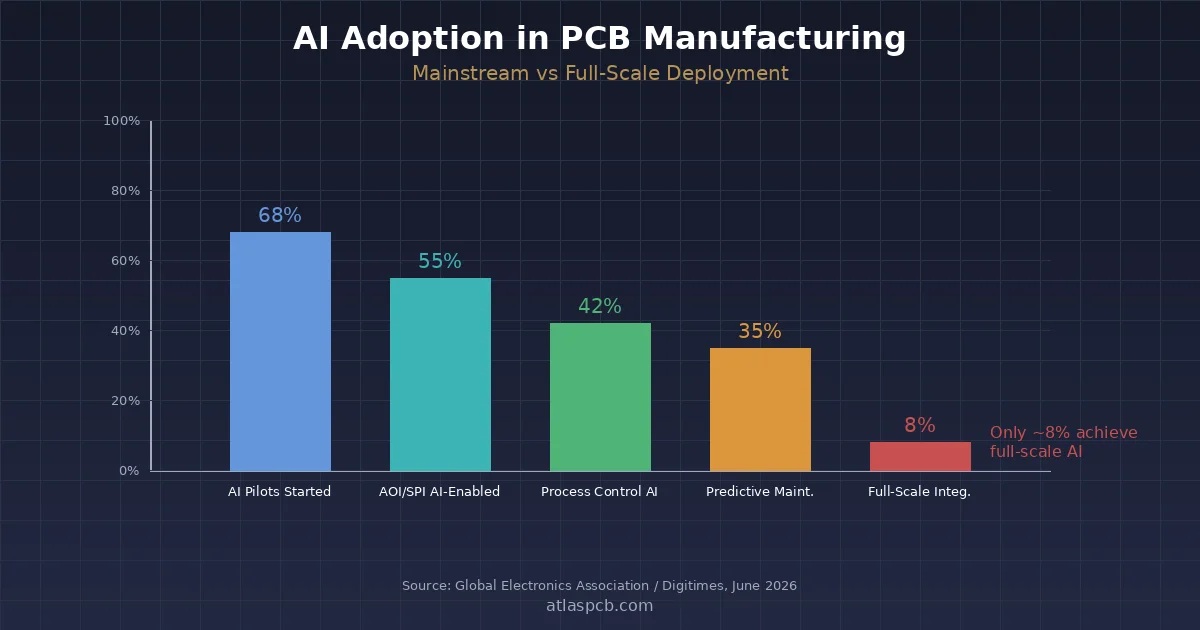
- AI-driven process optimization, where machine learning algorithms analyze CFX data streams to recommend parameter adjustments that improve yield or reduce defect rates.
- Customer-facing transparency portals, where OEMs can access real-time production status and quality data for their orders — a service differentiator that several advanced fabricators are piloting.
What This Means for PCB Buyers
For engineers and procurement teams specifying PCBs in 2026, CFX adoption is becoming a meaningful differentiator in fabricator selection:
- For Class 3 applications, ask about CFX. Fabricators with CFX-connected lines can provide more complete traceability documentation, faster RCA turnaround, and stronger evidence of process control.
- Real-time quality visibility is achievable. Some fabricators now offer customer portals showing live production status and quality metrics for active orders.
- CFX is a proxy for digital maturity. A fabricator investing in CFX is also likely investing in modern equipment, trained personnel, and continuous improvement — all indicators of manufacturing excellence.
At Atlas PCB, we are committed to smart factory principles and implement comprehensive traceability systems that ensure every board we produce can be traced back to specific process parameters, material lots, and quality data — meeting the demands of the most stringent aerospace, medical, and automotive applications.
Ready to start your project? Upload your Gerbers for a free engineering review, or talk to an engineer about your design requirements.
About AtlasPCB — We specialize in complex PCB manufacturing for HDI, RF, and high-reliability applications. Explore our full PCB manufacturing capabilities . Every order includes free engineering review. Get your quote.
Reviewed by AtlasPCB Engineering Team — IPC-certified manufacturing specialists with 15+ years of production experience in HDI, RF, and high-reliability PCB fabrication. Content based on factory floor data and real customer design reviews.
Frequently Asked Questions
What is IPC-CFX and how does it apply to PCB fabrication?
Why is IPC-CFX important for Class 3 PCB manufacturing?
Which PCB equipment manufacturers support IPC-CFX?
- industry-news
- ipc-cfx
- smart-factory
- traceability
- industry-4-0