· Thomas Webb · News · 5 min read
Glass Substrates vs Organic PCB Packaging
Intel and Samsung accelerate glass-core substrate production for AI chip packaging, challenging organic ABF materials with near-silicon CTE matching and sub-2-micron interconnects.

The Organic Substrate Era Hits Its Physical Limit
After three decades of faithful service, organic resin-based packaging substrates (primarily Ajinomoto Build-up Film, or ABF) are hitting what industry analysts now call the “Warpage Wall” — the point where thermal expansion mismatch between silicon dies and organic substrates makes reliable interconnection at advanced nodes physically untenable.
The 2026 pivot to glass-core substrates represents the most significant materials transition in semiconductor packaging since the move from ceramic to organic packages in the 1990s. Intel, Samsung Electro-Mechanics, and startup Absolics are leading the charge, with production-ready glass substrate technology now emerging from pilot lines into volume manufacturing.
Why Organic Substrates Are Failing
The fundamental problem is thermal expansion mismatch. Organic ABF substrates have a Coefficient of Thermal Expansion (CTE) of 14-17 ppm/°C — roughly 4× higher than silicon’s 2.6 ppm/°C. When AI accelerator packages grow to reticle-size dimensions (800+ mm²) and require co-packaging with HBM3e/4 memory stacks, this mismatch creates warpage exceeding acceptable limits during reflow soldering.
The consequences cascade:
- Solder joint failure — C4/micro-bump connections crack under cyclic thermal stress
- Signal integrity degradation — warpage changes micro-bump heights non-uniformly, creating impedance variations
- Die cracking — extreme cases see silicon fracture from substrate-induced stress
- Yield loss — large packages on organic substrates already suffer 5-15% assembly yield loss attributed to warpage
Glass changes the equation fundamentally. With a CTE of 3-7 ppm/°C (tunable through composition), glass substrates nearly match silicon’s thermal behavior. The result: ultra-flat packages that maintain planarity through reflow, enabling reliable sub-2-micron interconnect pitches that organic substrates simply cannot support.
Intel: Glass-Core Meets EMIB
By early 2026, Intel has officially integrated glass-core substrates with its Embedded Multi-die Interconnect Bridge (EMIB) technology, targeting the data center AI accelerator market. Intel’s internal data suggests glass-core packages deliver:
- 40% better signal propagation speed — glass has lower dielectric loss than organic resin at high frequencies
- 50% reduction in power leakage — tighter interconnect pitches reduce parasitic capacitance
- 2× interconnect density — sub-2 μm line/space on glass vs 5 μm minimum on organic
Intel’s approach uses a thick glass core (150-300 μm) with through-glass vias (TGVs) providing vertical interconnection. Build-up layers on both sides of the glass core use conventional semi-additive processes for fine-line routing. The EMIB bridges, embedded within the glass core, provide high-bandwidth die-to-die connections without the cost of a full silicon interposer.
Samsung Electro-Mechanics: Sejong Mass Production
Samsung Electro-Mechanics has accelerated equipment installation at its Sejong, South Korea facility, with glass substrate pilot production beginning in Q1 2026 and volume ramp planned for late 2026. Samsung’s strategy differs from Intel’s:
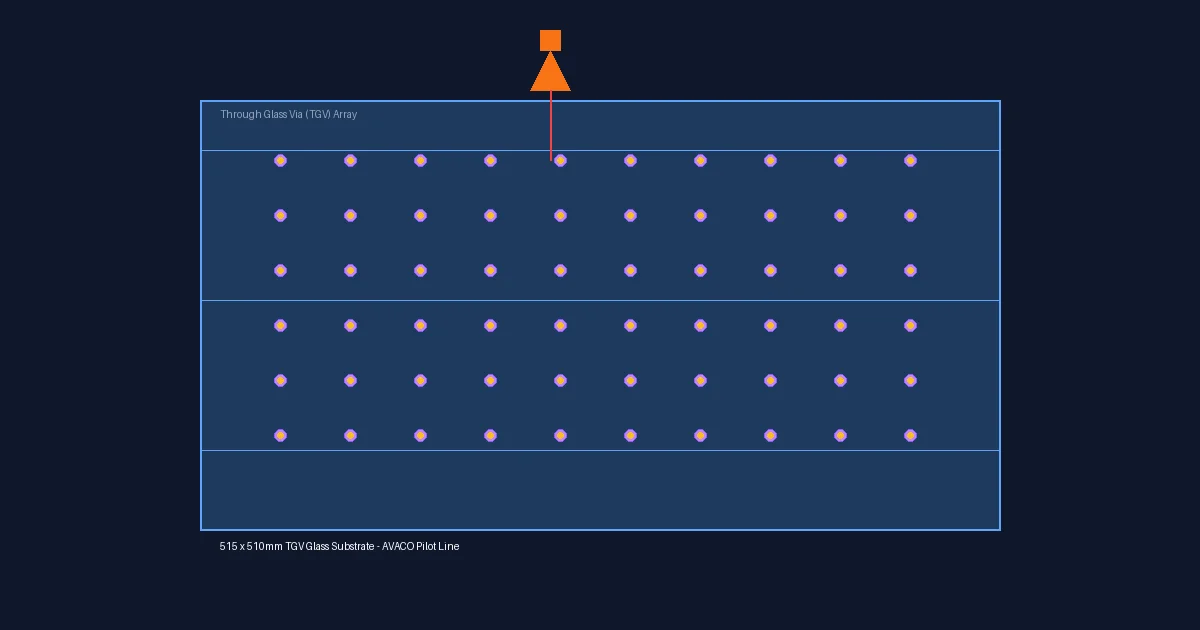
- Focus on panel-level processing (510×515 mm panels vs wafer-level) for cost efficiency
- Target HBM memory packaging first, where CTE matching is most critical
- Use thinner glass (100-150 μm) for mobile and wearable applications
- Partnership with Corning for specialized glass compositions optimized for TGV drilling
Samsung’s fab-in-a-package (FiP) concept integrates glass substrates with their fan-out panel-level packaging (FOPLP) technology, potentially enabling complete system integration at the substrate level.
Absolics: The Georgia Wild Card
Absolics (a SKC subsidiary) operates what may be the world’s first dedicated glass substrate factory in Covington, Georgia, USA. Backed by $600M+ in investment and incentives under the CHIPS Act, Absolics aims to provide the Western hemisphere’s glass substrate supply base for defense, AI, and automotive applications.
Their facility targets:
- Annual capacity of 12M glass substrate units by 2027
- Support for Intel, AMD, and NVIDIA next-generation packages
- Localized supply chain reducing dependence on Asian manufacturing
Through-Glass Via (TGV) Technology
The enabling technology for glass substrates is Through-Glass Vias — vertical interconnections drilled through the glass core:
Drilling methods:
- UV laser ablation — production-ready, 20-50 μm via diameter
- Photo-etchable glass — Schott FLEXINITY process, lithographically defined vias
- Sand blasting + laser — hybrid approach for high aspect ratios
TGV challenges:
- Glass brittleness requires careful handling and processing
- Via metallization adhesion to glass surfaces needs specialized seed layers
- Residual stress management during via filling
- Inspection difficulty (glass transparency complicates optical methods)
Current TGV pitch capability: 100-200 μm in production, with 50 μm demonstrated in research — already exceeding organic substrate through-hole capabilities.
Impact on the PCB Industry
Glass substrates won’t replace traditional PCBs for the foreseeable future — they target the highest-performance segment where organic materials physically cannot meet requirements. However, the implications ripple outward:
For PCB substrate manufacturers:
- ABF film suppliers (Ajinomoto) face demand erosion at the high end
- Traditional buildup substrate makers must develop glass-compatible processes
- Test and inspection equipment needs adaptation for transparent substrates
For PCB designers:
- Interposer-like routing rules coming to package substrates
- Finer design rules at the package level push more routing to the PCB (escape routing becomes critical)
- Power delivery network design must account for glass substrate electrical properties
For hardware engineers:
- Next-generation AI accelerators will ship on glass substrates — affecting board-level thermal and mechanical design
- Package planarity improvements simplify BGA assembly on the motherboard PCB
- New inspection criteria needed for glass-on-board assembly verification
At AtlasPCB, we are closely monitoring glass substrate developments as they directly influence the HDI PCBs and high-layer-count boards that interface with these advanced packages. Our engineering team continues to refine high-density interconnect processes to match the increasing I/O counts that glass-packaged chips will demand from their carrier PCBs.
Sources: Tom’s Hardware — China Moves Into Semiconductor Glass Substrates, January 2026; TechMacroArchive — The Glass Inflection, 2026
Image: Laura Ockel via Unsplash
About AtlasPCB — We specialize in complex PCB manufacturing for HDI, RF, and high-reliability applications. Explore our impedance-controlled PCB manufacturing . Every order includes free engineering review. Get your quote.
Reviewed by AtlasPCB Engineering Team — IPC-certified manufacturing specialists with 15+ years of production experience in HDI, RF, and high-reliability PCB fabrication. Content based on factory floor data and real customer design reviews.
- news
- advanced-packaging
- glass-substrate
- intel
- samsung
- semiconductor