· AtlasPCB Engineering Team · News · 4 min read
Edge AI Technology Report 2026
The Wevolver Edge AI Report 2026, backed by Siemens and industry partners, reveals how edge AI deployment is driving new PCB requirements — from heterogeneous compute architectures to advanced thermal packaging and power-optimized substrates.

The Edge AI Technology Report 2026, published by Wevolver in partnership with Siemens, Qualcomm, and leading semiconductor vendors, provides a comprehensive analysis of how intelligence at the edge is fundamentally reshaping electronics design — with printed circuit boards at the center of the transformation.
The report, announced in May 2026, confirms what PCB engineers have been experiencing firsthand: edge AI is no longer a niche segment. It’s becoming the dominant driver of PCB design complexity in consumer, industrial, automotive, and medical electronics.
Key Findings Relevant to PCB Design
Edge AI Is Now a Hardware Story
The report emphasizes that while AI headlines focus on model scale and cloud infrastructure, “deployment realities are increasingly shifting toward the edge.” Latency constraints, privacy requirements, bandwidth limitations, and energy efficiency demands are pushing inference closer to where data is generated.
This architectural shift places new emphasis on:
- Heterogeneous compute architectures (MCUs, MPUs, GPUs, NPUs, FPGAs)
- Power-optimized AI acceleration
- High-efficiency power management ICs
- Advanced sensor integration
- Thermal management and packaging innovation
System-Level Optimization Drives PCB Complexity
One key theme: edge AI performance is no longer defined solely by compute capability. “Data movement, memory bandwidth, interconnect efficiency, and power architecture are equally critical,” the report states.
For PCB designers, this translates to:
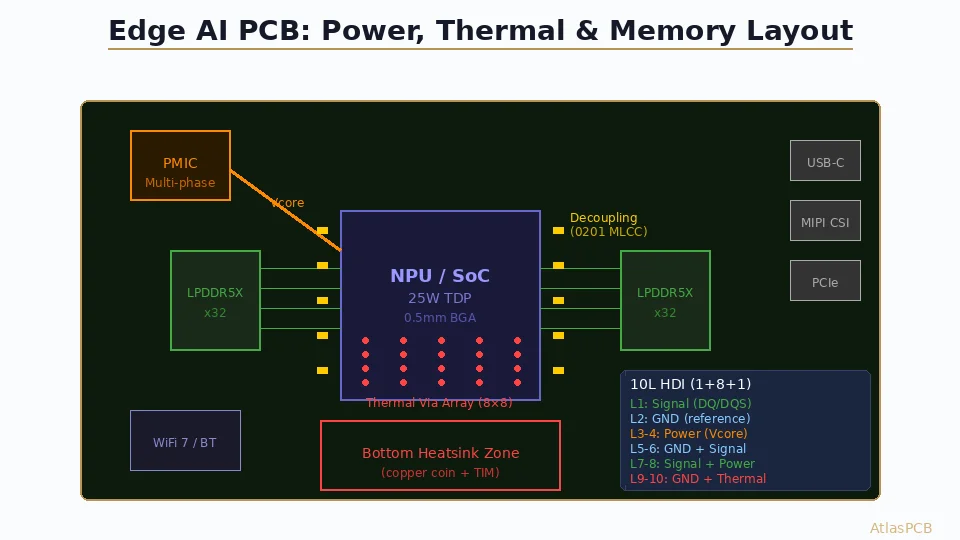
- Multi-interface boards: A single edge AI product may combine LPDDR5X (8533 MT/s), PCIe Gen5, MIPI CSI-2, and USB4 — each with unique impedance and routing requirements
- Mixed-signal challenges: NPU digital noise must be isolated from analog sensor front-ends
- Thermal co-design: PCB thermal management is integral to system performance, not an afterthought
The NPU Efficiency War at Board Level
The report highlights the ongoing “NPU vs GPU at the board level” competition:
- AMD Ryzen AI achieves 80 TOPS with dedicated NPU
- Qualcomm Snapdragon X Elite delivers 45 TOPS for mobile/edge
- Hailo-10 demonstrates 6.9 tokens/sec at just 1.87W for LLM inference
- Apple Neural Engine pushes 35+ TOPS in the M4 series
Each architecture imposes different PCB requirements — from the dense BGA patterns and thermal demands of discrete NPUs to the highly integrated SoC approaches that concentrate all challenges in a single IC footprint.
What This Means for PCB Manufacturers
New Material Requirements
Edge AI PCBs increasingly require:
- Low-loss laminates: Supporting 8800+ MT/s memory interfaces and 32+ GT/s SerDes
- High thermal conductivity: Metal-core or ceramic-filled substrates for fanless designs
- Ultra-thin build-up: 30-40 μm dielectric layers for fine-pitch BGA escape
- Embedded component substrates: Integrating passive components to reduce board area
Manufacturing Capability Escalation
The report notes that edge AI hardware requires PCB capabilities previously reserved for smartphone and data center applications:
- Any-layer HDI with 50 μm microvias
- 30/30 μm trace/space for component escape
- Thermal via arrays with >90% copper fill
- 8-12 layer stackups with ±5% impedance control
- Mixed material stackups (high-Tg + low-loss in same board)
Supply Chain Implications
For procurement teams and sourcing professionals, the report highlights that device selection must account for “not only performance specifications, but also long-term availability, supply chain resilience, and multi-sourcing strategies.” The same applies to PCB materials — edge AI designs lock in specific laminate and build-up materials that may have limited sourcing options.
Industry Response
Advantech’s presentation at Embedded World 2026 (referenced in the report’s supplementary materials) emphasized that “thermal design, lifecycle support, and software readiness often decide whether an AI product succeeds in the field” — placing PCB-level thermal management as a make-or-break factor.
The broader PCB industry response includes:
- Traditional fabricators investing in HDI and thermal management capabilities
- Equipment manufacturers developing specialized laser drills for thermal via arrays
- Laminate suppliers introducing new grades optimized for edge AI thermal/electrical balance
- EDA tool vendors adding AI-specific design rule checking
AtlasPCB’s Edge AI Capabilities
The convergence of thermal, signal integrity, and miniaturization challenges in edge AI hardware aligns directly with AtlasPCB’s advanced manufacturing platform. Our capabilities include any-layer HDI (50 μm microvias), heavy copper integration (up to 4 oz), thermal via arrays with verified copper fill, and mixed-material stackups — all the building blocks edge AI product teams need.
Discuss Your Edge AI Design → | View Advanced Capabilities →
Sources: Wevolver Edge AI Report 2026 via FindChips, Siemens Partners Blog, Advantech Embedded World 2026
Image: Google DeepMind via Unsplash
About AtlasPCB — We specialize in complex PCB manufacturing for HDI, RF, and high-reliability applications. Explore our aluminum and metal-core PCB services . Every order includes free engineering review. Get your quote.
Reviewed by AtlasPCB Engineering Team — IPC-certified manufacturing specialists with 15+ years of production experience in HDI, RF, and high-reliability PCB fabrication. Content based on factory floor data and real customer design reviews.
- news
- edge ai
- pcb design
- npu
- wevolver
- siemens
- hardware
- thermal management
- ai