· Marcus Lin · News · 3 min read
Amphenol to Showcase Large-Format RF and Microwave PCBs at IMS 2026 in Boston
Amphenol Printed Circuits will demonstrate advanced RF/microwave PCB technologies including phase-matched assemblies exceeding 40 inches at IEEE IMS 2026, highlighting growing demand for radar and satellite applications.

Amphenol Demonstrates the Opposite Trend: Bigger, Not Smaller
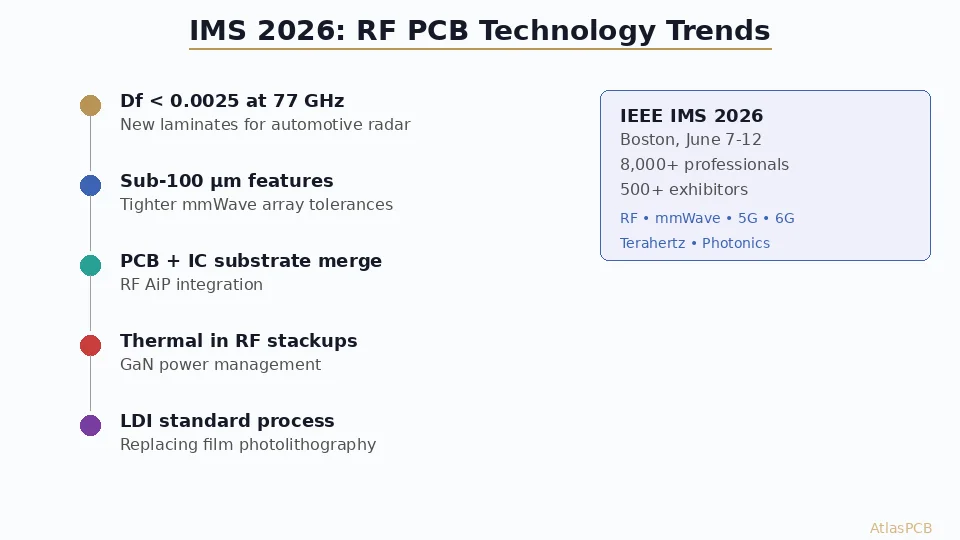
While most electronics engineering pursues miniaturization, Amphenol Printed Circuits (APC) is heading in the opposite direction—and business is booming. The company will present examples of large-format PCB assemblies exceeding 40 inches in length at the 2026 IEEE MTT-S International Microwave Symposium (IMS), taking place June 9–11 at the Thomas M. Menino Convention & Exhibition Center in Boston.
The assemblies on display feature tightly amplitude- and phase-matched channels designed for radar and satellite communication systems—applications where physical aperture size directly correlates with antenna gain and detection range.
“Most engineers are searching for ways to make things smaller, such as for reduced SWaP [Size, Weight, and Power],” said Colby Hobart, APC’s RF Applications Engineer. “But we have also had design and manufacturing inquiries for PCBs headed in the opposite direction. We will be showing examples of large-format PCB assemblies based on advanced materials that meet challenging amplitude and phase specs.”
What’s Driving Large-Format RF PCB Demand
The growth in large-format RF boards is being driven by several converging trends:
Active Electronically Scanned Arrays (AESAs): Modern radar systems use hundreds or thousands of active elements distributed across large printed circuit boards. These arrays require extreme phase matching—typically ±2° across all channels—over board dimensions that can exceed 1 meter.
Low-Earth Orbit (LEO) Satellite Ground Stations: The proliferation of Starlink, Kuiper, and OneWeb constellations is driving demand for phased-array ground terminals. Each terminal requires multiple large PCBs with tightly controlled dielectric properties.
5G mmWave Infrastructure: Massive MIMO base stations use large antenna arrays that combine multiple RF feeds on extended PCB panels.
Manufacturing Challenges at Scale
Fabricating RF boards at these dimensions introduces unique challenges that standard PCB shops cannot address:
Dimensional stability: A 40-inch board experiences significant thermal expansion during lamination. Material CTEs must be precisely matched across the entire layup to maintain phase matching.
Dielectric uniformity: Phase-matched channels require Dk variation below ±0.02 across the full panel. This demands premium laminate materials (Rogers, Taconic, or Isola specialty grades) with lot-tested dielectric consistency.
Registration accuracy: Layer-to-layer registration over 40+ inches must remain within ±3 mil—far tighter than the ±5 mil typical at standard panel sizes.
Copper etch uniformity: Impedance control over extreme lengths requires etch variation below ±0.3 mil, demanding advanced chemical processes and real-time bath monitoring.
IMS 2026 Exhibition Details
Amphenol Printed Circuits will exhibit at Booth #16054, showcasing PCBs spanning flex, rigid, and rigid-flex constructions for terrestrial, maritime, and space applications. The displays include SMT assemblies designed for reduced SWaP requirements alongside the large-format radar and satellite boards.
Hobart will also participate in the industry workshop “Next-Generation RF Components: Strategies to Minimize Loss, Noise, and Distortion” on Thursday, June 11 from 1:30–3:10 PM in Room 154.
What This Means for RF PCB Engineers
The IMS 2026 showcase reflects a broader industry truth: high-frequency PCB fabrication is becoming increasingly specialized. As frequencies climb into the millimeter-wave range and board dimensions grow for phased-array applications, the gap between standard PCB shops and RF-capable manufacturers widens.
Engineers designing next-generation radar, satellite, or 5G systems should evaluate fabrication partners based on:
- Proven experience with their specific laminate material
- Demonstrated phase-matching capability over the required dimensions
- In-house RF testing (network analyzer, TDR) for production verification
- Thermal cycling qualification data for the target environment
For engineers working on RF and microwave designs who need specialized material expertise, AtlasPCB provides RF PCB manufacturing with Rogers, Taconic, and PTFE materials, including phase-matched multi-channel designs.
Source: PCB Directory, May 21, 2026
Image: Alexandre Debiève via Unsplash
Related Articles
About AtlasPCB — We specialize in complex PCB manufacturing for HDI, RF, and high-reliability applications. Explore our RF and high-frequency PCB services, or get an Rogers RO4350B PCB manufacturing . Every order includes free engineering review. Get your quote.
Reviewed by AtlasPCB Engineering Team — IPC-certified manufacturing specialists with 15+ years of production experience in HDI, RF, and high-reliability PCB fabrication. Content based on factory floor data and real customer design reviews.
- news
- RF PCB
- microwave
- Amphenol
- IMS 2026
- radar
- satellite
- large format PCB
- 5G