· AtlasPCB Engineering Team · News · 4 min read
AI Edge Devices PCB Market to Hit $67.6 Billion
The global AI edge devices PCB market is projected to surge from $15.4B in 2026 to $67.6B by 2033, driven by NPU-optimized stackups, HDI routing for on-device inference, and thermal management challenges unique to edge AI hardware.
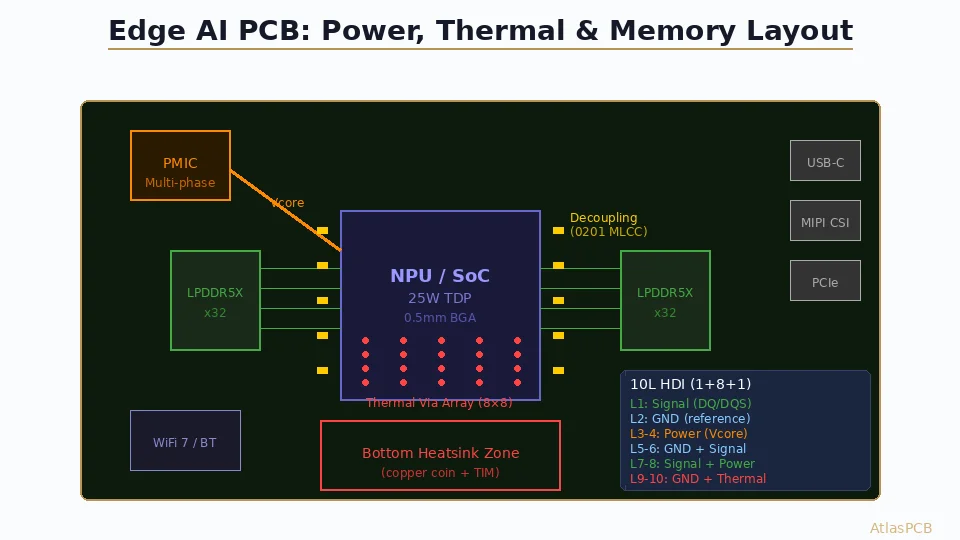
AI Edge PCB Market: $15.4B to $67.6B in Seven Years
A new market research report from Persistence Market Research projects the global AI edge devices PCB market will grow from US$15.4 billion in 2026 to US$67.6 billion by 2033 — a compound annual growth rate (CAGR) of 23.5% — driven by the rapid deployment of AI inference workloads on edge hardware where PCBs must support high-density interconnects, advanced thermal management, and reliable operation under constrained power budgets.
This growth represents a fundamental shift in PCB demand: edge AI devices require boards that are simultaneously more complex (denser routing, tighter impedance control, more layers) and more constrained (smaller form factors, lower power, tighter thermal budgets) than traditional electronics.
What’s Driving the Surge
The Inference Flip
By mid-2026, AI inference workloads have surpassed training compute globally for the first time. While training happens in data centers with virtually unlimited PCB real estate and cooling, inference happens everywhere — in phones, cars, cameras, robots, medical devices, and industrial sensors. Each of these devices needs a PCB optimized for on-device AI.
NPU Proliferation
Every major chip vendor now ships dedicated Neural Processing Units:
- Qualcomm Snapdragon X: 45 TOPS NPU for AI PCs
- Apple A18/M5: 38 TOPS Neural Engine
- Intel Lunar Lake: Integrated NPU + GPU for 75+ TOPS combined
- MediaTek Dimensity 9400: 36 TOPS APU for mobile
- AMD Ryzen AI: XDNA architecture delivering 50+ TOPS
These NPUs demand specific PCB characteristics that traditional designs don’t provide.
PCB Design Challenges for Edge AI
1. Power Delivery Network (PDN) Complexity
NPU workloads create bursty power demand — milliseconds of peak draw followed by idle states. The PCB’s power delivery network must:
- Provide transient response < 1 µs (requires embedded decoupling capacitance)
- Support multiple voltage rails (0.5V core, 0.75V NPU, 1.1V LPDDR5, 1.8V I/O)
- Maintain < 3% voltage droop during inference bursts
- Fit within smartphone-thickness stackups (8-12 layers, 0.8mm total)
This drives demand for advanced PDN design techniques including embedded capacitor layers and substrate-like PCB technologies.
2. High-Density Interconnect (HDI) Requirements
Edge AI processors use package-on-package (PoP) and fan-out wafer-level packaging with:
- Ball pitch as tight as 0.35mm
- 600-1200 signal pins requiring breakout routing
- Memory (LPDDR5) stacked directly on top of SoC
The PCB must support any-layer HDI with:
- Microvia diameter ≤ 75 µm
- Trace/space ≤ 40/40 µm (approaching mSAP territory)
- 10-14 layers in < 1.0mm total thickness
3. Thermal Management Without Fans
Edge devices can’t use active cooling fans (noise, size, reliability). The PCB itself becomes a critical thermal path:
- Thermal vias under NPU providing > 20 W/mK effective conductivity
- Copper coin or embedded heatsink designs
- Balanced copper distribution for uniform heat spreading
- Material selection for high Tg and thermal conductivity
Our earlier coverage of MEMS active cooling for edge AI PCBs explores emerging solutions to this challenge.
4. Signal Integrity for On-Package Memory
LPDDR5/5X running at 8533 MT/s requires:
- ±5% impedance control on memory channels
- Length matching < 2 ps intra-byte
- Low-loss laminates for memory routing layers
- Careful via transition design for PoP breakout
Market Segmentation
The $67.6B market by 2033 breaks down into key segments:
| Segment | 2026 Share | Growth Rate | Key PCB Requirements |
|---|---|---|---|
| AI PCs / Laptops | 28% | 18% CAGR | 8-10 layer HDI, low-loss |
| Smartphones | 24% | 15% CAGR | Any-layer HDI, ultra-thin |
| Automotive ADAS | 20% | 30% CAGR | High-Tg, automotive-grade |
| Industrial/Robotics | 15% | 28% CAGR | Extended temp, ruggedized |
| IoT/Smart Cameras | 8% | 35% CAGR | Compact, cost-optimized |
| Medical/Wearable | 5% | 25% CAGR | Biocompatible, flex |
The automotive ADAS and industrial robotics segments are growing fastest, driven by the shift from cloud-dependent AI to fully autonomous on-device inference.
Implications for PCB Manufacturers
This market shift creates opportunities and challenges for fabricators:
Opportunities
- Higher ASP boards: Edge AI PCBs command 2-5× the price of standard consumer electronics boards
- Advanced technology demand: HDI, substrate-like PCBs, and embedded components
- Volume growth: Every edge AI device needs at least one advanced PCB
- Design support value: Hardware teams need engineering review services for these complex designs
Challenges
- Capital investment: mSAP and any-layer HDI require $50M+ production line investments
- Yield management: Tighter tolerances mean higher scrap rates without AI-powered process control
- Material sourcing: Low-loss laminates and RA copper foil face supply constraints
- Workforce: Advanced fabrication requires highly skilled process engineers
What This Means for Hardware Engineers
If you’re designing edge AI hardware, plan for:
- Stackup complexity: Budget for 10+ layer HDI with controlled impedance on all signal layers
- Longer fabrication lead times: Advanced HDI typically adds 1-2 weeks vs. standard multilayer
- DFM collaboration early: Work with your PCB manufacturer during schematic design, not after layout
- Thermal simulation: Validate thermal performance before committing to PCB design — it’s expensive to iterate
- Test strategy: Plan for design-for-testability from day one — these boards are hard to probe
Source
Market data from Persistence Market Research, published 2026. Additional data from Mordor Intelligence Edge AI Hardware Market report.
Designing PCBs for edge AI hardware? AtlasPCB specializes in high-density interconnect boards with impedance-controlled routing, thermal via arrays, and ultra-fine features for NPU breakout. Get a quote for your edge AI project.
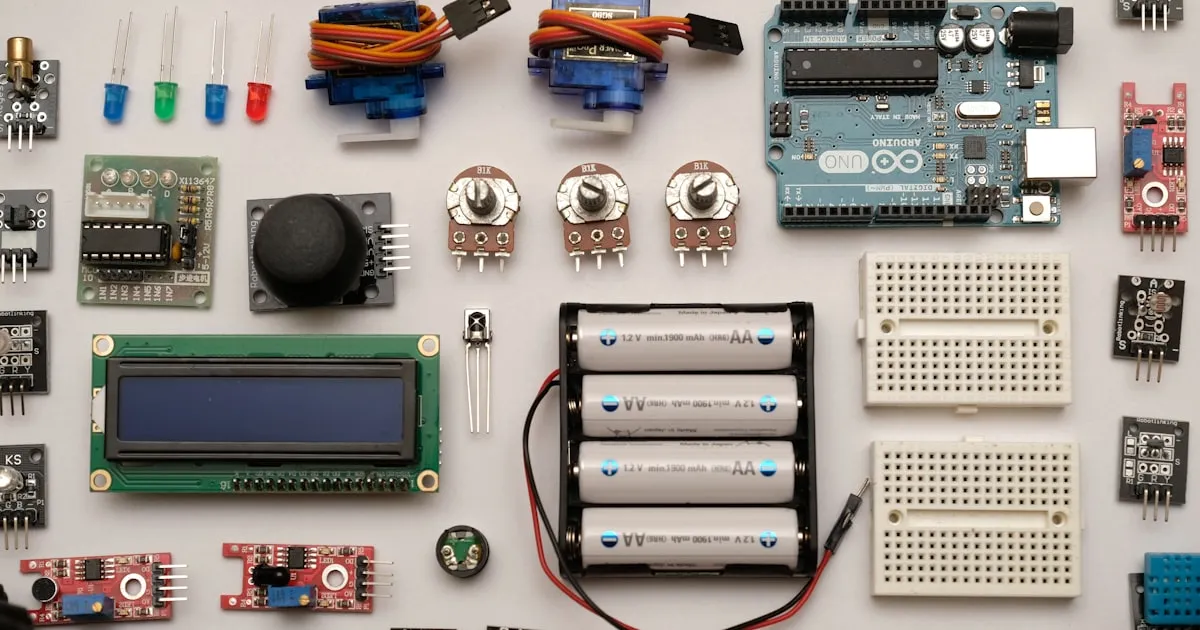
Image: Edge computing hardware via Unsplash
About AtlasPCB — We specialize in complex PCB manufacturing for HDI, RF, and high-reliability applications. Explore our HDI PCB manufacturing capabilities, or get an aluminum and metal-core PCB services . Every order includes free engineering review. Get your quote.
Reviewed by AtlasPCB Engineering Team — IPC-certified manufacturing specialists with 15+ years of production experience in HDI, RF, and high-reliability PCB fabrication. Content based on factory floor data and real customer design reviews.
- news
- ai
- edge-ai
- pcb-market
- hardware
- npu
- hdi
- thermal-management
- market-research