· Marcus Lin · Engineering · 5 min read
Rogers PCB Material Guide
Complete overview of Rogers PCB materials including RO4000, RO3000, RT/duroid series. Compare Dk, Df properties, application ranges from 5G mmWave to automotive radar, and learn what to look for in a Rogers PCB manufacturer.
Quick Answer
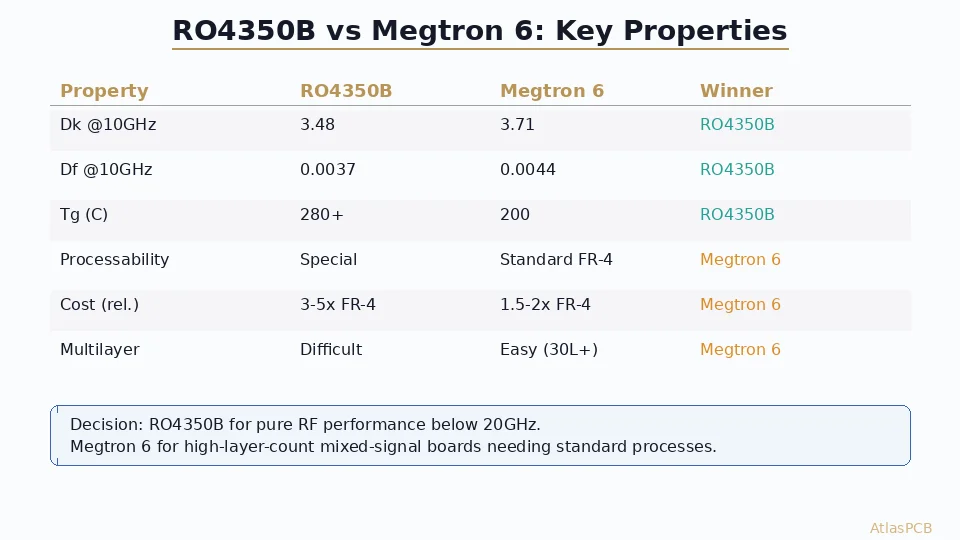
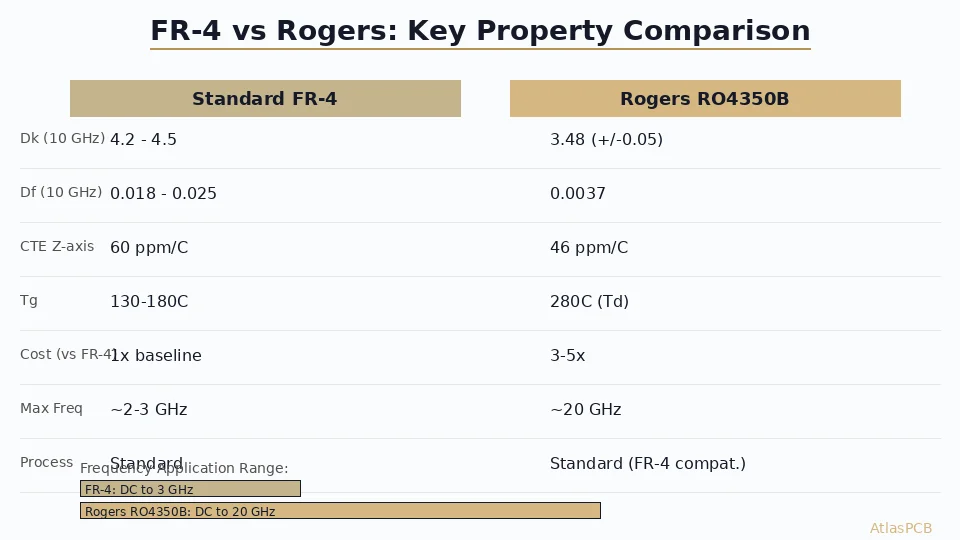
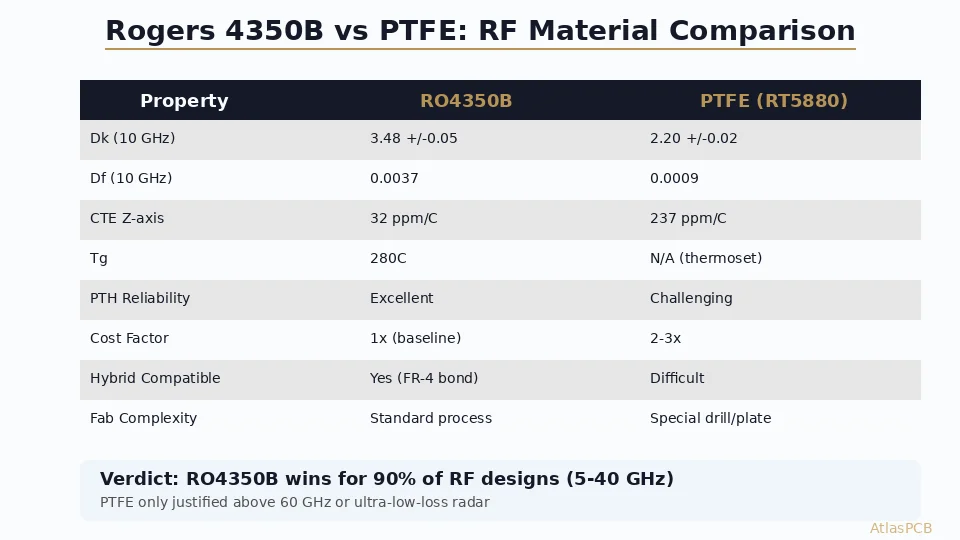
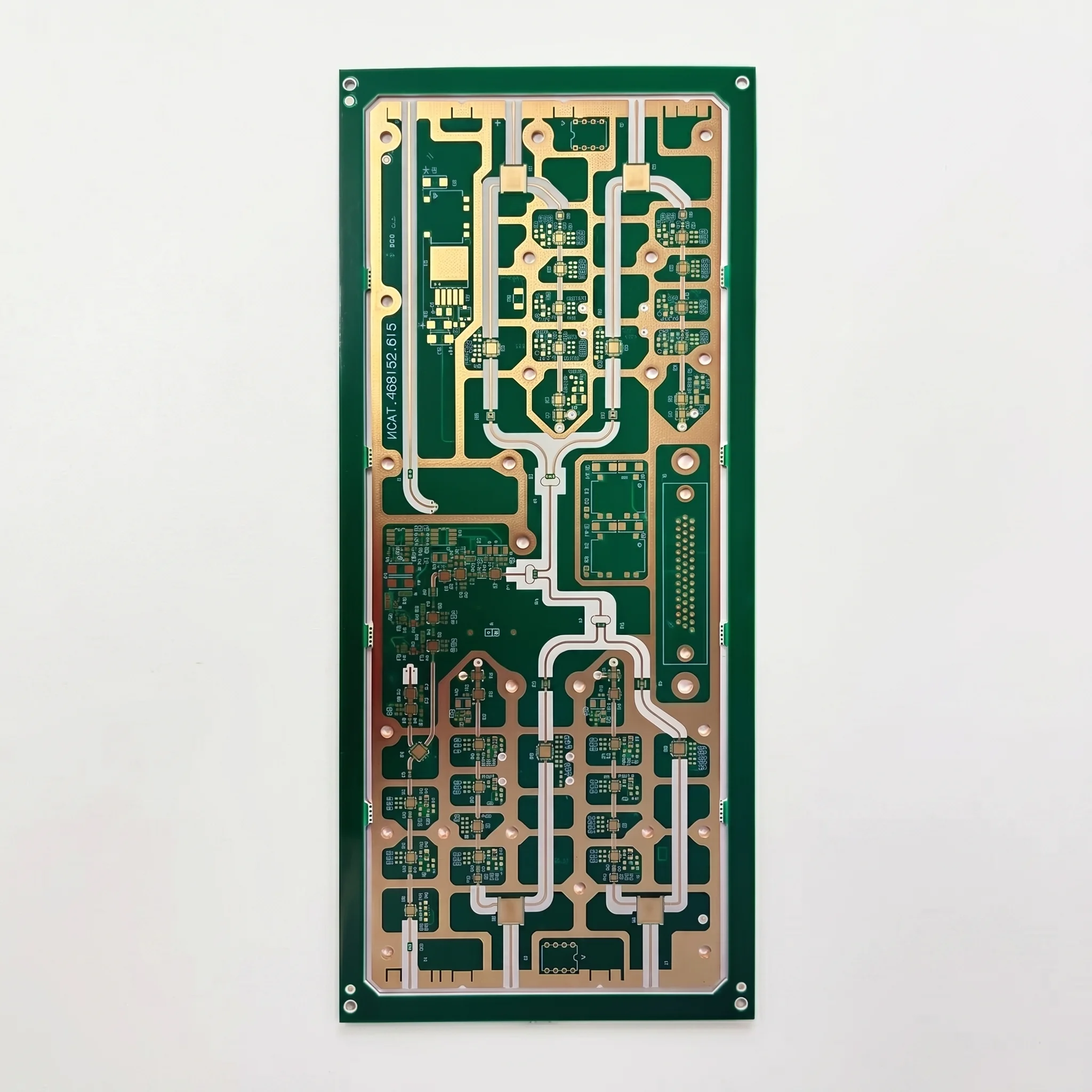
Rogers Corporation manufactures advanced PCB laminates engineered for high-frequency applications where standard FR4's high dielectric loss (Df 0.020 at 10 GHz) is unacceptable. Rogers materials use ceramic-filled PTFE (RO3000 series), woven glass/ceramic (RO4000 series), or pure PTFE (RT/duroid series) to achieve dielectric losses 5-50× lower than FR4. The most widely used Rogers material is RO4350B (Dk 3.48, Df 0.0037 at 10 GHz), which is compatible with standard FR4 processing. Atlas PCB stocks RO4350B, RO4003C, and RO3003, and fabricates Rogers PCBs with ±5% impedance control.
What Is Rogers PCB Material? Properties, Types & Applications
Rogers Corporation is the leading manufacturer of high-frequency PCB laminates, and “Rogers material” has become shorthand in the industry for any advanced laminate designed for RF, microwave, and millimeter-wave applications. But Rogers offers dozens of material grades across multiple product families, each optimized for different frequency ranges, processing methods, and cost targets.
This guide explains what Rogers materials are, how they differ from FR4, and which grade to specify for your application.
Why Rogers Instead of FR4?
Standard FR4 uses woven glass fabric reinforced with epoxy resin. While adequate for most digital applications, FR4 has two critical limitations at high frequencies:
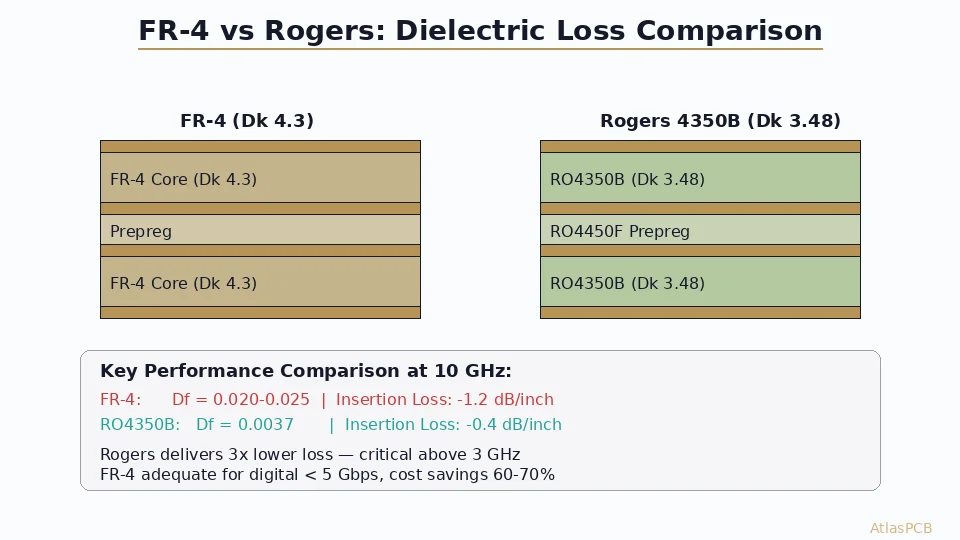
- High dielectric loss (Df): FR4’s Df of 0.018-0.025 at 1 GHz means significant signal attenuation. At 10 GHz, insertion loss on FR4 can be 3-5× higher than on Rogers materials.
- Unstable dielectric constant (Dk): FR4’s Dk varies with frequency (4.5 at 100 MHz to 4.0 at 10 GHz), temperature (±5-10% over operating range), and moisture (±3-5% with humidity changes). This makes precise impedance control difficult above 1 GHz.
Rogers materials address both limitations through engineered ceramic and PTFE formulations.
Rogers Material Families
RO4000 Series — The Mainstream Choice
| Property | RO4003C | RO4350B | RO4835 |
|---|---|---|---|
| Dk @ 10 GHz | 3.38 | 3.48 | 3.48 |
| Df @ 10 GHz | 0.0027 | 0.0037 | 0.0040 |
| Tg | >280°C | >280°C | >280°C |
| CTE (Z-axis) | 46 ppm/°C | 32 ppm/°C | 31 ppm/°C |
| FR4 compatible processing | Yes | Yes | Yes |
| UL 94 | V-0 | V-0 | V-0 |
| Relative cost | 3× FR4 | 3× FR4 | 2.5× FR4 |
The RO4000 series uses ceramic-filled hydrocarbon resin with woven glass reinforcement. The key advantage: they process identically to FR4 — same drilling, plating, etching, and lamination equipment.
See our [Rogers 4350B vs FR4 comparison]/blog/rogers-4350b-vs-fr4/) and [Rogers 4003C properties guide]/blog/rogers-4003c-properties/) for detailed specifications.
RO3000 Series — PTFE Performance
| Property | RO3003 | RO3006 | RO3010 |
|---|---|---|---|
| Dk @ 10 GHz | 3.00 | 6.15 | 10.2 |
| Df @ 10 GHz | 0.0013 | 0.0020 | 0.0035 |
| Reinforcement | Ceramic-filled PTFE | Ceramic-filled PTFE | Ceramic-filled PTFE |
| Application | Low-loss filters | Miniaturization | Antenna miniaturization |
RT/duroid Series — Ultra-Low Loss
| Property | RT/duroid 5880 | RT/duroid 6002 | RT/duroid 6010 |
|---|---|---|---|
| Dk @ 10 GHz | 2.20 | 2.94 | 10.2 |
| Df @ 10 GHz | 0.0009 | 0.0012 | 0.0023 |
| Reinforcement | Glass microfiber/PTFE | Glass microfiber/PTFE | Ceramic/PTFE |
| Application | Satellite, radar | Aerospace | Miniaturized antennas |
Application Selection Guide
| Application | Frequency Range | Recommended Material | Why |
|---|---|---|---|
| 5G base station | 3.5-6 GHz (Sub-6) | RO4350B | Cost-effective, standard processing |
| 5G mmWave | 24-40 GHz | RO3003 or RT5880 | Ultra-low loss at mmWave |
| Automotive radar (77 GHz) | 76-81 GHz | RO3003 | Lowest loss at mmWave |
| WiFi 6E/7 | 6 GHz | RO4003C or RO4350B | Adequate performance, lower cost |
| Satellite comms | 12-40 GHz | RT/duroid 5880 | Lowest Df available |
| Military radar | 1-20 GHz | RO4350B | MIL-qualified, standard processing |
| IoT (< 1 GHz) | Sub-1 GHz | FR4 (Rogers not needed) | Cost optimized |
For comprehensive material comparison, see our [RF PCB materials comparison]/blog/rf-pcb-materials-comparison/).
Choosing a Rogers PCB Manufacturer
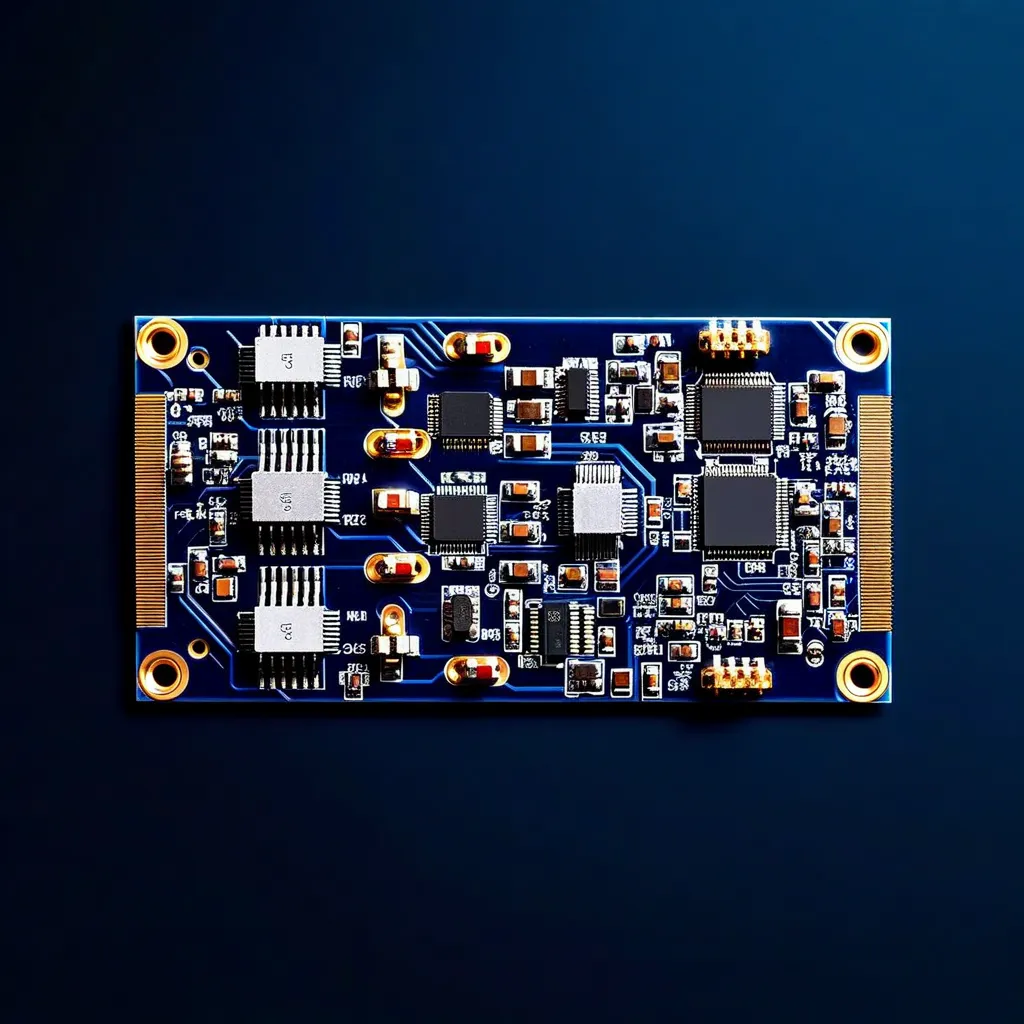
Not every PCB fabrication shop can handle Rogers materials well. The processing requirements differ enough from standard FR4 that you need a manufacturer with demonstrated high-frequency fabrication experience. Here is what to verify before placing an order:
Material stocking. A manufacturer that stocks RO4350B, RO4003C, and RO3003 in common thicknesses (10, 20, 30, 60 mil cores) can ship faster because there is no lead time on material procurement. Ask whether they hold inventory or order per job — the difference can be 2-3 weeks on your delivery.
Impedance control capability. Rogers PCBs are specified for controlled impedance in nearly every application. Your manufacturer should guarantee ±5% impedance tolerance with TDR coupon verification on every panel. Ask for sample coupon reports from previous builds at your target frequency.
Hybrid stackup experience. Most production Rogers designs use hybrid Rogers/FR4 stackups to control cost. This requires managing CTE mismatch during lamination, proper bondply selection (Rogers 4450F prepreg or equivalent), and validated press cycles. A manufacturer without hybrid experience will either refuse the job or risk delamination.
DFM review for RF. High-frequency designs are sensitive to manufacturing variations that digital boards tolerate easily — copper roughness, dielectric thickness tolerance, etch factor on fine traces. A qualified Rogers PCB manufacturer provides pre-production DFM review that catches these issues before they become signal integrity failures.
AtlasPCB stocks RO4350B and RO4003C in standard thicknesses, fabricates Rogers and hybrid Rogers/FR4 stackups with ±5% impedance control, and includes a free engineering review on every Rogers PCB order. Our engineering team has 15+ years of experience with high-frequency laminate processing.
ROGERS PCB MANUFACTURER
Need Rogers PCBs Fabricated?
Upload your Gerbers for a free DFM review. RO4350B and RO4003C in stock — typical lead time 7-10 days.
Get Instant Quote ›
Summary
Rogers materials are essential when your PCB design demands low dielectric loss, stable impedance, or operation above 1 GHz. Start with RO4350B for most applications—it offers the best balance of performance and manufacturability.
Ready to start your Rogers PCB project? Upload your Gerbers for a free engineering review.
Further Reading
- [Rogers 4350B vs FR4: When to Upgrade]/blog/rogers-4350b-vs-fr4/)
- [Rogers 4003C Material Properties]/blog/rogers-4003c-properties/)
- [RF PCB Materials Comparison]/blog/rf-pcb-materials-comparison/)
About AtlasPCB — We specialize in complex PCB manufacturing for HDI, RF, and high-reliability applications. Explore our RF and high-frequency PCB services, or get an Rogers RO4350B PCB manufacturing . Every order includes free engineering review. Get your quote.
Reviewed by AtlasPCB Engineering Team — IPC-certified manufacturing specialists with 15+ years of production experience in HDI, RF, and high-reliability PCB fabrication. Content based on factory floor data and real customer design reviews.
Frequently Asked Questions
What is the most commonly used Rogers material?
When should I use Rogers instead of FR4?
Can Rogers and FR4 be combined in a hybrid stackup?
- rogers-material
- rf-pcb
- high-frequency
- pcb-materials
- rogers-pcb-manufacturer