· Thomas Webb · Engineering · 6 min read
T-Glass Shortage Threatens AI Server PCB
The global shortage of T-glass (NE-glass) fiber for ultra-low-loss PCB laminates is emerging as a critical bottleneck for AI server and data center infrastructure. With AI accelerator PCBs requiring 20+ layers of premium laminate, T-glass supply constraints may limit hyperscaler buildout through 2027.
Quick Answer
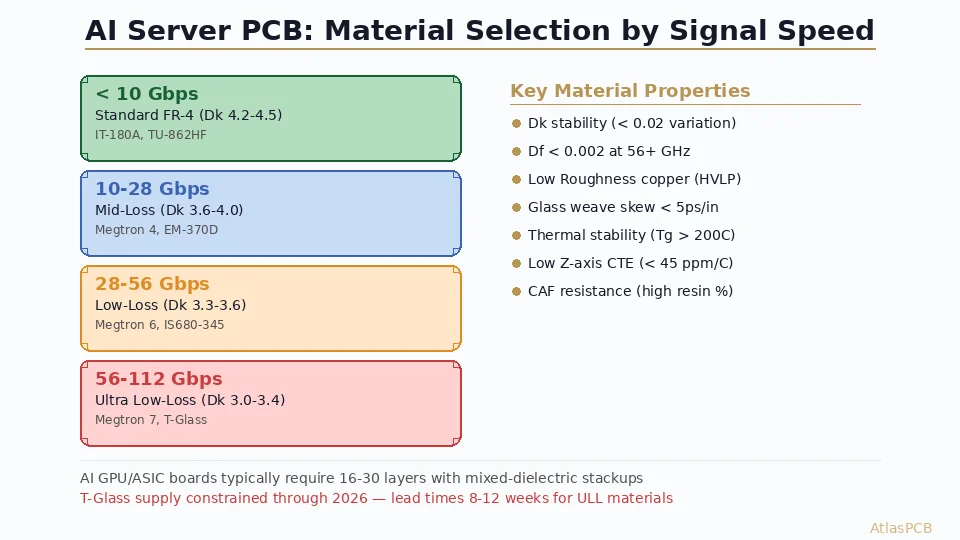
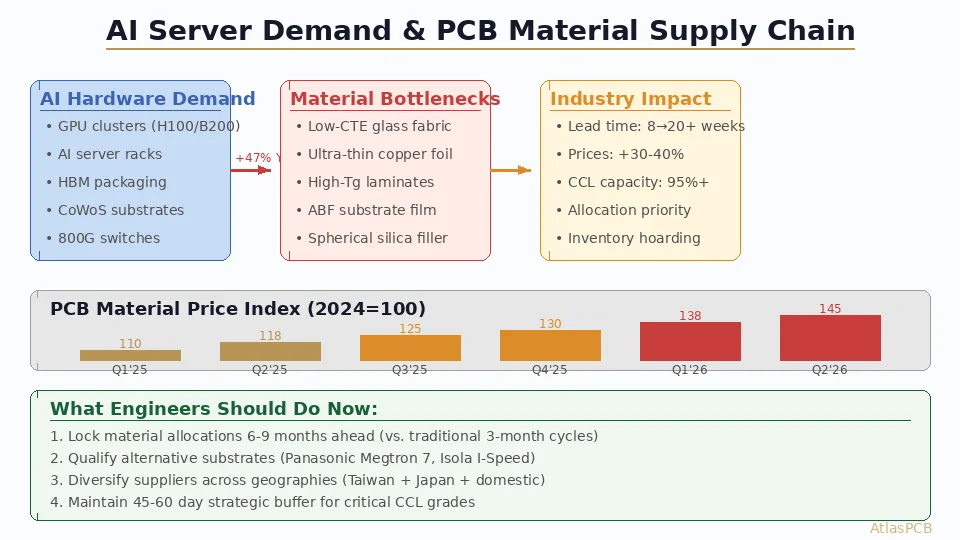
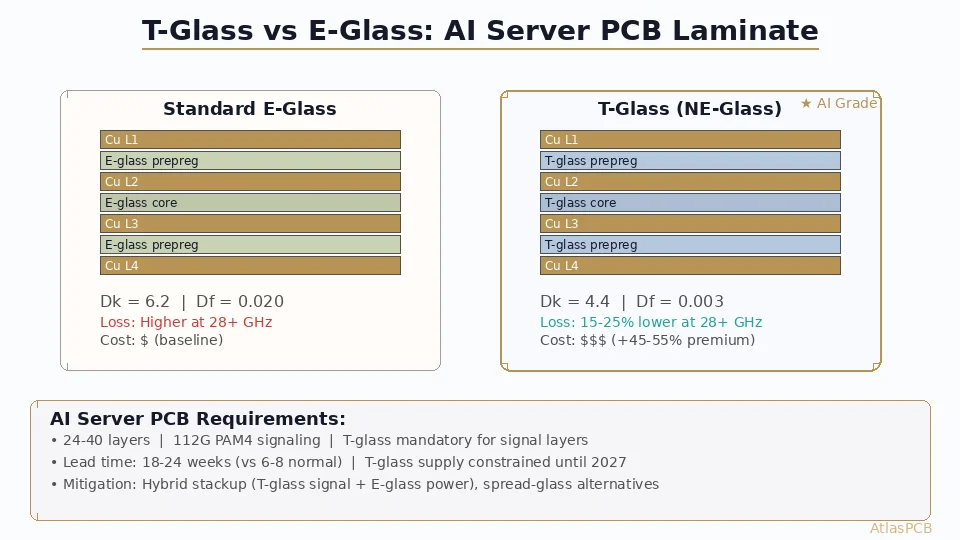
T-glass (also called NE-glass or low-Dk glass) is a specialty glass fiber with dielectric constant (Dk) of 4.4 vs standard E-glass at 6.2, enabling PCB laminates with lower insertion loss at 56–112 Gbps data rates. AI server motherboards requiring 20–40+ layers of T-glass-reinforced laminate (Megtron 7, Panasonic R-5785N, Isola I-Speed) are consuming available supply faster than manufacturers can expand capacity. The result is 16–24 week lead times for premium laminates vs the normal 6–8 weeks, threatening to delay hyperscaler data center buildouts.
The Hidden Bottleneck in AI Infrastructure
Everyone talks about GPU shortages and HBM memory constraints limiting AI infrastructure buildout. But there’s a less visible bottleneck emerging in the supply chain: the specialty glass fiber used to manufacture the PCB laminates inside every AI server.
T-glass — a low-dielectric-constant glass fiber critical for maintaining signal integrity at 56 Gbps and 112 Gbps data rates — is in severe shortage. And without T-glass laminates, you cannot manufacture the 24–40 layer motherboards, switch fabrics, and backplanes that connect AI accelerators together.
Why Standard Glass Won’t Work
The physics are straightforward. Standard E-glass fiber has a dielectric constant (Dk) of approximately 6.2. T-glass (NE-glass) has a Dk of 4.4 — a 30% reduction. This difference translates directly into:
Lower insertion loss: At 28+ GHz Nyquist frequency (112G PAM4), every 0.1 dB/inch of additional loss matters. T-glass laminates deliver 15–25% lower loss than equivalent E-glass constructions.
Tighter Dk tolerance: E-glass Dk varies ±5% due to manufacturing variation. T-glass achieves ±2% tolerance, enabling more predictable impedance control across 40+ layers.
Higher bandwidth density: Lower Dk enables wider traces at the same impedance, or equivalent impedance at narrower traces — both improving routing density in space-constrained server designs.
Reduced skew in differential pairs: More uniform Dk reduces intra-pair skew, which is the dominant limiter for 112G PAM4 reach.
The Demand Explosion
AI Server Board Specifications
Modern AI server platforms require extraordinary PCB specifications:
| Platform | Layer Count | Material Class | T-Glass Required |
|---|---|---|---|
| NVIDIA GB200 NVL72 | 28–36 layers | Megtron 7 / I-Speed | Yes (all signal layers) |
| NVIDIA GB300 NVL72 | 32–40 layers | Megtron 7N | Yes |
| AMD MI400 host | 24–32 layers | Megtron 6 / IS680 | Yes |
| Google TPU v6 | 28+ layers | Proprietary spec | Yes |
| Microsoft Maia 200 | 30+ layers | Ultra-low-loss | Yes |
Each of these platforms requires T-glass-reinforced laminate for every signal layer. Power and ground planes can tolerate standard E-glass, but signal layers — which comprise 60–70% of total layers in these designs — must use T-glass for adequate channel margin.
Volume Mathematics
Consider a single hyperscaler deploying 10,000 AI server racks in a quarter (a typical buildout pace for major cloud providers in 2026):
- 10,000 racks × 36 boards per rack = 360,000 boards
- 360,000 boards × 2 m² T-glass per board = 720,000 m² of T-glass fabric
- That’s 720,000 m² per quarter from a single customer
Global T-glass production capacity is estimated at approximately 15–20 million m² annually. When multiple hyperscalers simultaneously expand AI infrastructure, the demand-supply imbalance becomes acute.
Supply-Side Constraints
Why T-Glass Is Hard to Make
T-glass manufacturing differs from standard E-glass in several critical ways:
Furnace chemistry: T-glass uses an alumina-rich, boron-free formulation that requires higher melting temperatures (1,350°C vs 1,250°C for E-glass). This increases energy consumption and furnace wear.
Fiber drawing: The higher viscosity of T-glass melt makes fiber drawing more challenging. Yield rates are typically 70–80% compared to 90%+ for E-glass.
Qualification cycles: Switching a glass furnace from E-glass to T-glass requires complete drain-and-restart, consuming 6–8 weeks. Once running T-glass, the furnace cannot easily switch back.
Capital investment: A new T-glass furnace costs $50–$80 million and takes 18–24 months from investment decision to qualified production output.
Current Manufacturers
The T-glass supply base is concentrated among a few Japanese and Chinese producers:
- Nittobo (Nitto Boseki): Largest T-glass producer, estimated 40% market share
- AGC (Asahi Glass): Second-largest, focused on highest-purity grades
- CPIC (China Jushi subsidiary): Rapidly expanding, primarily serving Chinese laminate makers
- Taishan Fiberglass: Growing capacity, targeting mid-range applications
All four are investing in capacity expansion, but new furnaces won’t reach full production until late 2027 at earliest.
Impact on PCB Laminate Availability
The T-glass shortage cascades through the laminate supply chain:
Premium Laminate Lead Times (as of May 2026)
| Laminate | Normal Lead Time | Current Lead Time | Price Change |
|---|---|---|---|
| Panasonic Megtron 7 | 6–8 weeks | 18–24 weeks | +45% |
| Panasonic Megtron 7N | 8–10 weeks | 20–28 weeks | +55% |
| Isola I-Speed | 6–8 weeks | 16–20 weeks | +35% |
| Isola I-Tera MT40 | 8–10 weeks | 20–24 weeks | +50% |
| EMC EM-891K | 6–8 weeks | 14–18 weeks | +30% |
These extended lead times mean that AI server PCB manufacturers must commit to material purchases 5–6 months before board production — a dramatic shift from the previous 2-month planning cycle.
Building AI Infrastructure PCBs?
AtlasPCB maintains strategic laminate inventory including Megtron 6, I-Speed, and EM-891K for high-layer-count AI server boards. We provide material availability guidance and DFM optimization to minimize material consumption without compromising signal integrity.
Inquire About Material Availability →Design Strategies to Mitigate T-Glass Shortage
Hardware engineers facing T-glass laminate constraints can consider several mitigation strategies:
1. Hybrid Stackup Design
Not every layer needs T-glass reinforcement. A practical approach:
- Signal layers (high-speed): T-glass laminate (Megtron 7, I-Speed)
- Power/ground planes: Standard E-glass FR-4 or mid-tier laminate
- Low-speed signal layers: Standard laminate acceptable
A 32-layer board might use T-glass on 20 signal layers and standard glass on 12 power/ground layers — reducing T-glass consumption by 37% with minimal signal integrity impact.
2. Spread Glass (Flat Glass) Alternatives
Spread-glass E-glass weaves achieve Dk closer to T-glass by reducing the glass-to-resin ratio:
- Standard E-glass: Dk = 6.2 at 10 GHz
- Spread E-glass in high-resin laminate: Dk = 3.8–4.2 at 10 GHz
- T-glass: Dk = 4.4 at 10 GHz
For applications at 56G or below, spread-glass constructions may provide adequate performance at lower cost and better availability.
3. Reduce Layer Count Through Advanced Routing
- Use via-in-pad and blind/buried vias to increase routing density per layer
- Employ wider bus topologies (fewer, faster links vs. many slower links)
- Consider chiplet architectures that reduce board-level interconnect length
4. Trace Geometry Optimization
Advanced fabrication techniques can partially compensate for higher-Dk materials:
- mSAP (modified Semi-Additive Process): Enables smoother copper with lower conductor loss
- Ultra-low-profile copper foil: HVLP or reverse-treated foil reduces roughness loss
- Combined effect: 3–5 dB/m improvement at 28 GHz, partially offsetting the E-glass vs T-glass delta
Market Outlook
The T-glass shortage represents a structural challenge that will persist through 2027:
- Q3–Q4 2026: Tightest supply period as AI infrastructure buildout accelerates and new capacity hasn’t arrived
- H1 2027: Incremental capacity from Nittobo and CPIC expansions provides partial relief
- H2 2027–2028: New furnaces reach full qualification, supply-demand rebalances
For hardware teams, the strategic implication is clear: treat T-glass laminate availability as a long-lead constraint item (similar to leading-edge semiconductors) and plan material procurement accordingly.
Further Reading
- High-Speed PCB Laminate Dk/Df Comparison: Megtron, Rogers, Isola
- High-Layer-Count PCB Design and Manufacturing Challenges
- PCB Back-Drilling for Via Stub Removal and Signal Integrity
- Data Center PCB Demand Surge Q2 2026
Sources: Fusion Worldwide (2026); EDN — The Next EDA Wave: DATE 2026 (2026); Industry supply chain data from laminate manufacturer communications.
Need immediate access to T-glass laminates for your AI server board project? Contact AtlasPCB — we maintain buffer inventory and can provide realistic material procurement timelines.
About AtlasPCB — We specialize in complex PCB manufacturing for HDI, RF, and high-reliability applications. Explore our impedance-controlled PCB manufacturing, or get an Megtron 6 & 7 low-loss PCB manufacturing . Every order includes free engineering review. Get your quote.
Reviewed by AtlasPCB Engineering Team — IPC-certified manufacturing specialists with 15+ years of production experience in HDI, RF, and high-reliability PCB fabrication. Content based on factory floor data and real customer design reviews.
Frequently Asked Questions
What is T-glass and why does AI hardware need it?
How much T-glass does a single AI server consume?
When will the T-glass shortage resolve?
- AI PCB
- T-glass
- NE-glass
- PCB laminate
- data center PCB
- AI server
- high-layer-count
- signal integrity
- low-loss material
- Megtron
- supply chain