· Priya Nair · Engineering · 7 min read
PCB Conformal Coating Selection Guide
Complete guide to PCB conformal coating selection. Compare acrylic, silicone, urethane, epoxy, and parylene coatings. Learn IPC-CC-830B testing, application methods, and design rules for reliable electronics protection.
Quick Answer
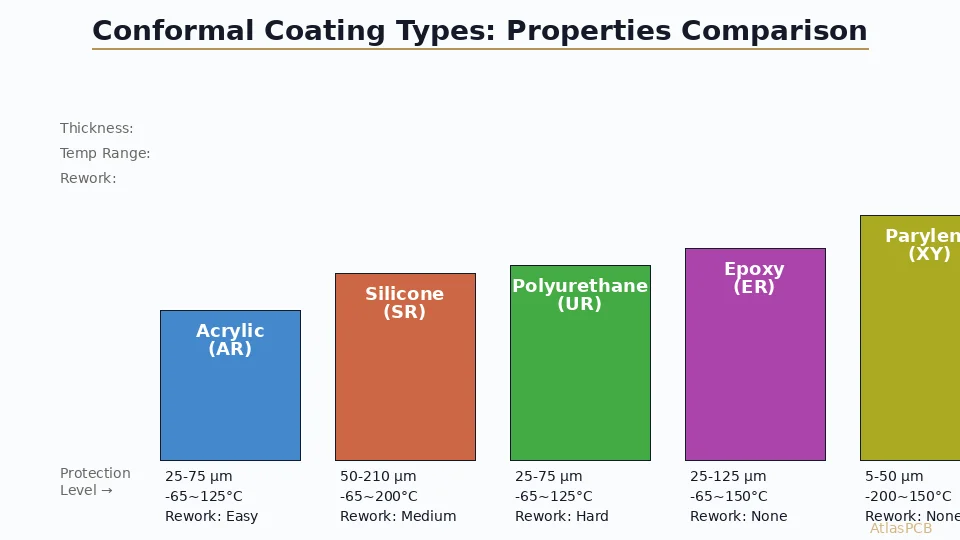
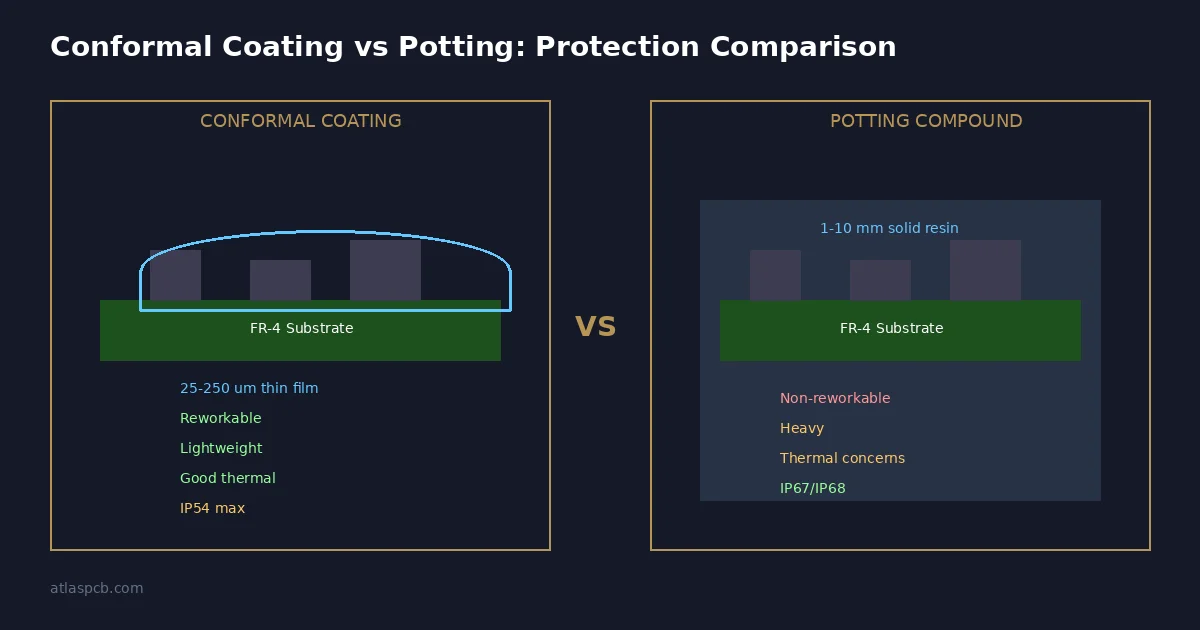
Conformal coating is a thin polymeric film (25–250 µm) applied to assembled PCBs to protect against moisture, dust, chemicals, and thermal shock. The five main types are acrylic (AR) for general use with easy rework, silicone (SR) for wide temperature ranges −65°C to +200°C, urethane (UR) for chemical and abrasion resistance, epoxy (ER) for hardest protection, and parylene (XY) for ultra-thin uniform coverage in medical/military applications. Selection depends on operating environment, rework requirements, and IPC-CC-830B performance class.
Why Conformal Coating Matters
Every assembled PCB operates in an environment that degrades bare electronics over time. Moisture causes electrochemical migration between traces. Dust particles create conductive bridges. Chemical vapors attack solder joints. Thermal cycling stresses component leads.
Conformal coating addresses all of these threats by encapsulating the assembled board in a protective polymer film that conforms to the complex three-dimensional topography of components, leads, solder fillets, and bare traces.
When to Use Conformal Coating
Required applications:
- Automotive electronics (AEC-Q200 environment)
- Outdoor/industrial controls (IP54+ environments)
- Marine and offshore electronics
- Medical devices (implantable and non-implantable)
- Aerospace and defense (MIL-I-46058C heritage)
- Consumer products exposed to humidity (>85% RH)
Not typically needed:
- Office/indoor electronics in climate-controlled environments
- Short-lifetime consumer electronics (< 2 year service life)
- Boards inside sealed, desiccated enclosures
- High-frequency RF sections where coating affects impedance
Coating Types Compared
Acrylic Resin (Type AR)
Chemistry: Polymethyl methacrylate (PMMA) and copolymers dissolved in solvent.
Properties:
- Thickness: 25–75 µm
- Temperature range: −65°C to +125°C
- Dielectric strength: 50–70 kV/mm
- Moisture resistance: Good
- Chemical resistance: Fair (attacked by solvents)
- Reworkability: Excellent (dissolves in IPA, MEK, acetone)
Best for: General-purpose protection where future rework is likely. Consumer electronics, industrial controls, telecom equipment.
Application methods: Spray, dip, selective conformal coating robot.
Silicone Resin (Type SR)
Chemistry: Polydimethylsiloxane (PDMS) and modified silicone elastomers.
Properties:
- Thickness: 50–210 µm
- Temperature range: −65°C to +200°C (widest of all types)
- Dielectric strength: 30–40 kV/mm
- Moisture resistance: Excellent
- Chemical resistance: Fair
- Reworkability: Good (cut and peel, or solvent soak)
Best for: Extreme temperature environments. Automotive under-hood, LED lighting, power electronics, aerospace thermal cycling applications.
Application methods: Spray, selective coating, manual brush (thixotropic formulations).
Urethane/Polyurethane Resin (Type UR)
Chemistry: Polyisocyanate crosslinked with polyol; available as 1-part moisture-cure or 2-part systems.
Properties:
- Thickness: 25–75 µm
- Temperature range: −65°C to +125°C
- Dielectric strength: 50–70 kV/mm
- Moisture resistance: Excellent
- Chemical resistance: Excellent (resists fuels, solvents)
- Reworkability: Difficult (requires abrasion or burn-through)
Best for: Chemical exposure environments. Automotive fuel systems, industrial chemical processing, marine applications.
Application methods: Spray, dip, selective coating.
Epoxy Resin (Type ER)
Chemistry: Two-part bisphenol-A/epichlorohydrin systems, heat or ambient cure.
Properties:
- Thickness: 25–125 µm
- Temperature range: −65°C to +150°C
- Dielectric strength: 70–100 kV/mm
- Moisture resistance: Excellent
- Chemical resistance: Excellent
- Reworkability: Very difficult (essentially permanent)
Best for: Severe environments requiring maximum hardness and abrasion resistance. Not recommended where any future rework is anticipated.
Application methods: Dip, selective dispensing.
Parylene (Type XY)
Chemistry: Vapor-deposited poly(p-xylylene). Applied by vacuum deposition (CVD), not liquid.
Properties:
- Thickness: 5–50 µm (ultra-thin)
- Temperature range: −65°C to +150°C (Type C: +80°C long-term)
- Dielectric strength: 220 kV/mm (highest of all coatings)
- Moisture resistance: Outstanding
- Chemical resistance: Excellent
- Reworkability: Impossible (cannot be selectively removed)
Best for: Medical implants, MEMS devices, aerospace sensors — anywhere requiring ultra-thin, perfectly uniform, pinhole-free coating.
Application methods: Chemical vapor deposition (CVD) only. Entire boards are coated in a vacuum chamber.
IPC-CC-830B Qualification Testing
IPC-CC-830B “Qualification and Performance of Electrical Insulating Compound for Printed Board Assemblies” defines the performance requirements for conformal coatings.
Key Tests
| Test | Method | Pass Criteria |
|---|---|---|
| Insulation resistance | 96h at 85°C/85% RH | ≥ 100 MΩ (Class 1), ≥ 500 MΩ (Class 3) |
| Dielectric withstanding | Per IPC-TM-650 | No breakdown at rated voltage |
| Moisture and insulation | MIL-I-46058C / IPC-TM-650 2.6.3 | IR ≥ spec after conditioning |
| Thermal shock | −65°C to +125°C, 100 cycles | No cracking, delamination, or loss of adhesion |
| Fungus resistance | 28-day exposure per ASTM G21 | No growth on coating surface |
| Flammability | UL 94 | V-0 rating (most applications) |
| Flexibility | Mandrel bend test | No cracking at specified radius |
Performance Classes
- Class 1: Consumer/commercial — basic environmental protection
- Class 2: Industrial — enhanced moisture and thermal resistance
- Class 3: High-reliability (military, medical, aerospace) — maximum performance in all categories
Application Methods
Spray Coating
Pros: Fast, low equipment cost, good for flat boards. Cons: Shadow areas under tall components, overspray waste, requires masking. Typical thickness control: ±15 µm.
Selective Coating (Robot)
Pros: Precise — coats only defined areas, no masking needed, repeatable. Cons: High equipment cost ($80K–$200K+), programming time for new products. Typical thickness control: ±10 µm. Best for: High-volume production, boards with many keep-out zones (connectors, switches, test points).
Dip Coating
Pros: Complete coverage including edges and underneath components, fast. Cons: Excessive thickness on bottom edges (dripping), requires extensive masking. Typical thickness: 50–150 µm (hard to control precisely).
Brush Application
Pros: Low cost, good for prototypes and repairs. Cons: Inconsistent thickness, operator-dependent, slow. Not recommended for production volumes exceeding 100 boards/week.
Vapor Deposition (Parylene only)
Pros: Perfect uniformity, no surface tension effects, pinhole-free. Cons: Extremely expensive ($50–$200 per board), long cycle times (8–24 hours per batch), cannot be selectively applied.
Need Conformal-Coated PCB Assemblies?
AtlasPCB provides full PCBA services with IPC-CC-830B qualified conformal coating. Selective robotic coating, AOI inspection, and UV fluorescence verification included. From prototype to volume production.
Request Assembly Quote →PCB Design Rules for Conformal Coating
Keep-Out Zones
Define these areas with solder mask or mechanical layer markings:
- Connectors: All mating surfaces — coat prevents proper contact
- Switches and buttons: Mechanical actuation surfaces
- Test points: In-circuit test pads and bed-of-nails contacts
- Heat sinks: Coating is thermal insulator — derates cooling
- RF antenna areas: Coating changes effective dielectric, shifts resonant frequency
- Potentiometers and adjustment trims: Prevents mechanical adjustment
- Battery contacts: Prevents electrical connection
- LEDs: May diffuse or attenuate light output
Component Spacing for Coating Access
Selective coating nozzles require clearance to access between tall components:
- Minimum gap between tall components: 2.5 mm for nozzle access
- Minimum standoff for bottom coating: 0.5 mm (if dip or bottom-spray is required)
- Maximum component height variation: Consider shadow effects — components >10 mm may block spray on adjacent low-profile parts
Solder Mask Considerations
- Matte solder mask improves coating adhesion vs. glossy finish
- Dark green or black mask allows easier UV fluorescence inspection of coating coverage
- Ensure solder mask is fully cured before coating — uncured mask contaminates coating layer
Inspection Methods
UV Fluorescence (Primary Method)
Most conformal coatings contain UV fluorescent additives. Under 365 nm UV light:
- Coated areas fluoresce blue/green
- Uncoated areas appear dark
- Thin spots show reduced fluorescence intensity
- Contamination under coating may appear as dark spots
Limitation: Fluorescence only confirms presence, not thickness. Some components (white LEDs, certain ceramics) also fluoresce and may mask uncoated areas.
Thickness Measurement
- Eddy current gauge: Non-destructive, measures coating over copper (±2 µm accuracy)
- Cross-section: Destructive but definitive — used for qualification
- Wet film gauge: During application (approximate, liquid thickness)
Adhesion Testing
Per IPC-TM-650 Method 2.4.1:
- Cross-hatch tape test (ASTM D3359)
- Minimum: No more than 5% removal (Class 4B)
- Class 3 hardware: No removal permitted (Class 5B)
Environmental Resistance Comparison
| Parameter | Acrylic | Silicone | Urethane | Epoxy | Parylene |
|---|---|---|---|---|---|
| Salt spray (500h) | Fair | Good | Excellent | Excellent | Excellent |
| 85/85 aging (1000h) | Good | Excellent | Excellent | Excellent | Outstanding |
| Thermal cycling (ΔT=190°C) | Fair | Excellent | Good | Fair | Good |
| Chemical splash (fuel) | Poor | Fair | Excellent | Excellent | Excellent |
| UV aging (outdoor) | Fair | Excellent | Poor | Good | Fair |
| Fungal resistance | Good | Good | Good | Good | Excellent |
| Tin whisker mitigation | Good | Good | Good | Excellent | Outstanding |
Cost Considerations
Per-Board Coating Cost (approximate for 100×100 mm PCB)
| Method | Acrylic | Silicone | Urethane | Parylene |
|---|---|---|---|---|
| Spray (manual) | $0.30 | $0.50 | $0.40 | N/A |
| Selective robot | $0.50 | $0.70 | $0.60 | N/A |
| Dip | $0.20 | $0.40 | $0.30 | N/A |
| CVD | N/A | N/A | N/A | $50–$200 |
Note: Masking labor adds $1–$5 per board for spray/dip methods with complex keep-out zones. Selective coating eliminates masking cost but requires programming.
Selection Decision Tree
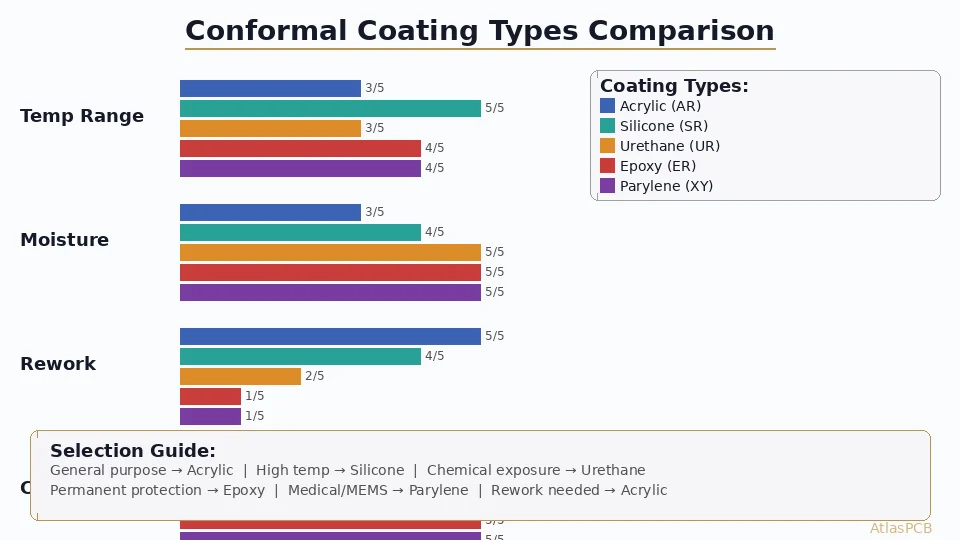
- Operating temperature > 150°C? → Silicone
- Exposure to fuels/solvents? → Urethane
- Medical implant or MEMS? → Parylene
- Rework required in field? → Acrylic
- Maximum hardness/permanent? → Epoxy
- General-purpose, cost-sensitive? → Acrylic
- Wide temperature cycling (−55 to +150°C)? → Silicone
- Outdoor with UV exposure? → Silicone (UV-stable)
Common Failures and Root Causes
Delamination
Cause: Surface contamination (flux residues, finger oils) before coating. Solution: Clean per IPC-J-STD-001 (ionic contamination < 1.56 µg/cm² NaCl equivalent). Verify with ROSE test or ion chromatography.
Cracking
Cause: CTE mismatch between coating and substrate during thermal cycling. Epoxy most susceptible. Solution: Use flexible coatings (silicone, acrylic) for thermal cycling >100°C ΔT. Or reduce coating thickness to below 50 µm.
Bubbling
Cause: Solvent entrapment during cure, or outgassing from components. Solution: Pre-bake boards at 80°C for 2 hours before coating. Apply coating in thin layers with flash-off between passes.
Orange Peel Texture
Cause: Spray viscosity too high, atomization pressure too low, or ambient temperature too cold. Solution: Dilute to manufacturer’s recommended spray viscosity. Maintain coating area at 20–25°C. Increase atomization pressure.
Further Reading
- PCB Surface Finish Guide: ENIG, HASL, OSP Comparison
- What Causes PCB Delamination? Root Causes and Prevention
- IPC-A-610 Class 3 Inspection Standards
- Reflow Soldering Profile Optimization
Need advice on conformal coating selection for your application environment? Contact AtlasPCB — our engineering team provides coating recommendations, DFM review, and full PCBA services with qualified conformal coating lines.
About AtlasPCB — We specialize in complex PCB manufacturing for HDI, RF, and high-reliability applications. Explore our full PCB manufacturing capabilities . Every order includes free engineering review. Get your quote.
Reviewed by AtlasPCB Engineering Team — IPC-certified manufacturing specialists with 15+ years of production experience in HDI, RF, and high-reliability PCB fabrication. Content based on factory floor data and real customer design reviews.
Frequently Asked Questions
What is the standard thickness for conformal coating on PCBs?
Can conformal coating be applied over components that need rework?
Does conformal coating eliminate the need for PCB cleaning before assembly?
- conformal coating
- PCB protection
- IPC-CC-830
- electronics reliability
- moisture protection
- acrylic coating
- silicone coating
- parylene
- urethane coating
- environmental protection