· Thomas Webb · Engineering · 8 min read
AI Server PCB Material Selection
Engineering guide to PCB material selection for AI server and GPU accelerator boards operating at 56-112 Gbps per lane. Covers T-Glass shortage impact, Megtron 6/7 supply constraints, alternative ultra-low-loss laminates, mixed-dielectric stackup strategies, and how to secure materials for 16-30 layer AI compute boards in 2026.
Quick Answer
AI server PCBs running 112G PAM4 SerDes require ultra-low-loss laminates with Df below 0.002 at 28+ GHz — primarily Panasonic Megtron 7, AGC T-Glass (Dk 3.2, Df 0.0015), or Isola I-Speed variants. T-Glass supply remains critically constrained through 2026 with lead times of 8-14 weeks due to AGC capacity being fully allocated to hyperscaler GPU boards. Megtron 6 (Df 0.004) is insufficient for 112G but remains viable for 56G PAM4 channels under 12 inches. For new AI hardware designs, qualify at least two material options to avoid single-source supply risk.
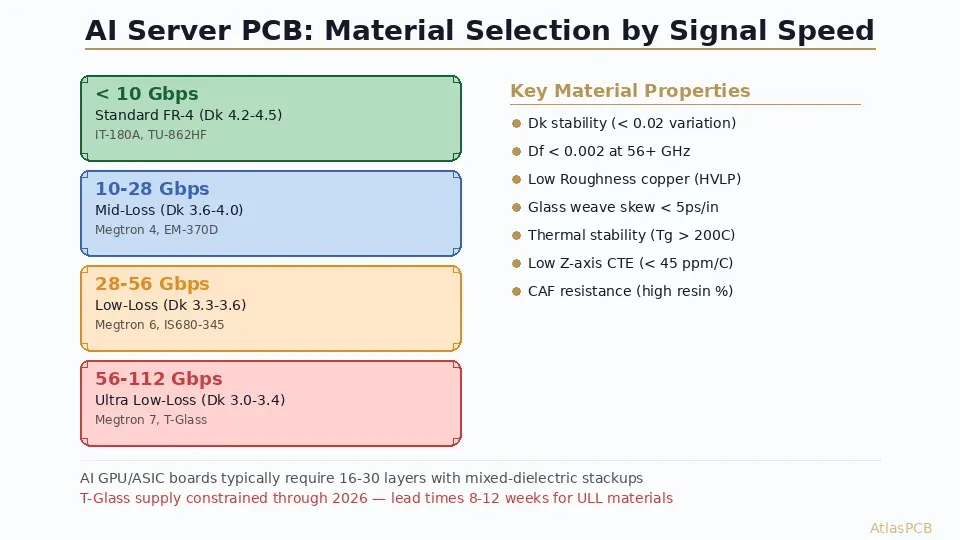
Quick Decision: Material Tier by Channel Data Rate
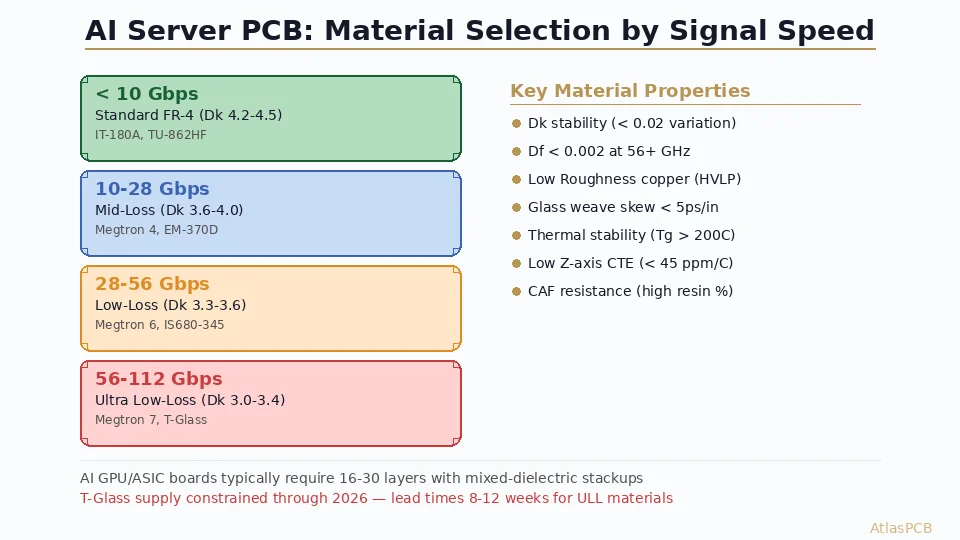
The signal speed on your highest-bandwidth SerDes links determines the minimum material performance tier. Everything else — cost, availability, lead time — flows from this fundamental requirement.
| Data Rate (per lane) | Required Df (at freq) | Material Tier | Options |
|---|---|---|---|
| < 10 Gbps NRZ | < 0.020 @ 5 GHz | Standard FR-4 | IT-180A, TU-862HF, S1000-2M |
| 10-28 Gbps NRZ | < 0.010 @ 14 GHz | Mid-Loss | Megtron 4, EM-370D, S1170G |
| 28-56 Gbps PAM4 | < 0.005 @ 14 GHz | Low-Loss | Megtron 6, IS680-345, S7136G |
| 56-112 Gbps PAM4 | < 0.002 @ 28 GHz | Ultra Low-Loss | Megtron 7, T-Glass, I-Speed CAF |
The Supply Crisis: Why AI is Breaking the PCB Material Chain
The PCB materials industry in 2026 faces a structural imbalance that no amount of pricing adjustment can quickly resolve. Global demand for ultra-low-loss laminates has approximately tripled since 2023, driven almost entirely by AI accelerator deployments. Every GPU training cluster, every inference rack, every switch connecting them — all require PCBs built on materials that were previously niche products serving a small segment of telecom and defense applications.
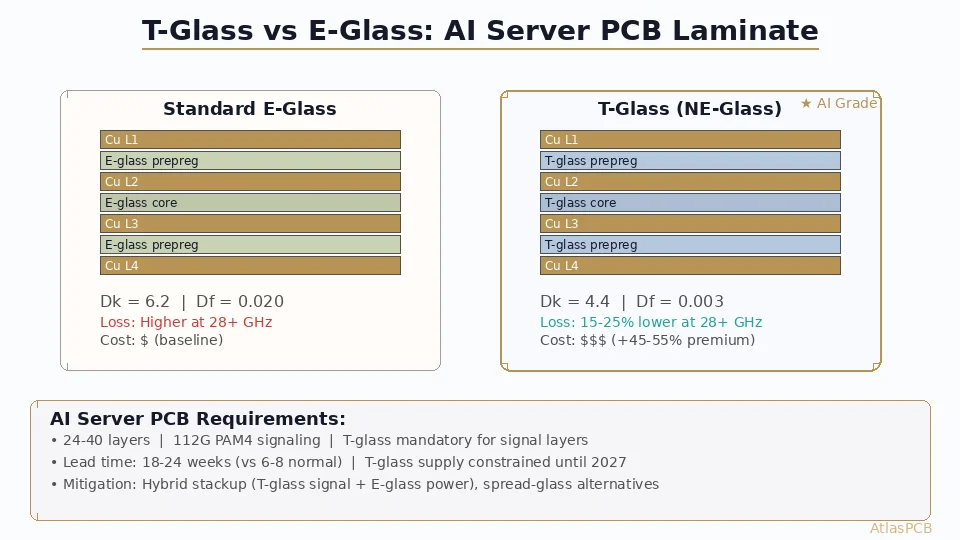
AGC’s T-Glass, the highest-performance glass cloth available for PCB laminates, exemplifies the constraint. Traditional E-glass has a dielectric constant of 6.2-6.6, which dominates the composite laminate Dk regardless of resin choice. T-Glass (also called NE-glass or low-Dk glass) reduces the glass Dk to 4.4-4.6, enabling composite laminate Dk values of 3.0-3.2 — a level impossible with E-glass regardless of how advanced the resin system. The problem: AGC is the sole volume producer of T-Glass, and expanding production requires new glass furnaces with 18-24 month construction timelines.
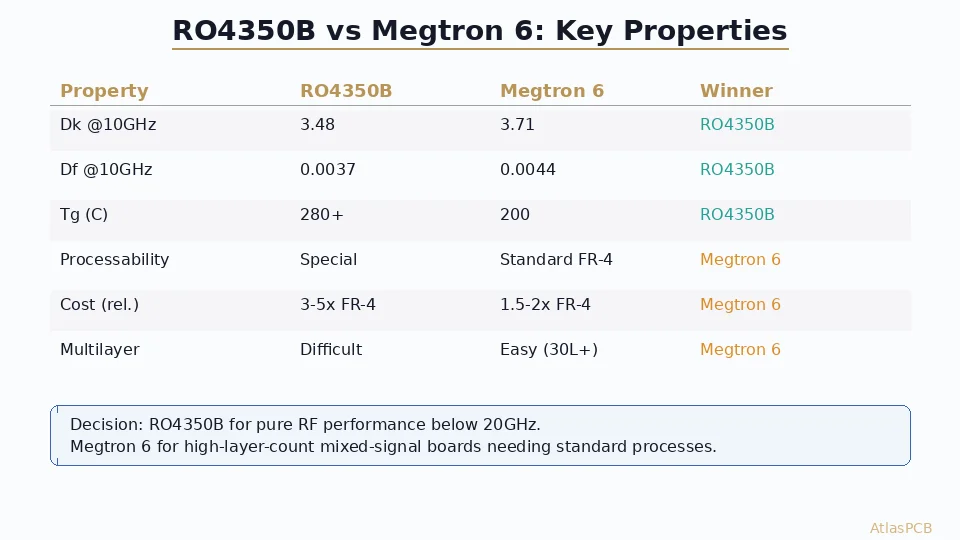
Panasonic’s Megtron 7, the most widely specified ULL laminate for AI server applications, uses T-Glass cloth as its reinforcement. When T-Glass supply constrains, Megtron 7 supply constrains proportionally. Panasonic has responded with increased Megtron 6 production (which uses standard E-glass with advanced low-Dk resin), but Megtron 6’s Df of 0.004 at 10 GHz is marginal for 112G PAM4 channels longer than 8 inches.
The competitive landscape has shifted accordingly. Chinese laminate manufacturers Shengyi and ITEQ have developed T-Glass-equivalent products (Shengyi S7439G, ITEQ IT-968SE) that deliver comparable electrical performance. However, qualification cycles for AI server applications take 9-15 months, and hyperscaler supply chain teams have been cautious about single-sourcing from newer suppliers for the most critical applications. Mid-2026 represents an inflection point where these alternatives are beginning to receive volume qualification approvals.
AI HARDWARE PCB EXPERTISE
Building AI Accelerator Boards? We Stock ULL Materials
We maintain Megtron 6 and Megtron 7 inventory for qualified AI server designs. Mixed-dielectric stackups up to 30 layers with controlled impedance on ULL signal pairs.
Check Material Availability ›
Mixed-Dielectric Stackup: The Practical Engineering Solution
Building an entire 20-30 layer AI server board from Megtron 7 or T-Glass is both unnecessary and financially unjustifiable. In a typical GPU baseboard, only 4-8 layers carry the critical 112G high-speed signals. The remaining layers serve as power/ground planes, low-speed control signals (I2C, SPI, JTAG), and mid-speed interfaces (1G Ethernet management, PCIe Gen 3 maintenance paths). These layers perform identically on standard mid-Tg or high-Tg FR-4.
A practical mixed-dielectric stackup for a 24-layer AI accelerator board might look like this: Megtron 7 dielectric on layers 3-4, 7-8, 17-18, and 21-22 (the high-speed SerDes pairs) with IT-180A or Megtron 4 on all other dielectric layers. The cost saving is substantial — Megtron 7 runs $180-250/sheet versus $40-60/sheet for IT-180A. Using ULL material on 8 of 23 dielectric interfaces instead of all 23 reduces the material bill by approximately 55-65%.
The engineering challenge with mixed-dielectric stackups is managing the different press cycle requirements and ensuring proper bonding between dissimilar resin systems. Not all material combinations are compatible — the prepreg must wet and bond reliably to adjacent core materials during lamination. Work with your fabricator to confirm they have qualified the specific material combination in your stackup. Established combinations (Megtron 6 or 7 with IT-180A) are well-characterized, but novel pairings may require lamination trials.
Impedance control becomes more complex in mixed-dielectric stackups because each signal layer pair sits between potentially different dielectric materials with different Dk values. The stackup designer must account for the actual Dk of each specific dielectric layer when calculating trace geometry for target impedance — using a single “average Dk” value across the entire stackup will produce impedance errors of 5-10% on ULL layers. Provide your fabricator with explicit Dk values per layer, or specify the target impedance per layer and let their stackup team calculate geometries.
STACKUP ENGINEERING
Need a Mixed-Dielectric Stackup for AI Server Boards?
Our stackup engineers design optimized mixed-material configurations that balance signal performance, material availability, and cost. We have qualified Megtron 6/7 + IT-180A combinations in production.
Copper Roughness: The Hidden Variable in Material Performance
Selecting the right laminate Df is only half the material story for 56-112G channels. Copper surface roughness contributes an additional 0.5-1.5 dB/inch of insertion loss at 28 GHz — potentially exceeding the dielectric loss contribution on ultra-low-loss laminates. An engineer who specifies Megtron 7 (Df 0.002) but accepts standard copper foil (Rz 3-5 µm) has negated much of the expensive laminate’s benefit.
The mechanism is straightforward: high-frequency currents concentrate in the skin depth (approximately 0.4 µm at 28 GHz for copper). When surface roughness features are comparable to or larger than the skin depth, the current path becomes longer and more resistive as it follows the rough topography. This “roughness loss” adds to conductor resistive loss and shows up as excess insertion loss in channel measurements.
For 112G PAM4 applications, specify HVLP (Hyper-Very-Low-Profile) or RTF (Reverse Treated Foil) copper with Rz below 1.5 µm. The cost premium for HVLP foil is modest (5-10% over standard foil) but the performance improvement at 28+ GHz is dramatic — typically 0.3-0.5 dB/inch improvement. When combined with ULL laminate, this copper selection enables channel lengths of 12-18 inches with adequate margin for PAM4 link budget closure.
One practical consideration: HVLP copper bonds less aggressively to resin systems because the smooth surface provides less mechanical interlocking. Some ULL laminates require specific surface treatments (micro-roughening or chemical primer) to achieve reliable adhesion with HVLP foil. Verify with your laminate supplier and fabricator that the specific HVLP foil type is compatible with your chosen resin system — adhesion test failures during qualification can delay production by months.
MATERIAL EXPERTISE
Questions About Material + Copper Foil Combinations?
We work with Panasonic, Isola, and Shengyi ULL laminates paired with HVLP copper. Our process engineers validate material compatibility before production commitment.
Discuss Requirements ›Securing Supply: Practical Strategies for 2026
The material landscape rewards engineers who plan ahead and maintain design flexibility. Several strategies can reduce supply risk without compromising channel performance.
First, qualify two material options for every critical signal layer. If your channel simulation closes with both Megtron 7 and I-Speed CAF, you have procurement leverage and fallback options. Run full channel simulations with both materials’ S-parameter models and verify compliance margins — the 10-15% Dk/Df variation between material brands can shift impedance targets and loss budgets enough to require adjusted trace geometries for each material option.
Second, engage your PCB fabricator early in the design cycle — ideally during schematic/layout planning, not after Gerber release. Fabricators with strong material supplier relationships can pre-allocate laminate inventory for your project timeline. A 12-week lead time becomes manageable when flagged at design start; it becomes a schedule-breaking delay when discovered after design release.
Third, consider regional material sourcing. Chinese-manufactured ULL laminates (Shengyi S7439G, ITEQ IT-968SE) offer lead times of 4-6 weeks versus 8-14 weeks for Japanese materials, at approximately 70-80% of the cost. For designs not bound to specific vendor qualification mandates (defense, automotive safety), these alternatives provide functionally equivalent performance with better availability.
ATLASPCB
AI Server Boards: From Material Sourcing to Finished Product
Up to 30-layer mixed-dielectric stackups. Megtron 6/7, T-Glass, and Chinese ULL alternatives in stock. Impedance-controlled routing with HVLP copper. Let us handle material procurement headaches.
Get Instant Quote ›
Related Reading:
About AtlasPCB — We specialize in complex PCB manufacturing for HDI, RF, and high-reliability applications. Explore our impedance-controlled PCB manufacturing, or get an Megtron 6 & 7 low-loss PCB manufacturing . Every order includes free engineering review. Get your quote.
Reviewed by AtlasPCB Engineering Team — IPC-certified manufacturing specialists with 15+ years of production experience in HDI, RF, and high-reliability PCB fabrication. Content based on factory floor data and real customer design reviews.
Frequently Asked Questions
Why do AI server PCBs need ultra-low-loss materials like T-Glass?
What are the alternatives to T-Glass when it is out of stock?
How long is the current lead time for T-Glass PCB laminate?
Can I use a mixed-dielectric stackup to reduce T-Glass requirements?
- AI server
- PCB materials
- T-Glass
- Megtron
- low-loss laminate
- high-speed