· Thomas Webb · Engineering · 7 min read
AI Server Demand Is Breaking the PCB Material
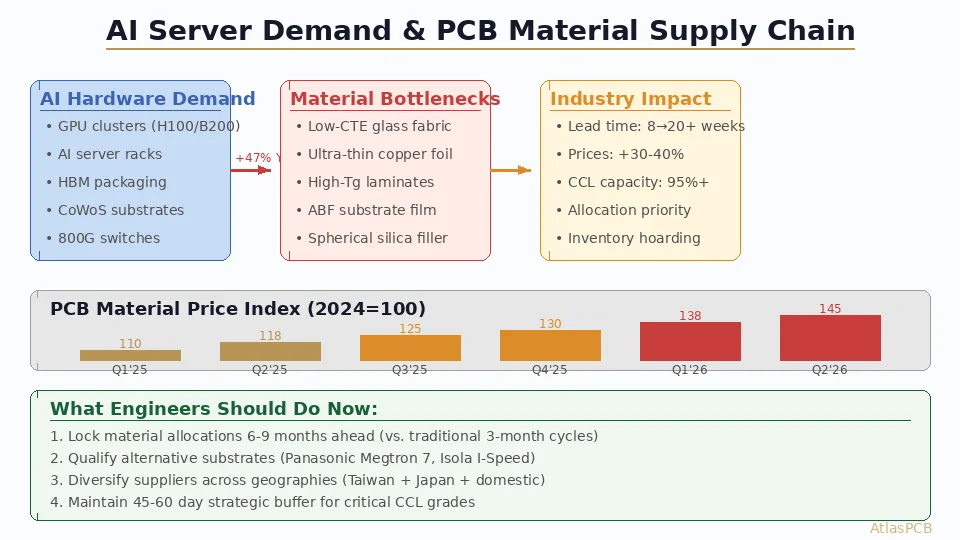
AI hardware demand has driven PCB raw material prices up 30-40% and lead times from 8 to 20+ weeks. This guide explains the supply chain mechanics, identifies which materials are most constrained, and provides actionable strategies for engineers navigating procurement in 2026.
Quick Answer
AI server and data center hardware demand has created a structural PCB material supply shortage in 2026, with high-end CCL prices rising 30-40% and lead times doubling from 8-12 weeks to 20-30 weeks. The bottleneck extends beyond specialty laminates — even standard FR-4 availability is affected as manufacturers redirect capacity toward higher-margin AI server substrates. Engineers should secure material allocations 6-9 months ahead, qualify alternative substrates, and diversify suppliers across geographies.
The AI Hardware Boom’s Hidden Casualty: PCB Material Supply
While the semiconductor industry’s capacity constraints from AI demand have dominated headlines for two years, a less visible but equally disruptive bottleneck has emerged one level down in the electronics supply chain: PCB raw materials — specifically Copper Clad Laminate (CCL), the fundamental substrate from which all rigid PCBs are fabricated.
In the first half of 2026, the PCB material supply chain has reached a critical inflection point:
- High-end CCL prices up 30-40% from H2 2024 baseline
- Standard FR-4 prices up 15-20%, with intermittent allocation restrictions
- Lead times doubled from historical 8-12 weeks to 20-30 weeks for premium grades
- Allocation-only sales for specific materials (ultra-low-loss, thin-core variants)
This isn’t a temporary logistics disruption — it’s a structural demand-supply imbalance that industry analysts project will persist through 2027-2028 until new CCL production capacity comes online.
Understanding the Demand Side: Why AI Consumes So Much PCB Material
A single AI server rack represents an extraordinary concentration of PCB demand compared to traditional computing infrastructure:
PCB Content Per AI Server
| Component | PCB Layers | Board Area | Material Grade |
|---|---|---|---|
| GPU baseboard | 20-24 layers | 600×500 mm | Ultra-low-loss (Megtron 7) |
| Backplane | 28-36 layers | 800×600 mm | Very-low-loss (Megtron 6) |
| Switch board (800G) | 20-28 layers | 400×500 mm | Ultra-low-loss |
| Memory riser | 12-16 layers | 300×100 mm | Low-loss FR-4 |
| Power board | 8-12 layers | 300×200 mm | High-Tg FR-4 |
| Cable assemblies | 4-8 layers | Various | Flex (polyimide) |
Total PCB area per AI server: approximately 1.5-2.0 m² of multilayer PCB Comparison: A standard 1U server requires ~0.15 m² of PCB
This means each AI server consumes 10-15× more PCB material than equivalent traditional server infrastructure. When hyperscalers deploy 100,000+ GPU servers per data center facility, the CCL consumption is staggering.
The Layer Count Multiplier
It’s not just area — it’s layer-weighted area that matters for material consumption. A 30-layer backplane consumes 30× more CCL core and prepreg than a single-layer board of the same size. The AI server’s aggregate demand, adjusted for layer count, represents approximately 50-80× the material consumption of a standard enterprise server.
The Supply Side: Why CCL Manufacturers Can’t Keep Up
Capacity Utilization at Limits
Global CCL capacity utilization reached 92-95% in Q1 2026, according to Taiwan Printed Circuit Association (TPCA) data. At these levels, any incremental demand growth cannot be absorbed — it directly translates to allocation, lead time extension, and pricing pressure.
Major CCL manufacturers face a capital expenditure dilemma:
- New production lines require 18-24 months from ground-breaking to volume production
- Each line represents $50-100M investment with uncertain long-term demand sustainability
- The highest-margin products (AI server laminates) receive priority investment, leaving standard-grade capacity flat or declining
The E-Glass Fabric Bottleneck
A less-publicized constraint sits upstream of CCL manufacturers: E-glass fabric availability. E-glass woven fabric is the mechanical reinforcement in every FR-4 and high-speed laminate. Glass fabric suppliers face their own capacity limits:
- Only 5-7 major producers globally (Nitto Boseki, Nittobo, Porcher, JPS, AGY)
- Specialty weave styles (1035, 1067, 106) for thin cores are production-constrained
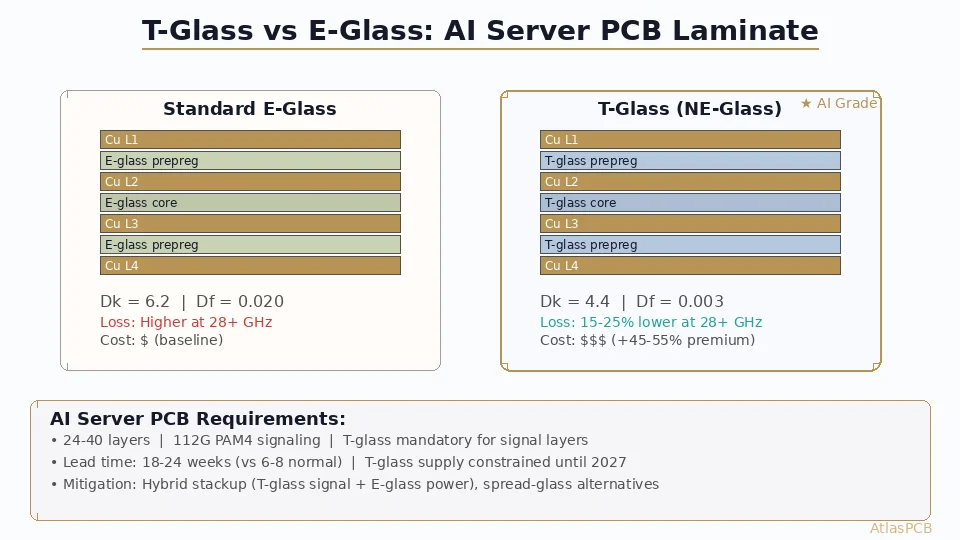
- NE-glass and T-glass (next-generation ultra-low-Dk fabrics) have limited qualified sources
The fabric shortage creates a cascade: CCL manufacturers cannot produce more laminate even if they had additional resin and copper foil capacity.
Copper Foil Competition
Electronic-grade copper foil faces dual demand pressure:
- PCB CCL consumption (traditional demand)
- Lithium-ion battery anode current collectors (rapidly growing demand)
Battery-grade and PCB-grade copper foil share similar manufacturing processes, and battery manufacturers often offer higher prices for bulk purchases, diverting supply from PCB applications.
Navigating Material Constraints?
AtlasPCB maintains strategic inventory and multi-source relationships for critical laminates. We help you select available materials without compromising performance.
Discuss Your Stackup →Which Materials Are Most Constrained?
Tier 1: Severe Constraint (Allocation Only)
| Material | Application | Typical Lead Time (2026) |
|---|---|---|
| Panasonic Megtron 7 | AI server backplanes, 112G channels | 24-30 weeks |
| Isola I-Speed | High-speed networking | 20-26 weeks |
| AGC/NE-glass thin cores | CoWoS substrates | 28-32 weeks |
| ABF substrate film | AI chip packaging | 30+ weeks |
| VLP copper foil (Rz<1.5μm) | 56G+ signal integrity | 16-22 weeks |
Tier 2: Significant Pressure (Extended Lead, Price Increase)
| Material | Application | Typical Lead Time (2026) |
|---|---|---|
| Panasonic Megtron 6 | High-speed servers, switches | 16-22 weeks |
| TUC TU-87P SLN | Alternative to Megtron 6 | 14-20 weeks |
| Isola I-Tera MT40 | Mid-high speed | 12-18 weeks |
| Shengyi S1000-2M | High-Tg standard | 10-14 weeks |
| Thin prepreg (1080, 2116) | HDI builds | 10-16 weeks |
Tier 3: Moderate Impact (Price Increase, Generally Available)
| Material | Application | Typical Lead Time (2026) |
|---|---|---|
| Standard FR-4 (Tg 135-150°C) | Consumer, industrial | 6-10 weeks |
| High-Tg FR-4 (Tg 170°C) | Automotive, industrial | 8-12 weeks |
| Standard copper foil (STD, RTF) | General purpose | 4-8 weeks |
| Polyimide flex materials | Flex/rigid-flex | 6-10 weeks |
Impact on Non-AI PCB Projects
The most significant collateral damage falls on mid-tier projects that don’t directly involve AI hardware but require materials caught in the allocation cascade:
Automotive electronics — Vehicle ECUs and ADAS boards increasingly use the same mid-loss laminates (IT-180A, Megtron 4) that are adjacent to AI-demand materials in CCL manufacturers’ production schedules.
5G infrastructure — Base station boards compete directly with AI server boards for the same ultra-low-loss material grades and manufacturing slots.
Medical devices — Low-volume, high-reliability boards face MOQ challenges as CCL manufacturers prioritize large-volume AI orders.
Aerospace/defense — Programs requiring specific qualified materials (listed on QPL) cannot substitute alternatives without expensive requalification.
Engineer’s Survival Guide: 7 Strategies for 2026-2027
1. Extend Planning Horizons
Move from 3-month material planning to 6-9 month advance reservation. For production programs, place blanket orders with 6-month material call-off schedules. This locks allocation at current pricing and ensures production isn’t stopped by material unavailability.
2. Qualify Alternative Substrates
Never design a stackup that depends on a single material with no qualified alternative. For every critical laminate, identify at least one substitute with similar electrical properties:
| Primary Material | Alternative 1 | Alternative 2 |
|---|---|---|
| Megtron 6 | TUC TU-87P SLN | Isola I-Tera MT40 |
| Megtron 7 | Isola I-Speed | TUC TU-933+ |
| Isola FR408HR | Shengyi S1000-2M | Ventec VT-47 |
| Rogers RO4003C | Isola Astra MT77 | TUC TU-862 HF |
Validate that your impedance targets are achievable on both primary and alternative materials before production release.
3. Diversify Geographically
Relying on a single-country supply chain creates correlated risk. Qualify fabricators and material sources across multiple regions:
- Taiwan/Japan — highest-end materials, longest lead times
- China mainland — broad availability, competitive pricing
- Southeast Asia — emerging CCL production (Thailand, Vietnam)
- Domestic (US/EU) — limited selection but shortest logistics
4. Optimize Stackup for Available Materials
Rather than specifying exact material part numbers, define stackup requirements in terms of performance parameters: target Dk, max Df, minimum Tg, required CTI. This gives your fabricator flexibility to source from available inventory rather than waiting for specific brand/grade availability.
5. Maintain Strategic Buffer Inventory
For active production programs, maintain 45-60 days of raw material buffer at the fabricator’s facility (consignment model). The carrying cost (typically 1-2% per month) is far less than the production stoppage cost of a material outage.
6. Design for Fewer Layers When Possible
Each additional layer multiplies material consumption. Challenge whether your design truly needs 20 layers or whether aggressive routing optimization, via-in-pad, and HDI stackup techniques could achieve the same functionality in 16 or 14 layers — significantly reducing material cost and lead time.
7. Engage Fabricators During Design Phase
Your fabricator’s material knowledge is your most valuable resource during a supply shortage. They know which materials are available in their warehouse today, which suppliers have capacity, and which alternatives have been validated on their process line.
Market Outlook: When Does Relief Arrive?
Industry consensus suggests the material supply situation will gradually improve through 2027-2028 as:
- New CCL capacity comes online (multiple Taiwan/China expansion projects with 2027-2028 start dates)
- Glass fabric expansions by Nitto Boseki and AGY targeting H2 2027 volume ramp
- Alternative materials (low-loss hydrocarbon laminates, next-gen resin systems) diversify supply base
- Demand normalization as the initial AI infrastructure buildout moderates from exponential to linear growth
However, structural demand growth from AI will likely keep the market in tight balance rather than returning to pre-2024 surplus conditions. The era of unlimited material availability at stable pricing is unlikely to return.
Conclusion
The AI hardware revolution is reshaping the PCB material supply chain in ways that affect every electronics manufacturer — not just those building AI servers. Engineers who adapt their material strategy, diversify suppliers, and engage fabricators early will navigate this transition successfully. Those who maintain legacy 3-month planning cycles and single-source material dependencies face production disruptions, cost overruns, and delayed product launches.
The supply chain message is clear: in 2026, PCB material procurement is a strategic function, not an administrative one.
Concerned about material availability for your next build? AtlasPCB provides material consultation and maintains multi-source inventory for production continuity. Discuss your project →
Sources: UG PCB, Traxtech, Digitimes, TPCA industry data
Further Reading:
About AtlasPCB — We specialize in complex PCB manufacturing for HDI, RF, and high-reliability applications. Explore our HDI PCB manufacturing capabilities, quick-turn PCB manufacturing from 24 hours, or get an instant online PCB quote . Every order includes free engineering review. Get your quote.
Reviewed by AtlasPCB Engineering Team — IPC-certified manufacturing specialists with 15+ years of production experience in HDI, RF, and high-reliability PCB fabrication. Content based on factory floor data and real customer design reviews.
Frequently Asked Questions
Why are PCB material prices rising in 2026?
Which PCB materials are most affected by AI demand?
How should engineers plan PCB procurement during the shortage?
- AI PCB
- supply chain
- CCL shortage
- AI servers
- material procurement
- lead times
- HDI materials
- PCB cost