· Marcus Lin · Engineering · 8 min read
RF PCB Material Selection for Automotive Radar
Compare Rogers and PTFE materials for automotive radar PCBs. Analyze dielectric properties, loss tangent, and thermal performance for 77-81 GHz ADAS applications in harsh automotive environments.
Quick Answer
Rogers RO3003 (Dk=3.00, Df=0.0013 at 77 GHz, -3 ppm/°C) is the automotive radar standard, delivering 0.15 dB/cm insertion loss with standard fabrication. RT/duroid 5880 offers lower loss (0.08 dB/cm) but poor temperature stability (-240 ppm/°C) and 2-3× higher manufacturing complexity, justified only for ultra-long-range applications demanding maximum sensitivity.
Introduction: Material Selection Drives Radar Performance
Automotive radar systems operating at 77-81 GHz are the backbone of modern Advanced Driver Assistance Systems (ADAS). From adaptive cruise control to emergency braking, these millimeter-wave sensors must maintain precision performance across extreme temperature ranges while surviving 15+ years of automotive exposure.
The PCB substrate choice fundamentally determines radar system performance, cost, and reliability. Unlike consumer electronics where cost often drives material selection, automotive radar applications demand materials that maintain stable electrical properties from -40°C to +125°C while minimizing signal loss at frequencies approaching 100 GHz.
This analysis compares Rogers high-frequency laminates with PTFE-based substrates across the critical parameters that determine automotive radar success: dielectric stability, loss performance, thermal behavior, and long-term reliability.
Understanding Automotive Radar Requirements
Frequency Band Characteristics
77-81 GHz radar presents unique challenges compared to lower frequency automotive applications:
- Short wavelengths: 3.7-3.9 mm in free space
- Material sensitivity: Dielectric constant variations directly impact antenna tuning
- Loss criticality: Every 0.1 dB of substrate loss reduces detection range
- Manufacturing precision: ±10% dielectric tolerance can detune antennas beyond specification
Automotive Environmental Demands
Unlike consumer or industrial applications, automotive radar must survive:
Temperature cycling: -40°C to +125°C operational, up to +150°C survival Humidity exposure: 85% RH at elevated temperatures Vibration stress: 10-2000 Hz random vibration per ISO 16750-3 Chemical resistance: Salt spray, automotive fluids, UV exposure Longevity: 15-20 year operational life requirement
Rogers Materials: Engineering for Performance
RO3003™: The Automotive Standard
Rogers RO3003 has become the de facto standard for automotive radar applications, offering an optimal balance of performance, manufacturability, and cost:
Key Properties:
- Dielectric constant (Dk): 3.00 ±0.04 (X/Y axis), 3.00 ±0.05 (Z axis)
- Loss tangent (Df): 0.0010 at 10 GHz, 0.0013 at 77 GHz
- Thermal coefficient of Dk: -3 ppm/°C
- Thermal expansion: 17 ppm/°C (X/Y), 24 ppm/°C (Z)
Manufacturing advantages:
- Standard processing: Compatible with conventional FR-4 fabrication
- Lead-free soldering: Survives 260°C reflow cycles
- Dimensional stability: <0.1% shrinkage during processing
- Availability: Global supply chain with automotive qualification
RO4003C™: Cost-Optimized Alternative
For cost-sensitive applications, Rogers RO4003C provides similar performance characteristics:
- Dielectric constant: 3.38 ±0.05
- Loss tangent: 0.0027 at 10 GHz
- Processing compatibility: Standard FR-4 fabrication techniques
- Cost advantage: 20-30% lower than RO3003 in volume
However, the higher loss tangent becomes significant at 77 GHz, where insertion loss increases by approximately 40% compared to RO3003.
Advanced Rogers Options
RO3035™: Ultra-low loss variant
- Loss tangent: 0.0015 at 77 GHz
- Application: Long-range radar requiring maximum sensitivity
- Trade-off: Higher cost, specialized processing
RO4835T™: High thermal conductivity
- Thermal conductivity: 0.66 W/m·K
- Application: High-power radar transmitters
- Benefit: Improved thermal management for power amplifiers
PTFE-Based Materials: Maximum Performance
Pure PTFE Substrates
Polytetrafluoroethylene (PTFE) offers the lowest dielectric losses available in commercial PCB materials:
Taconic RF-60A:
- Dielectric constant: 2.15 ±0.04
- Loss tangent: 0.00038 at 10 GHz, <0.0008 at 77 GHz
- Temperature stability: Excellent across automotive range
- Applications: Ultra-long-range radar, research applications
Rogers RT/duroid® 5880:
- Dielectric constant: 2.20 ±0.02
- Loss tangent: 0.0009 at 10 GHz
- Thermal expansion: 200+ ppm/°C (high)
- Challenge: Dimensional stability in automotive environments
PTFE Composite Materials
Ceramic-filled PTFE combines low loss with improved dimensional stability:
Rogers TMM® Series:
- TMM4: Dk = 4.5, Df = 0.0018
- TMM10i: Dk = 9.8, Df = 0.0019
- Advantage: Lower thermal expansion than pure PTFE
- Application: Antenna substrates requiring higher dielectric constants
Performance Comparison at 77-81 GHz
Insertion Loss Analysis
At 77 GHz, substrate losses become the dominant factor in radar range:
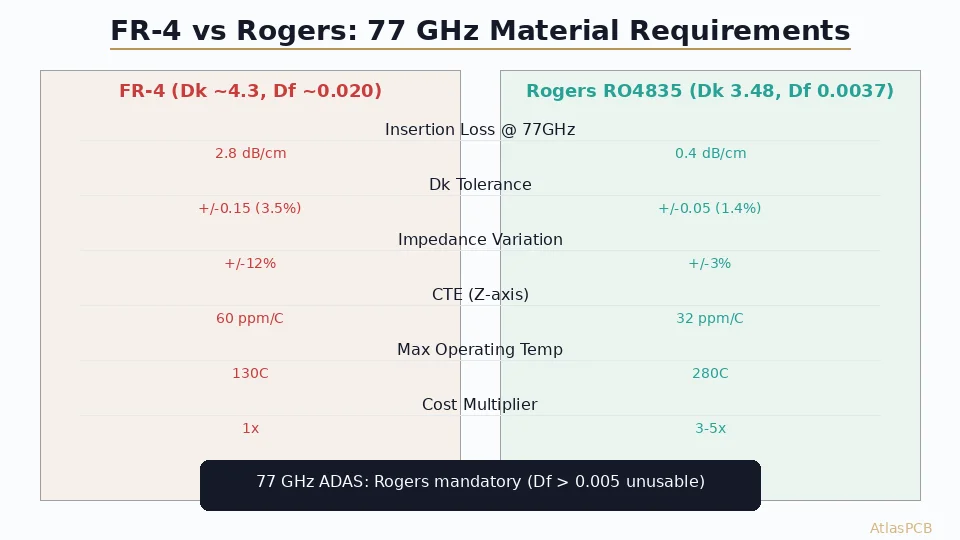
Material Comparison (dB/cm at 77 GHz):
- RO3003: 0.15 dB/cm
- RO4003C: 0.22 dB/cm
- RT/duroid 5880: 0.08 dB/cm
- TMM4: 0.16 dB/cm
For a typical 4 cm signal path from antenna to chipset:
- RO3003: 0.6 dB total loss
- PTFE (5880): 0.32 dB total loss
- Performance impact: 0.28 dB difference ≈ 3% range improvement
Temperature Stability
Dielectric constant temperature coefficient directly affects antenna tuning:
RO3003: -3 ppm/°C (excellent stability) RO4003C: +40 ppm/°C (acceptable for most applications) RT/duroid 5880: -240 ppm/°C (requires temperature compensation)
Over a 165°C automotive temperature range:
- RO3003: 0.05% Dk variation
- RT/duroid 5880: 4% Dk variation (significant antenna detuning)
Manufacturing Considerations
Rogers materials leverage standard PCB processes:
- Drilling: Conventional carbide tooling
- Plating: Standard copper electroplating
- Etching: Compatible with standard etchants
- Lamination: Press cycles similar to FR-4
PTFE materials require specialized processing:
- Surface preparation: Plasma treatment or chemical etching for adhesion
- Drilling: Diamond-coated tooling to prevent delamination
- Via formation: Enhanced cleaning processes
- Yield impact: 10-20% lower yields typical
Thermal Performance in Automotive Environments
Heat Dissipation Requirements
Modern automotive radar transceivers generate significant heat:
- Power consumption: 5-15W total system power
- Local hotspots: Power amplifier sections >100°C
- Thermal cycling: Rapid temperature changes during operation
- Heat sinking: Limited thermal mass in typical installations
Material Thermal Properties
Thermal conductivity comparison:
- RO3003: 0.50 W/m·K (in-plane), 0.79 W/m·K (through-plane)
- RO4003C: 0.71 W/m·K (in-plane), 0.80 W/m·K (through-plane)
- RT/duroid 5880: 0.20 W/m·K (both directions)
- Standard FR-4: 0.30 W/m·K (reference)
Rogers materials provide 2-3× better thermal conductivity than PTFE, enabling more effective heat spreading and reducing hotspot temperatures.
Coefficient of Thermal Expansion (CTE)
Mechanical stress from CTE mismatch can cause:
- Solder joint fatigue: Repeated thermal cycling
- Via barrel cracking: Differential expansion stress
- Substrate warpage: Bow and twist under temperature
CTE values (ppm/°C, X/Y direction):
- RO3003: 17 ppm/°C
- Silicon (reference): 3 ppm/°C
- RT/duroid 5880: 200+ ppm/°C
- Copper: 17 ppm/°C
Rogers materials closely match copper CTE, minimizing thermal stress on plated features.
Cost-Performance Analysis
Material Cost Comparison
Relative substrate cost (RO4003C = 1.0×):
- RO4003C: 1.0× (baseline)
- RO3003: 1.8× (premium for lower loss)
- RT/duroid 5880: 4.5× (specialized PTFE)
- TMM4: 3.2× (ceramic-filled PTFE)
Total Cost of Ownership
Processing complexity impacts total board cost:
Rogers materials:
- Standard fabrication: No specialized equipment required
- High yields: >95% typical for volume production
- Supply chain: Multiple qualified sources globally
- Lead times: 4-6 weeks standard
PTFE materials:
- Specialized processing: Surface treatment, drilling modifications
- Lower yields: 75-85% due to handling sensitivity
- Limited sources: Fewer qualified suppliers
- Extended lead times: 8-12 weeks typical
Performance ROI Calculation
For long-range radar applications (>200m detection):
- Loss budget: Every 0.1 dB loss = ~3% range reduction
- System impact: Reduced performance may require additional sensors
- Cost trade-off: Premium substrate cost often justified by performance
For short-range applications (<50m):
- Performance margin: Higher loss budgets acceptable
- Cost focus: RO4003C or hybrid constructions cost-effective
- Volume production: Standard processing reduces manufacturing risk
Application-Specific Recommendations
Long-Range Adaptive Cruise Control
Requirements: Maximum detection range, high sensitivity Recommended material: RO3003 or RT/duroid 5880 Key factors: Loss performance outweighs cost considerations Design approach: Minimize signal path lengths, optimize antenna efficiency
Parking Assist and Blind Spot Detection
Requirements: Cost-effective, moderate performance Recommended material: RO4003C or hybrid construction Key factors: Balance cost vs. adequate performance Design approach: Standard fabrication techniques, proven supply chain
Emergency Braking Systems
Requirements: Reliability, consistent performance, safety certification Recommended material: RO3003 (established automotive qualification) Key factors: Proven reliability outweighs cost optimization Design approach: Conservative design margins, extensive validation
Multi-Function Radar Systems
Requirements: Multiple frequency bands, complex routing Recommended material: Hybrid stackup (Rogers + FR-4) Approach:
- RF layers: RO3003 for 77 GHz sections
- Digital layers: FR-4 for baseband processing
- Cost optimization: Premium materials only where essential
Design Guidelines and Best Practices
Stackup Construction
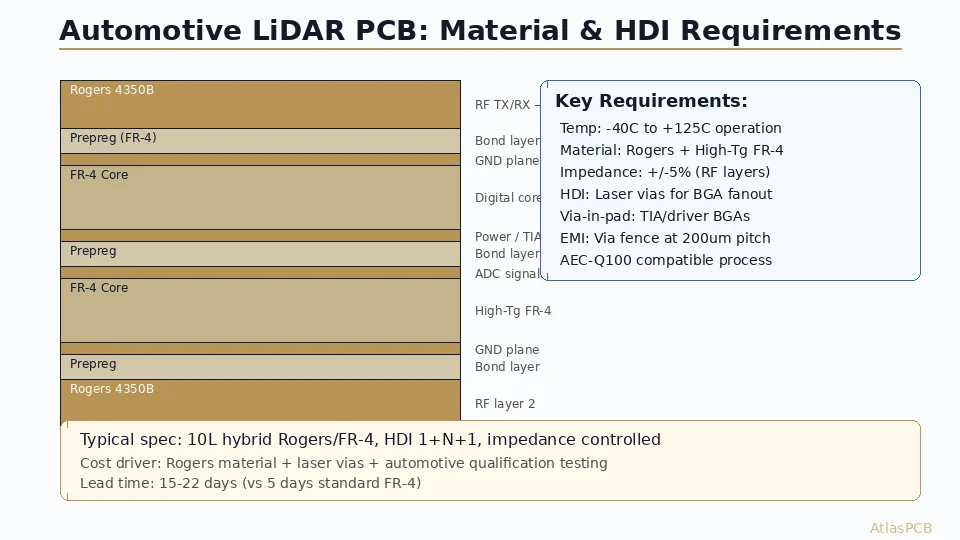
Typical 6-layer automotive radar stackup:
- L1: Antenna elements, RF routing (RO3003)
- L2: Ground plane (solid reference)
- L3: RF signal routing, power (RO3003)
- L4: Digital signals (FR-4 acceptable)
- L5: Power distribution (FR-4)
- L6: Component placement, I/O (FR-4)
Via Design Considerations
Microvia requirements for 77 GHz performance:
- Via diameter: <100 μm to minimize inductance
- Aspect ratio: <1:1 for reliable copper fill
- Back-drilling: Remove stubs below target layer
- Via fencing: Prevent cross-talk between RF sections
Antenna Integration
Patch antenna design on Rogers vs. PTFE:
- Antenna size: Inversely proportional to √Dk
- Bandwidth: Lower Dk provides wider bandwidth
- Efficiency: Loss tangent directly impacts radiation efficiency
- Temperature stability: Dk stability maintains frequency tuning
Quality Control and Testing
Dielectric Property Validation
Critical measurements for automotive qualification:
- Dielectric constant: ±2% accuracy required
- Loss tangent: 0.0001 resolution at test frequency
- Temperature coefficient: Characterization from -40°C to +125°C
- Statistical control: Process capability studies (Cpk >1.33)
Electrical Test Requirements
S-parameter characterization:
- Frequency range: DC to 110 GHz minimum
- Test fixtures: Coplanar waveguide or microstrip geometries
- Reference standards: Traceable calibration standards
- Statistical sampling: AQL levels per automotive standards
Environmental Qualification
Automotive-specific testing:
- Temperature cycling: IEC 60068-2-14 Test Nb
- Humidity resistance: 85°C/85% RH per IEC 60068-2-78
- Salt spray: ISO 9227 neutral salt spray
- Vibration: Random vibration per ISO 16750-3
Future Trends and Emerging Materials
Next-Generation Requirements
Trends driving material evolution:
- Higher frequencies: 140-170 GHz for imaging radar
- Increased integration: Antenna-in-package (AiP) concepts
- Thermal management: Active cooling for high-power systems
- Cost pressure: Volume production driving standardization
Emerging Material Technologies
Advanced Rogers developments:
- RO3006: Lower loss successor to RO3003
- Hybrid constructions: Embedded cooling channels
- Flexible-rigid: Conformal antenna assemblies
Alternative approaches:
- Liquid Crystal Polymer (LCP): Ultra-low loss, flexible
- Glass substrates: Extreme dimensional stability
- Ceramic substrates: High thermal conductivity options
Manufacturing Partnerships and Supply Chain
Supplier Selection Criteria
Key factors for automotive radar PCB manufacturing:
- Automotive certification: ISO/TS 16949 compliance
- Material qualification: Approved vendor lists (AVL)
- Process controls: Statistical process control (SPC)
- Traceability: Lot tracking, material genealogy
- Geographic presence: Regional supply security
Design for Manufacturing (DFM)
Rogers material DFM guidelines:
- Minimum features: 0.1 mm (4 mil) traces/spaces achievable
- Via sizes: 0.15 mm (6 mil) minimum for high reliability
- Layer registration: ±25 μm standard capability
- Surface finish: ENIG preferred for wire bonding compatibility
Conclusion: Optimizing Material Selection
The choice between Rogers and PTFE materials for automotive radar applications involves careful balance of performance, cost, and manufacturability requirements:
Choose Rogers (RO3003) when:
- Balanced performance: Good loss characteristics with manufacturing practicality
- Cost optimization: Volume production with standard processes
- Supply chain: Established automotive qualification and availability
- Thermal management: Higher thermal conductivity requirements
Choose PTFE when:
- Maximum performance: Ultra-low loss is critical for range
- Research/development: Performance exploration without cost constraints
- Specialized applications: Custom requirements beyond standard materials
- Low-volume production: Processing complexity is manageable
Hybrid approaches when:
- Cost optimization: Premium materials only where essential
- Multi-function designs: Different sections have different requirements
- Transition strategies: Gradual migration to new technologies
- Risk mitigation: Proven and advanced technologies combined
For most automotive radar applications, Rogers RO3003 provides the optimal balance of 77-81 GHz performance, automotive environmental capability, and manufacturing practicality. PTFE materials remain valuable for specialized applications where ultimate performance justifies the additional complexity and cost.
The key to successful material selection lies in understanding your specific application requirements and working closely with experienced PCB manufacturers who can navigate the complex trade-offs between performance, cost, and reliability in demanding automotive environments.
Developing automotive radar systems? Our team has extensive experience with Rogers and PTFE materials for 77-81 GHz applications. Contact us to discuss your specific material requirements and [automotive PCB manufacturing]/blog/automotive-pcb-requirements-en/) capabilities.
Further Reading
- [mmWave PCB Material Selection: Rogers vs Megtron vs LCP for 5G and 6G Applications]/blog/mmwave-pcb-material-selection-rogers-megtron-lcp-5g-6g/)
- [Rogers PCB Fabrication: Material Sourcing, Lead Times & Quality Control]/blog/rogers-pcb-fabrication/)
- [PCB Design for GaN and SiC Power Devices: Thermal Management, Layout Rules, and Material Selection]/blog/pcb-design-gan-sic-power-devices-thermal-layout/)
- [PCB Panelization and Array Design: V-Score vs Tab Routing, DFM Rules, and Cost Optimization]/blog/pcb-panelization-v-score-tab-routing-dfm-cost-optimization/)
- [PCB Rigid-Flex Bend Zone Reliability: Design Rules, Material Selection & Lifecycle Testing]/blog/pcb-rigid-flex-bend-zone-reliability/)
- Material Options & Capabilities
About AtlasPCB — We specialize in complex PCB manufacturing for HDI, RF, and high-reliability applications. Explore our RF and high-frequency PCB services, or get an Rogers RO4350B PCB manufacturing . Every order includes free engineering review. Get your quote.
Reviewed by AtlasPCB Engineering Team — IPC-certified manufacturing specialists with 15+ years of production experience in HDI, RF, and high-reliability PCB fabrication. Content based on factory floor data and real customer design reviews.
Frequently Asked Questions
Why is Rogers RO3003 the standard material for 77-81 GHz automotive radar?
What insertion loss can I expect at 77 GHz with different PCB materials?
How does temperature affect dielectric constant stability in automotive radar materials?
When should I choose PTFE materials over Rogers for automotive radar?
- RF PCB materials
- automotive radar
- Rogers materials
- PTFE substrate
- 77 GHz radar
- ADAS